Arctic sea ice hits record low for its usual peak growth period
Advertisement
Read this article for free:
or
Already have an account? Log in here »
To continue reading, please subscribe:
Digital Subscription
One year of digital access for only $1.44 a week*
- Enjoy unlimited reading on winnipegfreepress.com
- Read the E-Edition, our digital replica newspaper
- Access News Break, our award-winning app
- Play interactive puzzles
*Billed as $5.77 plus GST every four weeks. After 52 weeks, price increases to the regular rate of $19.95 plus GST every four weeks. Offer available to new and qualified returning subscribers only. Cancel any time.
To continue reading, please subscribe:
Add Free Press access to your Brandon Sun subscription for only an additional
$1 for the first 4 weeks*
- Enjoy unlimited reading on winnipegfreepress.com
- Read the E-Edition, our digital replica newspaper
- Access News Break, our award-winning app
- Play interactive puzzles
*Your next Brandon Sun subscription payment will increase by $1.00 and you will be charged $17.95 plus GST for four weeks. After four weeks, your payment will increase to $24.95 plus GST every four weeks.
Read unlimited articles for free today:
or
Already have an account? Log in here »
Hey there, time traveller!
This article was published 27/03/2025 (579 days ago), so information in it may no longer be current.
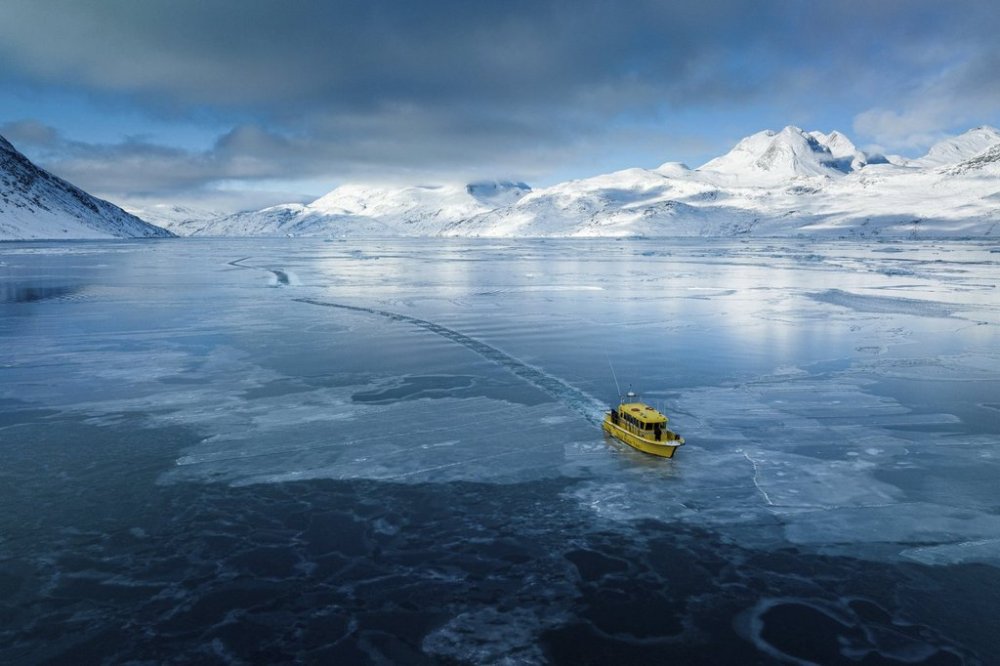
Arctic sea ice had its weakest winter buildup since record-keeping began 47 years ago, a symptom of climate change that will have repercussions globally, scientists said Thursday.
The Arctic reaches its maximum sea ice in March each year and then starts a six-month melt season. The National Snow and Ice Data Center said the peak measurement taken Saturday was 5.53 million square miles (14.33 million square kilometers) — about 30,000 square miles (80,000 square kilometers) smaller than the lowest previous peak in 2017.
That’s a difference about the size of California.
“ Warming temperatures are what’s causing the ice to decline,” ice data scientist Walt Meier said. “You know, sea ice in particular is very sensitive… 31 degrees is ice skating and 33 degrees it’s swimming.”
Jennifer Francis, a scientist at the Woodwell Climate Research Center in Cape Cod, said this is yet another ringing alarm bell in the form of a broken record.
“Disappearing sea ice is a particularly worrisome story because it’s truly an early warning system alerting us about a variety of hard-to-see changes,” Francis said in an email.
Scientists said warming conditions in the Arctic — the region is warming four times faster than the rest of the world — affect weather elsewhere. Pressure and temperature differences between north and south shrink. That weakens the jet stream, that moves weather systems along, making it dip further south with cold outbreaks and storms that often get stuck and rain or snow more, according to the snow and ice center and Francis.
“The warming winter atmosphere above the Arctic Circle does impact large-scale weather patterns that do influence for those of us outside the Arctic,” said Julienne Stroeve, an ice scientist at the University of Manitoba.
Of the smaller sea ice, Stroeve also noted that it’s not only that there’s less of it. The remaining ice is thin enough for more of it to melt quickly this summer, Stroeve said. She cautioned that a record low area in the winter doesn’t guarantee a record small area in the summer.
Melting Arctic sea ice — mostly in the summer — is making the polar bear population smaller, weaker and hungrier because they rely on the sea ice to hunt from, scientists said. And winter sea ice is especially important for fisheries and seal pups, Meier said.
Arctic sea ice’s biggest year since record-keeping began was 1979, at 6.42 million square miles (16.64 million square kilometers). That means since satellites began tracking it, Arctic sea ice’s winter peak has shrunk by about the size of Pakistan.
When winter sea ice is doing well it can extend more than halfway down the Earth toward the equator, reach Japan, China and Canada’s Gulf of St. Lawrence, Meier said.
Meier said sea ice extent is shrinking all four seasons, but the most important season for the overall health of the Arctic ice is the summer. That’s because ice-free waters warm up quicker, hold more energy and make fall and winter warmer and weaker.
The five lowest amounts for winter peak Arctic sea ice have been since 2015.
Earlier this month, Antarctica came close to breaking a record for record low sea ice — this is the time of year the region hits its minimum — and ended up with the second-lowest sea level on record.
There’s more sea ice in the Antarctic in general and the two poles are timed a bit differently, but in February, global sea ice — the combination of Arctic and Antarctic — hit a record low, Meier said.
___
Follow Seth Borenstein on X at @borenbears
___
The Associated Press’ climate and environmental coverage receives financial support from multiple private foundations. AP is solely responsible for all content. Find AP’s standards for working with philanthropies, a list of supporters and funded coverage areas at AP.org.
Advertisement Advertise With Us
Advertisement Advertise With Us