‘Sobering statistic:’ One-fifth of pollinators in North America at extinction risk

Advertisement

Advertise with us

FREDERICTON - Many butterflies, bees and moths are fluttering into oblivion. A new report co-authored by a Canadian researcher warns that more than one-fifth of pollinator species it studied in North America are at risk of extinction.

Read this article for free:


or

Already have an account? Log in here »

To continue reading, please subscribe:

Subscribe and receive a limited-edition Free Press branded hat or tote.

Digital Subscription

One year of digital access for only $205*

  • Enjoy unlimited reading on winnipegfreepress.com
  • Read the E-Edition, our digital replica newspaper
  • Access News Break, our award-winning app
  • Play interactive puzzles

*First annual payment billed as $205.00 + GST for one year. This annual subscription will automatically renew at $233.00 + GST every 52 weeks (10% off the regular annual price of $259.35). Offer available to new and qualified returning subscribers only. Cancel any time.

To continue reading, please subscribe:

Add Free Press access to your Brandon Sun subscription for only an additional

$1 for the first 4 weeks*

  • Enjoy unlimited reading on winnipegfreepress.com
  • Read the E-Edition, our digital replica newspaper
  • Access News Break, our award-winning app
  • Play interactive puzzles
Start now

*Your next Brandon Sun subscription payment will increase by $1.00 and you will be charged $17.95 plus GST for four weeks. After four weeks, your payment will increase to $24.95 plus GST every four weeks.

Hey there, time traveller!
This article was published 30/03/2025 (563 days ago), so information in it may no longer be current.

FREDERICTON – Many butterflies, bees and moths are fluttering into oblivion. A new report co-authored by a Canadian researcher warns that more than one-fifth of pollinator species it studied in North America are at risk of extinction.

Out of 759 pollinators — animals critical for food production and healthy ecosystems — studied in Canada, more than 10 per cent were at some level of risk of extinction, says the study published this week in the journal Proceedings of the National Academy of Sciences, or PNAS. And of 1,579 pollinators assessed in the United States, 22.5 per cent were found to be at some level of risk.

The study is the most comprehensive look at North American pollinators and their conservation status to date, John Klymko, scientist at Atlantic Canada Conservation Data Centre in Sackville, N.B., and one of the co-authors, said in a recent interview.
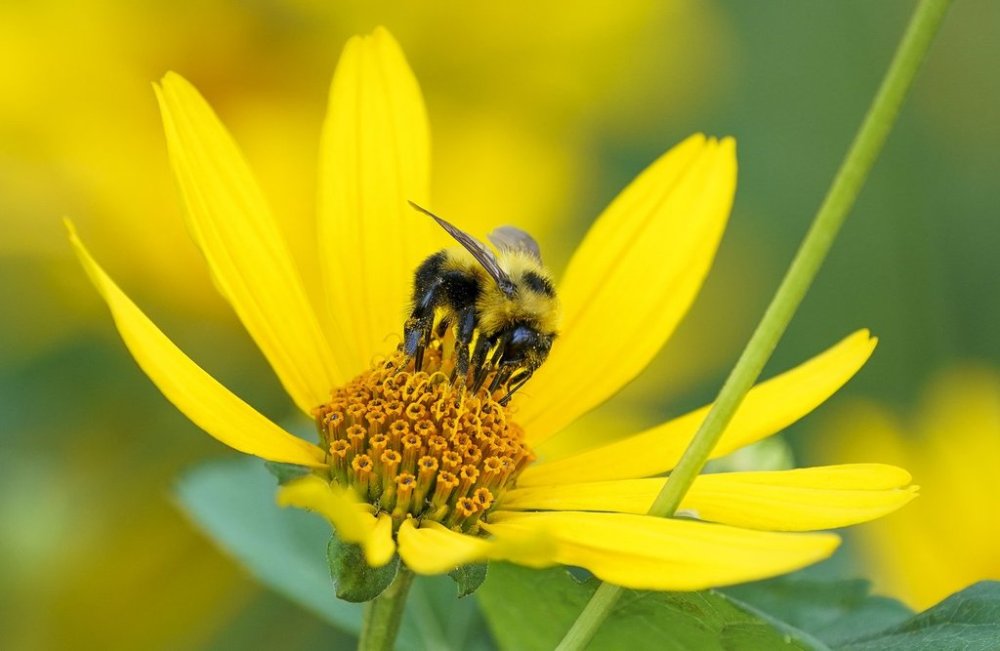
A bee collects pollen on a flower on the grounds of the Canadian Museum of Nature in Ottawa on July 28, 2021.  A new report involving a Canadian researcher warns more than one-fifth of pollinator species assessed in North America — critical for food production and ecosystem function — are at risk. THE CANADIAN PRESS/Sean Kilpatrick
A bee collects pollen on a flower on the grounds of the Canadian Museum of Nature in Ottawa on July 28, 2021. A new report involving a Canadian researcher warns more than one-fifth of pollinator species assessed in North America — critical for food production and ecosystem function — are at risk. THE CANADIAN PRESS/Sean Kilpatrick

Commonly known pollinators, which transfer pollen from one flower to another, are bees, butterflies and moths, Klymko said. But they also include vertebrates like hummingbirds and bats. “Many plants are reliant on pollinators in order to reproduce,” he said.

The study noted that pollinators provide more than $15 billion worth of food each year in North America. 

Among the insect pollinators, extinction risks were highest with bees. Out of 472 species of bees studied in Canada and the U.S., 34.7 per cent were at risk of extinction. The study said that 10 bee, 11 butterfly, and two moth species were classified as critically imperilled.

Flower flies and beetles are relatively secure from extinction, but all three pollinating bat species are at risk of extinction. The 17 hummingbird species studied have seen a population decline but their numbers are high enough that they don’t qualify for an at-risk status.

“To have a broad diversity of pollinators is important because there’s a whole broad diversity of plants that need to be pollinated, and different species of pollinators will be more efficient at pollinating some plants compared to others,” Klymko said.

“Certain species (pollinate) only a handful of plants. And so if you start to lose that diversity of pollinators, there are going to be plant species that are affected.” 

Klymko studied the extinction risk for flower flies for the paper.

“They’re an attractive group of flies. A lot of them are bee or wasp mimics,” he said, describing the insects.

“They hang out on flowers, so it benefits them to look like an insect that can sting you. They trick predators into thinking that they would be stung. So they are a lot of pretty spectacular looking flies. They’re a diverse, diverse group.”

The risk for pollinators is lower, on average, in Canada because many species are distributed over larger areas than they are in the United States. Although there are some Canadian species that are quite restricted in range, and that puts them at an elevated risk level, he added.

Some pollinator species have large ranges such as the boreal forest, which extends from Atlantic Canada all the way to the Yukon, he said.

“When you have species with that broad distribution, the risk of imperilment tends to be less. They’re just inherently more secure by being so broad and widespread.”

But he pointed out that some Canadian species are reliant on rare habitats in places such as southern Ontario, the prairies, and in British Columbia’s Okanagan Valley, where there is fairly high pollinator diversity.

“But there is also a fairly heavy human footprint (in those regions), and continued pressure on the landscape from humans,” he said, warning against complacency. 

Habitat loss, pesticide exposure, climate change, and disease can all adversely affect pollinators, the study said. Klymko said climate change can disturb the routine of pollinators, causing them to emerge from hibernation “before the flowers they rely on are blooming.”

He said pesticides, while primarily used in agricultural areas, can drift to natural ecosystems, killing insects.

Habitat loss such as urban development is a significant driver of species loss, he added. What surprised Klymko the most about the study was the overall percentage of species at risk, he said.

“More than one-fifth of the species that were assessed were at risk,” he said. “That’s a sobering statistic.” 

This report by The Canadian Press was first published March 30, 2025.

Report Error Submit a Tip

More Stories

Man pleads guilty to five sex assaults at, near HSC

Dean Pritchard 5 minute read Preview

Man pleads guilty to five sex assaults at, near HSC

Dean Pritchard 5 minute read Yesterday at 3:41 PM CDT

A Winnipeg man previously found not criminally responsible for a violent assault on his father has pleaded guilty to sexually assaulting four women and a teen girl in and around the Health Sciences Centre last year.

Donovan Mohammed, 29, admitted responsibility for the attacks, on Friday in Winnipeg court. He remains in custody and will be sentenced at a later date following the completion of a court-ordered pre-sentence report.

Mohammed admitted to sexually assaulting a 14-year-old girl and four women — all strangers to him — within the span of an hour on July 2, 2025.

Court heard three of Mohammed’s victims were nurses and three of the assaults were captured on security video.

Read
Yesterday at 3:41 PM CDT

MPI not sleeping on ride-share fraud

Editorial 4 minute read Preview

MPI not sleeping on ride-share fraud

Editorial 4 minute read 2:00 AM CDT

Rust never sleeps.

You may remember those words as the title of a Neil Young and Crazy Horse album from 1979. You might even recognize an even older use of the words as an advertising slogan for anti-rust paint Rust-Oleum.

Or you might be more familiar with the overall concept behind the saying.

That is, that corrosion is a continuous thing that requires constant attention and action, rather than one simple fix. You might even look at it specifically from the point of view of society, as defined by Quora: “neglect, decadence, or entropy accumulate quietly; vigilance and maintenance of institutions or values are necessary.”

Read
2:00 AM CDT

Creatures’ comfort key to coping with loss

Maureen Scurfield 4 minute read Yesterday at 2:00 AM CDT

DEAR MISS LONELYHEARTS: Not long ago I lost my husband to illness at far too young an age. My spouse was a great guy, but I do want another one.

I just want to pass on a little tip. When my husband was dying, he encouraged me to bring home warm and loving pets to our acreage just outside the city. They were my saviours when my husband was ill.

Since he has died, they continue to help me keep warm, happy and affectionate. They were my greatest comfort in the later stages when my man was in too much pain to hold me or be held. The cats and the dog would welcome me home from the hospital and transfer their cuddling to me, giving me all the attention I needed, and I always felt so loved.

I have been dating a fair bit for a fairly recent widow because I’m ready to be held and loved, and I feel my husband and the pets saying, “Way to go.”

Police, street groups looking to extend co-ordinated outreach-first approach to drug-use, trafficking crackdown

Chris Kitching 6 minute read Preview

Police, street groups looking to extend co-ordinated outreach-first approach to drug-use, trafficking crackdown

Chris Kitching 6 minute read Updated: Yesterday at 5:36 PM CDT

Winnipeg police and street outreach groups are discussing how to extend an initiative that tries to link people with addictions and homelessness services, while targeting open drug use and dealing.

Read
Updated: Yesterday at 5:36 PM CDT

Tenants battling landlords find help in short supply from province

Scott Billeck 14 minute read Preview

Tenants battling landlords find help in short supply from province

Scott Billeck 14 minute read Yesterday at 6:00 AM CDT

For nearly three years, Quincy Houdayer and Avery Helm repeatedly pressed their landlord to address plumbing failures, water damage and other maintenance problems at their West Broadway apartment, with records showing some issues persisted until the couple turned to the Residential Tenancies Branch.

Emails and text messages between the tenants, Clearwater Management and the RTB reviewed by the Free Press document recurring leaks and flooding, periods without heat or hot water, concerns about mould and basement conditions and repeated followups from the couple seeking repairs.

“Most of the experiences we’ve had with them can be boiled down to, like, they either are very dismissive about it, they act like it’s not their problem… or they will just fully, blatantly ignore you,” Helm said, adding that the only way to get Clearwater to respond was to threaten going to the RTB, a provincial government agency.

RTB data obtained by the Free Press also shows 13 orders involving the three-building complex at 193-197 Furby St. in 2026 alone. All but one favoured the tenant, while the remaining order ruled in favour of both the tenant and landlord on different items.

Read
Yesterday at 6:00 AM CDT

Manitoba e-scooter legislation changes set to impose speed limit, age restrictions, sidewalk ban

Matthew Frank 5 minute read Preview

Manitoba e-scooter legislation changes set to impose speed limit, age restrictions, sidewalk ban

Matthew Frank 5 minute read Updated: Yesterday at 11:26 AM CDT

People riding e-scooters and other personal electric vehicles in Manitoba will have to strap on a helmet, stay off sidewalks and follow new age limits once new provincial rules for the devices take effect next year.

The vehicles, which also include electric skateboards, hoverboards and unicycles, will fall under The Highway Traffic Act starting in 2027, according to the province’s website. E-bikes are excluded from the new rules, according to the province’s frequently-asked-questions page.

All riders must be at least 16 years old and wear properly fitting helmets — that goes for passengers, too, the province said.

The proposed new legislation sets a speed limit of 25 km/h and would prohibit personal electric vehicles from sidewalks unless signs specifically allow sidewalk use. Riders would be using shared paths or roads with speed limits of 50 km/hr or less. They won’t be allowed to operate the vehicles under the influence of alcohol or drugs and they must use hand signals and obey traffic signs.

Read
Updated: Yesterday at 11:26 AM CDT