Scientists release plans for an even bigger atom smasher to address the mysteries of physics

Advertisement

Advertise with us

GENEVA (AP) — Top minds at the world's largest atom smasher have released a blueprint for a much bigger successor that could vastly improve research into the remaining enigmas of physics.

Read this article for free:


or

Already have an account? Log in here »

To continue reading, please subscribe:

Subscribe and receive a limited-edition Free Press branded hat or tote.

Digital Subscription

One year of digital access for only $205*

  • Enjoy unlimited reading on winnipegfreepress.com
  • Read the E-Edition, our digital replica newspaper
  • Access News Break, our award-winning app
  • Play interactive puzzles

*First annual payment billed as $205.00 + GST for one year. This annual subscription will automatically renew at $233.00 + GST every 52 weeks (10% off the regular annual price of $259.35). Offer available to new and qualified returning subscribers only. Cancel any time.

To continue reading, please subscribe:

Add Free Press access to your Brandon Sun subscription for only an additional

$1 for the first 4 weeks*

  • Enjoy unlimited reading on winnipegfreepress.com
  • Read the E-Edition, our digital replica newspaper
  • Access News Break, our award-winning app
  • Play interactive puzzles
Start now

*Your next Brandon Sun subscription payment will increase by $1.00 and you will be charged $17.95 plus GST for four weeks. After four weeks, your payment will increase to $24.95 plus GST every four weeks.

Hey there, time traveller!
This article was published 01/04/2025 (541 days ago), so information in it may no longer be current.

GENEVA (AP) — Top minds at the world’s largest atom smasher have released a blueprint for a much bigger successor that could vastly improve research into the remaining enigmas of physics.

The plans for the Future Circular Collider — a nearly 91-kilometer (56.5-mile) loop along the French-Swiss border and below Lake Geneva — published late Monday put the finishing details on a project roughly a decade in the making at CERN, the European Organization for Nuclear Research.

The FCC would carry out high-precision experiments in the mid-2040s to study “known physics” in greater detail, then enter a second phase — planned for 2070 — that would conduct high-energy collisions of protons and heavy ions that would “open the door to the unknown,” said Giorgio Chiarelli, a research director at Italy’s National Institute of Nuclear Physics.
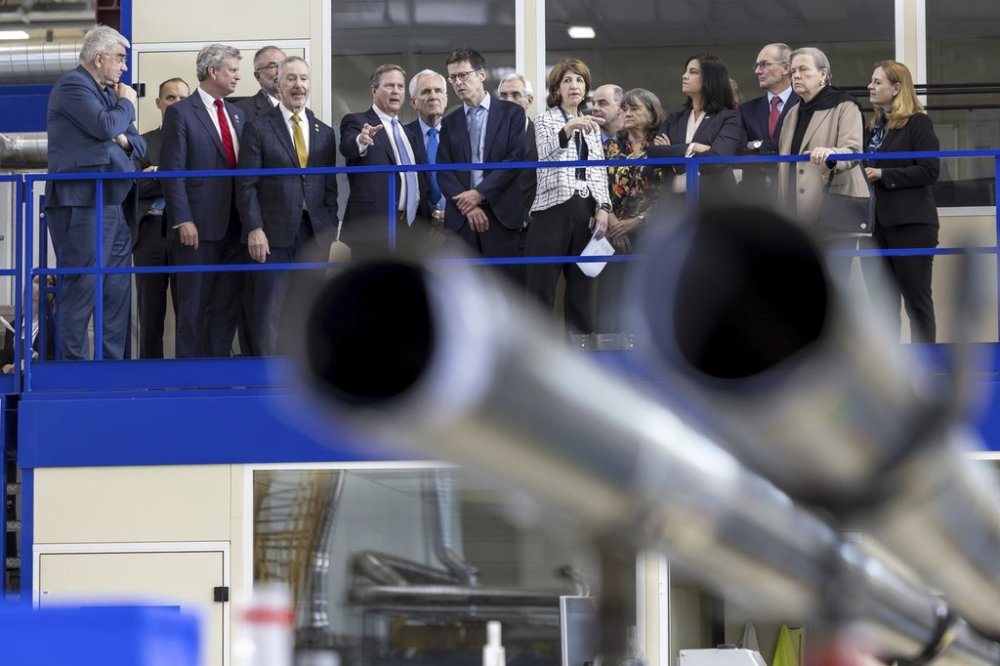
Mike Lamont, director for accelerators and technology, center left, and Fabiola Gianotti, center right, director general of the European Organization for Nuclear Research (CERN), speak with members of the U.S. House of Representatives in the Large Magnet Facility during a visit to CERN facilities in Meyrin, near Geneva, Switzerland, Friday, March 21, 2025. (Salvatore Di Nolfi/Keystone via AP)

“History of physics tells that when there is more data, the human ingenuity is able to extract more information than originally expected,” Chiarelli, who was not involved in the plans, said in an e-mail.

For roughly a decade, top minds at CERN have been making plans for a successor to the Large Hadron Collider, a network of magnets that accelerate particles through a 27-kilometer (17-mile) underground tunnel and slam them together at velocities approaching the speed of light.

The blueprint lays out the proposed path, environmental impact, scientific ambitions and project cost. Independent experts will take a look before CERN’s two dozen member countries — all European except for Israel — decide in 2028 whether to go forward, starting in the mid-2040s at a cost of some 14 billion Swiss francs (about $16 billion).

CERN officials tout the promise of scientific discoveries that could drive innovation in fields like cryogenics, superconducting magnets and vacuum technologies that could benefit humankind.

Outside experts point to the promise of learning more about the Higgs boson, the elusive particle that has been controversially dubbed “the God particle,” which helped explain how matter formed after the Big Bang.

Work at the Large Hadron Collider confirmed in 2013 the existence of the Higgs boson, the central piece in a puzzle known as the standard model that helps explains some fundamental forces in the universe.

CERN Director-General Fabiola Gianotti said the future collider “could become the most extraordinary instrument ever built by humanity to study the constituents and the laws of nature at the most fundamental levels in two ways,” by improving study of the Higgs boson and paving the way to “explore the energy frontier,” and by looking for new physics that explain the structure and evolution of the universe.

One unknown is whether the Trump administration, which has been cutting foreign aid and spending in academia and research, will continue to support CERN a year after the Biden administration pledged U.S. support for the study and collaboration on the FCC’s construction and “physics exploitation” if it’s approved.

The United States is home to 2,000 users of CERN, making them the single largest national contingent among the 17,000 people working there, including outside experts abroad and staff on site, Gianotti said.

While an observer state and not a member, the U.S. doesn’t pay into the CERN regular budget but has contributed to specific projects. Most of the CERN regular budget comes from Europe.

Costas Fountas, the CERN Council president, said he had spoken with some U.S. National Science Foundation and Department of Energy staff who relayed the message that so far “they’re ‘under the radar of the cuts of the Trump administration’. That’s their words.”

CERN scientists, engineers and partners behind the plans considered at least 100 scenarios for the new collider before coming up with the proposed 91-kilometer circumference at an average depth of 200 meters (656 feet). The tunnel would be about 5 meters (16 feet) in diameter, CERN said.

Report Error Submit a Tip

More Stories

Today’s horoscope

Georgia Nicols 4 minute read Preview

Today’s horoscope

Georgia Nicols 4 minute read Yesterday at 2:00 AM CDT

MOON ALERT: There are no restrictions to shopping or important decisions today. The moon is in Aquarius.

ARIES (March 21-April 19)

You will need more sleep in the next four weeks. You will see ways to improve your closest relationships because you will be more observant and more aware. Friendships are rewarding, especially with females.

TAURUS (April 20-May 20)

Read
Yesterday at 2:00 AM CDT

The truth, the hyperbolic truth and nothing but the public accounts truth

Dan Lett 5 minute read Preview

The truth, the hyperbolic truth and nothing but the public accounts truth

Dan Lett 5 minute read 1:49 PM CDT

The Manitoba public accounts — the final and definitive tabulation of government expenditures and revenues — have always been a difficult story to cover.

Difficult because the public accounts are complex, and explaining what the numbers mean and how they differ (but yet illuminate) the provincial budget is a gargantuan task.

However, the thing that really complicates the job of reporting the public accounts is the hyperbolic claims the government of the day makes about the numbers and what they mean.

In pursuit of the truth, let’s look at the numbers from the 2025-26 public accounts released this week, and some of the claims made by Premier Wab Kinew and Finance Minister Adrien Sala.

Read
1:49 PM CDT

Potential Jets backup options include two possible netminder reunions

Ken Wiebe 7 minute read Preview

Potential Jets backup options include two possible netminder reunions

Ken Wiebe 7 minute read 6:10 PM CDT

Kevin Cheveldayoff couldn’t help but make light of the situation.

Near the end of the press conference to discuss where things stand with training camp holdout Connor Hellebuyck, the general manager of the Jets was asked if he felt comfortable with the five goalies who were in training camp.

“You know I can’t have five on the roster,” Cheveldayoff quipped.

Only Cheveldayoff knows for sure how he feels about the organizational depth at the position and whether he’s planning to open the campaign with either Dom DiVincentiis or Thomas Milic in the backup role behind Stuart Skinner.

Read
6:10 PM CDT

Labour leaders, councillors urge Wyatt to reconsider re-election bid

Malak Abas 5 minute read Preview

Labour leaders, councillors urge Wyatt to reconsider re-election bid

Malak Abas 5 minute read Updated: Yesterday at 7:29 PM CDT

City councillors and labour leaders called on incumbent Transcona councillor Russ Wyatt to reconsider his decision to seek re-election while facing sexual assault charges.

A day after the longtime councillor announced he would be running again, the Canadian Union of Public Employees Local 500 and the Winnipeg Labour Council, joined by Couns. Cindy Gilroy and Evan Duncan, told reporters Wyatt would not be able to serve Transcona while fighting multiple sexual assault charges in court and should step aside.

The community of Transcona, traditionally known for its working-class roots, has “been through enough drama,” the president of the city’s largest union said.

“I am not declaring him guilty of anything, the courts will decide that, and his lawyer says that he is innocent. I’m stating a plain fact about capacity. Every hour spent on legal defence is an hour not spent on Transcona,” CUPE 500 president Patrick Troughton said at city hall Tuesday afternoon.

Read
Updated: Yesterday at 7:29 PM CDT

A legacy cast in bronze

Aaron Epp 4 minute read Preview

A legacy cast in bronze

Aaron Epp 4 minute read 6:34 PM CDT

Janice Filmon has a new accolade to add to the list of honours she’s received over the years.

The volunteer, philanthropist and former lieutenant-governor of Manitoba was inducted into the Winnipeg Citizens Hall of Fame on Wednesday. A bronze bust of Filmon was unveiled in Assiniboine Park, where it joins 51 others near the Leaf.

“It’s exciting,” Filmon said. “I don’t remember being so surprised in my adult life as I was when I was told that this was happening.”

In addition to serving as Manitoba’s 25th lieutenant-governor from 2015 to 2022, Filmon has chaired the Nellie McClung Foundation, the CancerCare Manitoba Foundation and co-chaired Leadership Winnipeg.

Read
6:34 PM CDT

Disgraced former law dean arrested, facing extradition to Canada

Morgan Modjeski 2 minute read Preview

Disgraced former law dean arrested, facing extradition to Canada

Morgan Modjeski 2 minute read Updated: 9:17 AM CDT

Jonathan Black-Branch, the disgraced former dean of law at the University of Manitoba, has been arrested in Europe and is awaiting extradition to Canada on fraud charges, Winnipeg police say.

Black-Branch, who failed to defend himself in a lawsuit filed by the U of M and his disbarment proceedings, was ordered in May 2025 to repay more than $682,000 in misspent expense funds.

Winnipeg police confirmed his arrest and pending extradition Wednesday morning. “The extradition process is ongoing,” police said.

Black-Branch left the university in 2020 amid allegations he had misspent public dollars and schemed to evade oversight while running Robson Hall from 2016 to 2020.

Read
Updated: 9:17 AM CDT