Industrial carbon pricing would kill Canadian steel industry, Poilievre claims
Advertisement
Read this article for free:
or
Already have an account? Log in here »
To continue reading, please subscribe:

Digital Subscription
One year of digital access for only $205*
- Enjoy unlimited reading on winnipegfreepress.com
- Read the E-Edition, our digital replica newspaper
- Access News Break, our award-winning app
- Play interactive puzzles
*First annual payment billed as $205.00 + GST for one year. This annual subscription will automatically renew at $233.00 + GST every 52 weeks (10% off the regular annual price of $259.35). Offer available to new and qualified returning subscribers only. Cancel any time.
To continue reading, please subscribe:
Add Free Press access to your Brandon Sun subscription for only an additional
$1 for the first 4 weeks*
- Enjoy unlimited reading on winnipegfreepress.com
- Read the E-Edition, our digital replica newspaper
- Access News Break, our award-winning app
- Play interactive puzzles
*Your next Brandon Sun subscription payment will increase by $1.00 and you will be charged $17.95 plus GST for four weeks. After four weeks, your payment will increase to $24.95 plus GST every four weeks.
Read unlimited articles for free today:
or
Already have an account? Log in here »
Hey there, time traveller!
This article was published 09/04/2025 (546 days ago), so information in it may no longer be current.
SAULT STE. MARIE – Conservative Leader Pierre Poilievre said Wednesday that Canada’s steel industry is being threatened by U.S. tariffs and the Liberals’ industrial carbon price — a policy big industry players have said they support.
The Conservative campaign kicked off the day in Sault Ste. Marie, Ont., a steel town that sits on Canada’s border with the United States.
Poilievre took to his podium at 9 a.m. in -13 C cold, in front of the bridge connecting the two nations currently locked in a bitter tariff dispute. That dispute has high stakes for the steel industry and residents of Sault Ste. Marie, where heavyweight Algoma Steel underpins the economy.
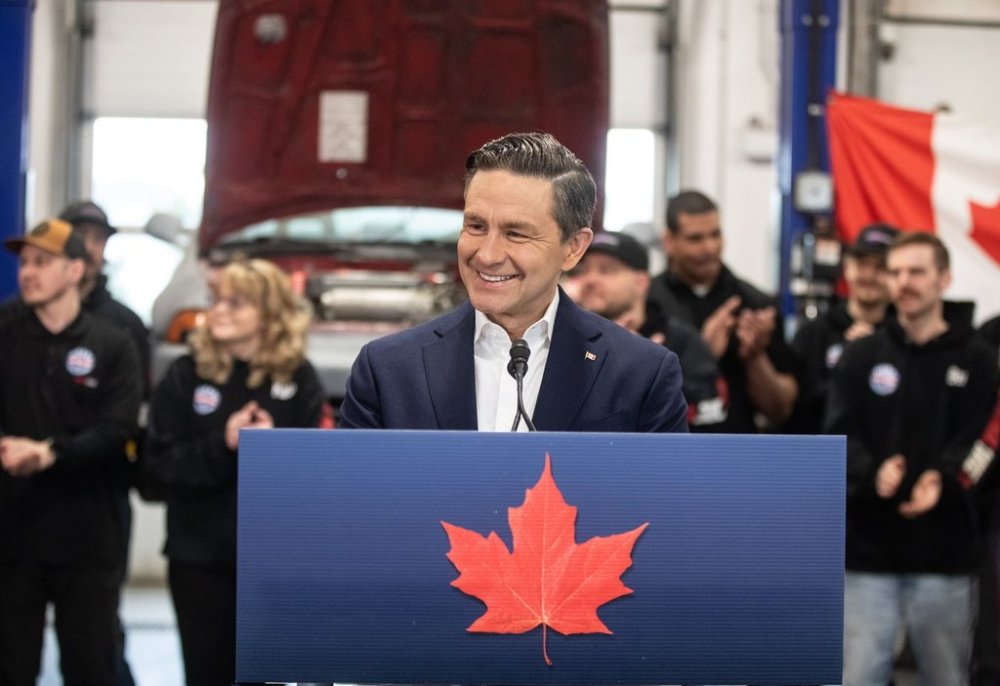
But Poilievre did not initially address steel, tariffs or U.S. President Donald Trump in his speech, which instead focused on previously announced policies to get tougher on crime. He mentioned the steel industry in passing at a rally in the same location the previous evening — mainly in the context of carbon pricing.
A local reporter pointed out the disconnect to the Conservative leader and asked him how he would support the steel industry through the tariff uncertainty.
Poilievre acknowledged the challenge and drew a comparison between Trump and Liberal Leader Mark Carney, his chief rival in the election.
“This is an area where Mr. Trump and Mr. Carney agree. They both want to tax Canadian steel. Trump with tariffs, Carney with carbon taxes,” he said.
While Carney eliminated the consumer carbon price when he assumed office last month, he maintained the industrial carbon price, which is paid by big emitters. After Carney dropped the consumer carbon price, Poilievre said he would end the industrial price as well.
Poilievre argued that many of Canada’s steel producers would “shut down and go south,” where he said they would be free from both carbon pricing and American tariffs.
He argued “there will be no steel industry left in Canada” if the industrial carbon pricing law remains in place.
The Canadian Steel Producers Association, which includes major industry players such as Algoma, said in an open letter in October that it supports an industrial carbon price “as the backbone of decarbonization” across Canada.
“Industrial carbon markets are the most flexible and cost-effective way to incentivize industry to systematically reduce emissions,” the letter said.
The association went on to criticize how the current system works and call on Ottawa to standardize regimes across provinces, arguing the “critical policy isn’t working as well as it should.”
Most provinces have their own pricing programs for big industrial emitters that meet standards set by the federal government, but they do vary from region to region.
The Canadian Climate Institute in January pointed to the industrial carbon price as a critical tool for cutting emissions from the steel industry.
According to an analysis published in January by 440 Megatonnes, a project of the Canadian Climate Institute, Canada’s iron and steel industry has already cut its emissions with energy efficiency upgrades.
It also found the industry is on track to cut its emissions by 40 per cent between 2022 and 2030, decarbonization projects.
Steel is one of the commodities under fire in Trump’s tariff war; the president imposed a 25 per cent levy on steel imports on March 12. Canada retaliated with dollar-for-dollar tariffs matching U.S. import taxes on steel and aluminum.
Poilievre on Wednesday repeated previous pledges to impose counter tariffs on the United States to protect the steel industry, and to allow Canadians to defer capital gains tax if the earnings are reinvested in Canada.
Critics — including some within the Conservative party’s ranks — have called on Poilievre to focus his campaign messaging on Trump and the trade war.
Poilievre, who started the day talking about crime with the former chief of police in Sault Ste. Marie, held a rally focused on crime Wednesday evening.
Adrian Woolley, president of the Peel Regional Police Association, said onstage at the rally that people in the area no longer feel safe and that Liberal policies have turned the justice system into a “joke.”
“Enough is enough, we can’t do this anymore,” said Woolley, who endorsed Poilievre. “The Liberals sent a message loud and clear: criminals come first and Canadians and community safety comes second.”
Poilievre repeated several promises at the rally, including creating a new criminal offence for intimate partner violence and banning bail, parole and house arrest for repeat serious offenders.
At the rally, Poilievre also reiterated his promise to fund recovery treatment for 50,000 people facing addiction.
Poilievre also spoke about Trump’s latest tariff moves, after the president reversed course Wednesday on his global trade war and immediately paused for 90 days the levies on nations slapped with the highest duties under his “reciprocal” tariff regime. He didn’t offer any changes to the tariffs hitting Canada.
Poilievre said that “almost every country in the world got a pause on American tariffs, but not us, America’s best friend.”
The Conservative leader said he would “move quickly” to negotiate an end to tariffs with protections for Canadian sovereignty and suggested that little progress had been made by Carney.
In early March, Trump imposed — and then partially paused — 25 per cent across-the-board tariffs on Canada and Mexico, with a lower 10 per cent levy on energy and potash. Goods imported under the Canada-U.S.-Mexico Agreement on trade, known as CUSMA, do not face duties. Imports that fall outside the continental trade pact are hit with the 25 per cent tariff.
Tariffs on automobiles, steel and aluminum imports to the U.S. also remain in place.
Poilievre was also questioned Wednesday about a Global News report which found some of Poilievre’s leadership campaign donors were also part of a group to help elect Indian Prime Minister Narendra Modi.

The final report of the public inquiry into foreign interference in January said India was among the actors engaging in foreign interference in Canada.
It said proxy agents of India may have, and may continue to be, clandestinely providing illicit financial support to various Canadian politicians in an attempt to secure the election of pro-India candidates or gain influence over candidates who take office.
“The intelligence does not necessarily indicate that the elected officials or candidates involved were aware of the interference attempts, or that the attempts necessarily succeeded.”
— With files from Nick Murray and Jim Bronskill in Ottawa
This report by The Canadian Press was first published April 9, 2025.
Related Articles
Liberals win 4th mandate as NDP vote collapses and Singh announces he will resign










Advertisement Advertise With Us
Advertisement Advertise With Us