Pope Francis apologized for residential schools on historic Canadian visit
Advertisement
Read this article for free:
or
Already have an account? Log in here »
To continue reading, please subscribe:

Digital Subscription
One year of digital access for only $205*
- Enjoy unlimited reading on winnipegfreepress.com
- Read the E-Edition, our digital replica newspaper
- Access News Break, our award-winning app
- Play interactive puzzles
*First annual payment billed as $205.00 + GST for one year. This annual subscription will automatically renew at $233.00 + GST every 52 weeks (10% off the regular annual price of $259.35). Offer available to new and qualified returning subscribers only. Cancel any time.
To continue reading, please subscribe:
Add Free Press access to your Brandon Sun subscription for only an additional
$1 for the first 4 weeks*
- Enjoy unlimited reading on winnipegfreepress.com
- Read the E-Edition, our digital replica newspaper
- Access News Break, our award-winning app
- Play interactive puzzles
*Your next Brandon Sun subscription payment will increase by $1.00 and you will be charged $17.95 plus GST for four weeks. After four weeks, your payment will increase to $24.95 plus GST every four weeks.
Read unlimited articles for free today:
or
Already have an account? Log in here »
Hey there, time traveller!
This article was published 21/04/2025 (541 days ago), so information in it may no longer be current.
On a warm July day in 2022, thousands of dignitaries, Indigenous leaders and residential school survivors travelled from across Canada to powwow grounds in central Alberta.
For some, the journey took days. For others, decades.
They had all come to hear Pope Francis apologize for the Catholic Church’s role in residential schools.
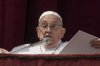
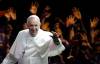
Francis died Monday at the Vatican. He was 88.
It was on the stage at Maskwacis, Alta., where Francis made history.
He said he was sorry and ashamed for abuses committed by some members of the Catholic Church as well as for the cultural destruction and forced assimilation that culminated in the schools.
“I’m sorry,” Francis said in Spanish.
“I humbly beg forgiveness for the evil committed by so many Christians against the Indigenous Peoples.”
There was applause. Some cheered. Others held their heads and wiped away tears. Some embraced the person next to them.
Survivors had asked for years for the Church to apologize. Demand grew after thousands of possible unmarked graves were discovered at the sites of numerous former residential schools.
An estimated 150,000 Indigenous children were forced to attend residential schools over a century. The Catholic Church ran about 60 per cent of the institutions.
The final report from the Truth and Reconciliation Commission of Canada, which investigated residential schools in Canada, described horrific details of physical, emotional and sexual abuse inflicted on Indigenous children.
Among its Calls to Action, the commission called on the Pope to apologize on Canadian soil.
The Pope’s apology came at the start of his six-day “penitential pilgrimage” in Canada.
At Maskwacis, Alta., an area home to four First Nations south of Edmonton, a 40-metre-long red banner weaved through the crowd with the names of 4,120 children who died in residential schools.
Then-prime minister Justin Trudeau attended with chiefs and survivors.
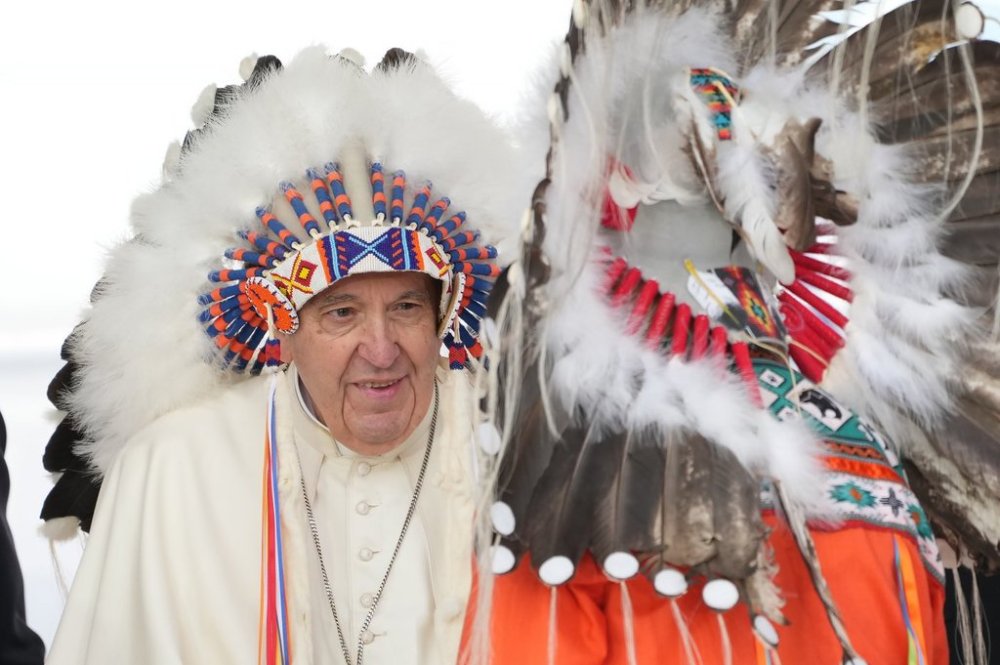
Chief Wilton Littlechild, a survivor and former commissioner with the Truth and Reconciliation Commission, gave the Pope a traditional headdress often reserved for First Nations chiefs. The move drew a mixed reaction from the crowd and others who watched the moment on TV.
Francis repeated the apology several times on the rest of his trip, and his words were met with a mixed response.
Many Indigenous people said the apology was necessary, especially for survivors, because it meant the head of the Catholic Church was finally recognizing that harms were committed.
Some criticized the Pope for not going far enough. They were disappointed he didn’t name the crimes and abuses.
Others called for action, not words.
Phil Fontaine, a survivor and former national chief of the Assembly of First Nations, spent much of his life fighting for the Pope to deliver an apology in Canada.
“Without an apology, it would be impossible to forgive,” Fontaine said a year after the Pope’s visit.
“And without forgiveness, there can’t be any true healing.”
Fontaine had gone to the Vatican in 2009 to meet former pope Benedict and requested an apology. Benedict didn’t oblige.
Fontaine once again travelled to the Vatican with an Indigenous delegation in the spring of 2022. This time, Francis delivered a first apology and promised to bring his atonement to Canada.
Many said an apology in person in Canada was needed for healing and reconciliation.
Archbishop Richard Smith served as the general coordinator of the pontiff’s visit to Canada.
“Pope Francis wore his heart on his sleeve, even to the public, even before mass audiences. But to see him open his heart, open his mind to the Indigenous (people) was really, I think, an example to us all,” Smith recalled in a statement on Monday.
The Catholic Archdiocese of Edmonton said in the same statement that the historic visit, only the fourth papal trip to Canada, marked a significant step on the journey towards healing and reconciliation with First Nations, Métis and Inuit, which continues today.
The Canadian visit also included a holy mass at Commonwealth Stadium in Edmonton. Francis blessed and kissed babies and young children handed to him as he was driven across the football field.
At a sacred pilgrimage site in Lac Ste. Anne, Alta., the Pope took part in a church service, wearing a red Métis sash around his neck.
In Quebec, he participated in various ceremonies and led another mass.
The final leg of his trip included a stop in Iqaluit, where he met with survivors. Traditional dancers, drummers and throat singers performed and explained how the practices were banned in residential schools.
In his speech, Francis said “Mamianaq,” the Inuktitut word for “sorry.”
On the Pope’s flight home, it was another word that became momentous. When asked by a reporter if the abuse at residential schools amounted to “genocide,” Francis agreed.
“To take away children, to change the culture, their mindset, their traditions — to change a race, an entire culture … yes I (do) use the word genocide,” he said through a translator.
The admission was welcomed by many who had pushed for the Canadian government to formally recognize that genocide occurred at the schools.

Months later, the Vatican also followed through on formally denouncing the Doctrine of Discovery, another point of contention on the Pope’s tour.
The papal bulls or edicts were connected to the idea that lands being colonized were empty, when Indigenous people had long called them home.
Documents from the federal government showed it spent at least $55 million on the Pope’s visit, including $18 million for the RCMP. The Canadian Conference of Catholic Bishops, which organized the papal visit, said it spent another $18 million.
Some criticized the cost, saying the money could have gone to healing efforts for survivors.
This report by The Canadian Press was first published April 21, 2025.
Related Articles
Pope Francis, Latin America's first pontiff who ministered with charm and humility, dies at 88
Advertisement Advertise With Us
Advertisement Advertise With Us
The Free Press acknowledges the financial support it receives from members of the city’s faith community, which makes our coverage of religion possible.