Pope Francis converted to the environmental cause and denounced those he blamed for climate change
Advertisement
Read this article for free:
or
Already have an account? Log in here »
To continue reading, please subscribe:

Digital Subscription
One year of digital access for only $205*
- Enjoy unlimited reading on winnipegfreepress.com
- Read the E-Edition, our digital replica newspaper
- Access News Break, our award-winning app
- Play interactive puzzles
*First annual payment billed as $205.00 + GST for one year. This annual subscription will automatically renew at $233.00 + GST every 52 weeks (10% off the regular annual price of $259.35). Offer available to new and qualified returning subscribers only. Cancel any time.
To continue reading, please subscribe:
Add Free Press access to your Brandon Sun subscription for only an additional
$1 for the first 4 weeks*
- Enjoy unlimited reading on winnipegfreepress.com
- Read the E-Edition, our digital replica newspaper
- Access News Break, our award-winning app
- Play interactive puzzles
*Your next Brandon Sun subscription payment will increase by $1.00 and you will be charged $17.95 plus GST for four weeks. After four weeks, your payment will increase to $24.95 plus GST every four weeks.
Read unlimited articles for free today:
or
Already have an account? Log in here »
Hey there, time traveller!
This article was published 22/04/2025 (482 days ago), so information in it may no longer be current.
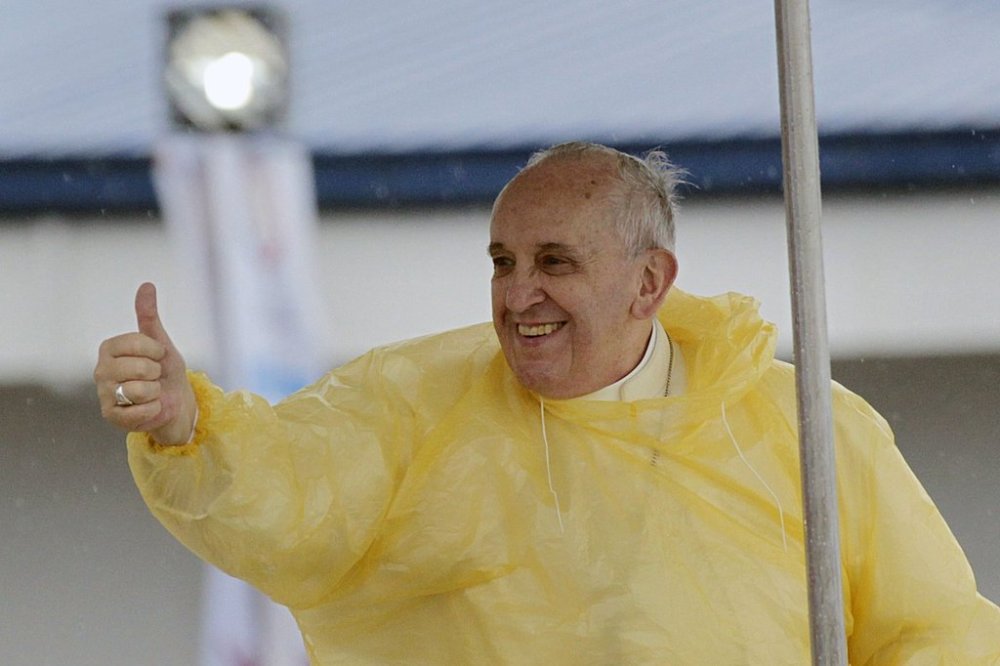
VATICAN CITY (AP) — Few moments in Pope Francis’ papacy better exemplify his understanding of climate change and the need to address it than the rain-soaked Mass he celebrated in Tacloban, Philippines, in 2015.
Wearing one of the cheap plastic yellow ponchos that were handed out to the faithful, Francis experienced first-hand the type of freak, extreme storms that scientists blame on global warming and are increasingly striking vulnerable, low-lying islands.
He had traveled to Tacloban, on the island of Leyte, to comfort survivors of one of the strongest recorded tropical cyclones, Typhoon Haiyan. The 2013 storm killed more than 7,300 people, flattened villages and displaced about 5 million residents.
But with another storm approaching Tacloban two years later, Francis had to cut short his visit to get off the island.
“So many of you have lost everything. I don’t know what to tell you,” Francis told the crowd in Tacloban’s muddy airport field as the wind nearly toppled candlesticks on the altar.
Francis, who died Monday at 88, was moved to silence that day by the survivors’ pain and the devastation he saw. But he would channel it a few months later when he published his landmark encyclical, “Praised Be,” which cast care for the planet as an urgent and existential moral concern.
The first ecological encyclical
The document, written to inspire global negotiators at the 2015 Paris climate talks, accused the “structurally perverse,” profit-driven economy of the global north of ravaging Earth and turning it into a “pile of filth.” The poor, Indigenous peoples and islanders like those in Tacloban suffered the most, he argued, bearing the brunt of increasing droughts, extreme storms, deforestation and pollution.
It was the first ecological encyclical, and it affirmed the Argentine Jesuit, who in his youth studied to be a chemist, as an authoritative voice in the environmental movement. Later cited by presidents and scientists, the document inspired a global faith-based coalition to try to save God’s creation before it was too late.
“I think he understood from the beginning that there are three relationships that had to be regenerated: Our relationship with God, our relationship with the created world and our relationship with our fellow creatures,” said papal biographer Austen Ivereigh.
It wasn’t always so.
A conversion in 2007 in Brazil
Francis had a steep learning curve on the environment, just as he did with clergy sexual abuse, which he initially dismissed as overblown. He himself pointed to a 2007 meeting of Latin American and Caribbean bishops in Aparecida, Brazil, as the moment of his ecological awakening.
There, the then-Cardinal Jorge Mario Bergoglio had been elected to draft the conference’s final document, and was under pressure to include calls from Brazilian bishops to highlight the plight of the Amazon.
Bergoglio, the dour-faced archbishop of urbane Buenos Aires, didn’t get what all the fuss was about.
“At first I was a bit annoyed,” Francis wrote in the 2020 book “Let Us Dream.” “It struck me as excessive.”
By the end of the meeting, Bergoglio was converted and convinced.
The final Aparecida document devoted several sections to the environment: It denounced multinational extraction companies that plundered the region’s resources at the expense of the poor. It warned of melting glaciers and the effects of lost biodiversity. It cast the ravaging of the planet as an assault on God’s divine plan that violated the biblical imperative to “cultivate and care” for creation.
Those same issues would later find prominence in “Praised Be,” which took its name from the repeated first line of the “Canticle of the Creatures,” one of the best-known poetic songs of the pontiff’s nature-loving namesake, St. Francis of Assisi.
They also would be highlighted in the Amazon Synod that Francis called at the Vatican in 2019, a meeting of bishops and Indigenous peoples specifically to address how the Catholic Church could and should respond to the plight of the Amazon and its impoverished people.
“I think the pope’s most important contribution was to insist on the ethical aspect of the debate about climate justice,” said Giuseppe Onofrio, head of Greenpeace Italy, “that the poor were those who contributed the least to pollution and the climate crisis, but were paying the highest price.”
How the environment affects all other ills
In many ways, those same issues would also come to define much of Francis’ papacy. He came to view the environmental cause as encapsulating nearly all the other ills afflicting humanity in the 21st century: poverty, social and economic injustice, migration and what he called the “throwaway culture” — a melting pot of problems that he was convinced could only be addressed holistically.
Some of Francis’ strongest calls to protect the environment would come on or around Earth Day, celebrated April 22.
“For some time now, we have been becoming more aware that nature deserves to be protected, even if only because human interaction with God’s biodiversity must take care with utmost care and respect,” Francis said in a video message released on Earth Day in 2021.
Cardinal Michael Czerny, the Canadian Jesuit whom Francis would later entrust with the ecological dossier, said the 2007 meeting in Brazil had a big impact on Francis.
“In Aparecida, listening to so many different bishops talking about what was deteriorating, but also what the people were suffering, I think really impressed him,” said Czerny.
Czerny’s mandate encapsulated Francis’ vision of “integral ecology,” covering the environment, the Vatican’s response to the COVID-19 pandemic, its charitable Caritas federation, migration advocacy, economic development and its antinuclear campaign.
The multifaceted approach was intentional, Czerny said, to establish new thinking about ecology that went beyond the politicized concept of “green” advocacy to something bigger and nonnegotiable: humanity’s relationship with God and creation.
“Everything is connected,” Francis liked to say.
A legacy from Pope Paul VI
He was by no means the first pope to embrace the ecological cause. According to the book “The Popes and Ecology,” Pope Paul VI was the first pontiff to refer to an “ecological catastrophe” in a 1970 speech to a U.N. food agency.

St. John Paul II largely ignored the environment, though he did write the first truly ecological manifesto: his 1990 World Day of Peace message, which linked consumer lifestyle with environmental decay.
Pope Benedict XVI was known as the “green pope,” primarily for having installed solar panels on the Vatican auditorium and starting a tree-planting campaign to offset the greenhouse gas emissions of Vatican City.
Francis issued an update to “Praised Be” in 2023, just before the U.N. climate conference in Dubai. While consistent with the original text, the update was even more dire and showed Francis had grown more urgent in his alarm.
He became even more willing to point fingers at the world’s biggest emitters of heat-trapping greenhouse gases, especially the U.S. And he called out those, including in the church, who denied the human causes of global warming.
“He showed that he had an understanding of what was happening in the world, and he saw the world from the point of view, as he was like to say, of the peripheries, of the margins,” said Ivereigh, the papal biographer. “He brought the margins into the center.”
Advertisement Advertise With Us
Advertisement Advertise With Us
The Free Press acknowledges the financial support it receives from members of the city’s faith community, which makes our coverage of religion possible.