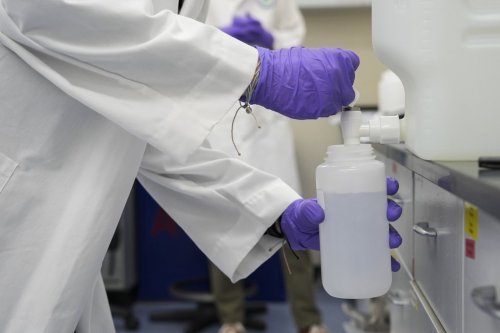
EPA announces rollback for some Biden-era limits on ‘forever chemicals’ in drinking water
Advertisement
Read this article for free:
or
Already have an account? Log in here »
To continue reading, please subscribe:

Digital Subscription
One year of digital access for only $205*
- Enjoy unlimited reading on winnipegfreepress.com
- Read the E-Edition, our digital replica newspaper
- Access News Break, our award-winning app
- Play interactive puzzles
*First annual payment billed as $205.00 + GST for one year. This annual subscription will automatically renew at $233.00 + GST every 52 weeks (10% off the regular annual price of $259.35). Offer available to new and qualified returning subscribers only. Cancel any time.
To continue reading, please subscribe:
Add Free Press access to your Brandon Sun subscription for only an additional
$1 for the first 4 weeks*
- Enjoy unlimited reading on winnipegfreepress.com
- Read the E-Edition, our digital replica newspaper
- Access News Break, our award-winning app
- Play interactive puzzles
*Your next Brandon Sun subscription payment will increase by $1.00 and you will be charged $17.95 plus GST for four weeks. After four weeks, your payment will increase to $24.95 plus GST every four weeks.
Read unlimited articles for free today:
or
Already have an account? Log in here »
Hey there, time traveller!
This article was published 14/05/2025 (515 days ago), so information in it may no longer be current.
The Environmental Protection Agency said Wednesday that it plans to weaken limits on some “forever chemicals” in drinking water that were finalized last year, while maintaining standards for two common ones.
The Biden administration set the first federal drinking water limits for PFAS, or perfluoroalkyl and polyfluoroalkyl substances, finding they increased the risk of cardiovascular disease, certain cancers and babies being born with low birth weight. Those limits on PFAS, which are human-made and don’t easily break down in nature, were expected to reduce their levels for millions of people.
Limits on three types of PFAS, including what are known as GenX substances found in North Carolina, will be scrapped and reconsidered by the agency, as will a limit on a mixture of several types of PFAS.

The Biden administration’s rule also set standards for the two common types of PFAS, referred to as PFOA and PFOS, at 4 parts per trillion, effectively the lowest level at which they can be reliably detected. The EPA will keep those standards, but give utilities two extra years — until 2031 — to comply.
“We are on a path to uphold the agency’s nationwide standards to protect Americans from PFOA and PFOS in their water. At the same time, we will work to provide common-sense flexibility in the form of additional time for compliance,” said EPA Administrator Lee Zeldin.
The development was first reported by The Washington Post.
Large scale changes and utility pushback
It appears few utilities will be impacted by the withdrawal of limits for certain, newer types of PFAS. So far, sampling has found nearly 12% of U.S. water utilities are above the Biden administration’s limits. But most utilities face problems with PFOA or PFOS.
Health advocates praised Biden’s administration for the limits. But water utilities complained, saying treatment systems are expensive and that customers will end up paying more. The utilities sued the EPA.
The EPA’s actions align with some arguments in the utilities’ lawsuit. They argued the EPA lacked authority to regulate a mixture of PFAS and said the agency didn’t properly support limits on several newer types of PFAS that the EPA now plans to rescind. They also sought the two-year extension.
Erik Olson, a senior strategist at the nonprofit Natural Resources Defense Council, said the move is illegal. The Safe Water Drinking Act gives the EPA authority to limit water contaminants, and it includes a provision meant to prevent new rules from being looser than previous ones.
“With a stroke of the pen, EPA is making a mockery of the Trump administration’s promise to deliver clean water for Americans,” Olson said.
President Donald Trump has sought fewer environmental rules and more oil and gas development. EPA Administrator Lee Zeldin has carried out that agenda by announcing massive regulatory rollbacks. The EPA plans to loosen regulations for greenhouse gas emissions, cleanup standards for coal plant waste and car emission limits, among many other clean air and water rules.
Zeldin’s history with PFAS is more nuanced; during his time as a New York congressman, he supported legislation to regulate forever chemicals.
Evidence of harm builds and so does the cost
Manufactured by companies like Chemours and 3M, PFAS were incredibly useful in many applications -– among them, helping clothes to withstand rain and ensuring that firefighting foam snuffed out flames. But the chemicals also accumulate in the body. As science advanced in recent years, evidence of harm at far lower levels became clearer.
The Biden-era EPA estimated the rule will cost about $1.5 billion to implement each year. Water utility associations say the costs, combined with recent mandates to replace lead pipes, will raise residents’ bills and fall hardest on small communities with few resources.
The Biden administration did work to address cost concerns. The Bipartisan Infrastructure Law provided $9 billion for chemicals like PFAS, utilities have won multibillion-dollar settlements against PFAS polluters.
Utilities see partial relief, activists see a backslide
Some utilities have been surprised to find out they are over limits. And small water providers might struggle with compliance costs and expertise.
“This gives water pros more time to deal with the ones we know are bad, and we are going to need more time. Some utilities are just finding out now where they stand,” said Mike McGill, president of WaterPIO, a water industry communications firm.
Some utilities wanted a higher limit on PFOA and PFOS, according to Mark White, drinking water leader at the engineering firm CDM Smith. He suspects the utility industry will continue to sue over those limits. Environmental groups will likely file challenges, too.
Melanie Benesh, vice president of government affairs at the nonprofit Environmental Working Group, said utilities may not have to install treatment that’s as broadly effective if they just have to focus on two types of older PFAS.
“You really reduce what utilities have to do to make sure that the other, newer generation PFAS are captured” she said.
When the Biden administration announced its rule, the head of the EPA traveled to North Carolina and was introduced by activist Emily Donovan, who said she was grateful for the first federal standards. She had long campaigned for tougher rules for GenX substances that had contaminated a local river.
Now the EPA says it will roll back those GenX limits.
“This current administration promised voters it would ‘Make America Healthy Again’ but rescinding part of the PFAS drinking water standards does no such thing,” she said.
___
The Associated Press receives support from the Walton Family Foundation for coverage of water and environmental policy. The AP is solely responsible for all content. For all of AP’s environmental coverage, visit https://apnews.com/hub/climate-and-environment