Civic perks weren’t always considered frivolous
Advertisement
Read this article for free:
or
Already have an account? Log in here »
To continue reading, please subscribe:
Digital Subscription
One year of digital access for only $1.44 a week*
- Enjoy unlimited reading on winnipegfreepress.com
- Read the E-Edition, our digital replica newspaper
- Access News Break, our award-winning app
- Play interactive puzzles
*Billed as $5.77 plus GST every four weeks. After 52 weeks, price increases to the regular rate of $19.95 plus GST every four weeks. Offer available to new and qualified returning subscribers only. Cancel any time.
To continue reading, please subscribe:
Add Free Press access to your Brandon Sun subscription for only an additional
$1 for the first 4 weeks*
- Enjoy unlimited reading on winnipegfreepress.com
- Read the E-Edition, our digital replica newspaper
- Access News Break, our award-winning app
- Play interactive puzzles
*Your next Brandon Sun subscription payment will increase by $1.00 and you will be charged $17.95 plus GST for four weeks. After four weeks, your payment will increase to $24.95 plus GST every four weeks.
Read unlimited articles for free today:
or
Already have an account? Log in here »
Hey there, time traveller!
This article was published 23/05/2025 (520 days ago), so information in it may no longer be current.
An excerpt from You’ll Pay For This (Great Plains Press) by Michel Durand-Wood, the first book in The City Project series.
The series, with Winnipeg as a case study, reflects on the struggles all North America cities are dealing with, and what needs to change to create a happier, healthier and more resilient city 50 years from now.
A book launch will take place May 31, 7 p.m., at McNally Robinson.
I often think about the gardener in Elmwood Park.
If you don’t know it, Elmwood Park is a small neighbourhood park. Locals like me lovingly refer to it as Roxy Park, even though that’s never actually been its official name. It’s always been Elmwood Park.
Aside from having two names — the real one and the one people actually use — it also has a sandbox, an aging wading pool, a swing set and play structure, a couple of benches, and an open area that can serve for pickup games of soccer, outdoor movie nights or winter skating.
Like so many places in the city, it’s definitely looking a little worse for wear, a result of decades of neglect from municipal budget cuts.
Many of the structures are nearing, or well past, the end of their useful lives. The lighting is insufficient, and there are often weeds, and garbage, and overgrown brush.
But many of my neighbours pick up garbage there on their daily walks, or spend time during the summer pulling weeds, planting community gardens, and adding public art. It’s where children play and dogs are walked.
As a park, it’s pretty unremarkable, but it’s ours and we love it.
Ryan Crocker photo Elmwood Park is commonly known as Roxy Park.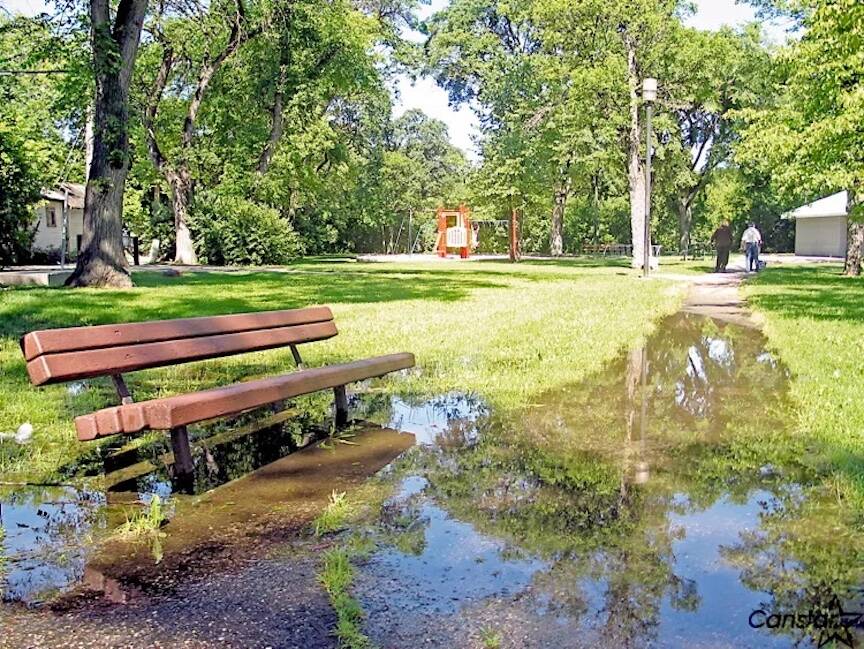
But for nearly 60 years starting in the early 1900s, Elmwood Park was a shining gem. My next-door neighbour, who has lived here since their childhood in the 1940s, remembers it being a common location for people taking wedding photos.
No doubt because, until the mid-1960s, the park had a full-time gardener who maintained it and planted up to 1,200 flowers every spring. The park also had a lily pond and fountain, a lot more seating, and amenities such as barbecue pits.
It was picture-perfect, worthy of a postcard. I know because I actually found a literal postcard from the 1940s featuring Elmwood Park.
I know, right? Hard to believe ol’ Roxy Park used to be that nice.
But more importantly, that it wasn’t the only one. A 1941 transportation map from the Winnipeg Electric Company (which operated the city’s streetcars at the time) had this to say:
Large parks such as Assiniboine and Kildonan are well-known but there are many other smaller parks distinct in their own special attractions, which are not so generally used by the citizens at large. A corner of one such park is pictured here. This quiet lily pool is in Elmwood Park on the banks of the Red River at Glenwood Crescent … There are scores of other small parks all within easy reach by street car or bus.
You read that right. Scores. Scores!
If Abe Lincoln has taught us anything, it’s that a score is 20. And our city once had, not one score, but multiple scores (with an “s”) of small neighbourhood parks that looked like this. Maybe not four score and seven, but scores nonetheless.
The point I’m trying to emphasize here is that while this might seem outright luxurious to us today, there was a time in our city’s history, which lasted many, many decades, when we could afford this. We could afford to pay staff to make even our small neighbourhood parks breathtakingly beautiful.
The lily pool at Elmwood Park (a.k.a. Roxy Park) graces a postcard from the 1940s. (Martin Berman postcard collection)
And we continued to afford it through a world war, a global influenza epidemic, a general strike, the Great Depression, a second world war, and a flood of the century. But then in the mid-1960s, all of a sudden, we had to start letting go of our park gardeners.
What gives? Instead of finding out the cause of our budget crunch, we just cut some services. After all, gardeners are nice to have, not critical to our city like roads are, right? And so it started, our journey towards decades of necessary cuts to services we used to be able to afford.
Catherine Macdonald’s 1995 book, A City at Leisure: An Illustrated History of Parks and Recreation Services in Winnipeg, has an entire chapter titled, Hard Choices: The ’80s and ’90s. In it, she explains:
The necessity of funding these development schemes while also maintaining other needed services caused the city to dig itself badly into debt. At the end of the ’80s, the Parks and Recreation Department found itself faced with some difficult challenges.
Hard choices. Difficult challenges. We’ve been using these words with respect to our city budgets for so long, before a lot of us were even born, that it has become normalized to us. New budget, new budget cuts. Every year, we pay more taxes for fewer services.
And this is normal.
Yet today, it’s about much more than gardeners: potholed streets we can never seem to get ahead of, decommissioned pools, the indefinite closure of the Arlington Bridge, the highest per capita debt in our city’s history, and a rainy-day fund that is now empty.
Worse even is that financial decline has not been felt equally by everyone. The generations of service cuts have taken their toll on our most vulnerable neighbours. And it’s gotten to the point that it’s impossible to look away, with some prominent Winnipeggers even going as far as calling it a humanitarian crisis.
It would be wrong to blame the COVID-19 pandemic. It may have accelerated the decline, but it didn’t cause it. As we can see, this was happening well before then. At least since we were forced to lay off the gardener at Elmwood Park.
So then, why is it that every year I’ve been alive, and even for a decade before that, we have had to make new cuts? How is it that, despite 150 years of consecutive balanced operating budgets (as is mandated by provincial law), and despite a growing population, we can afford less and less with each passing year?
That’s the question I was trying to answer when I started digging into city finance nearly a decade ago. And it’s the journey I’m hoping to take you on with this book.
We deserve better than to live in a city that is in constant decline. If I’m being honest, I’d like to see a gardener in Elmwood Park again at some point. And I’m sure you can easily think of several things in your neighbourhood you’d like to see improved, if the money was there for it.
We can get there. It obviously wasn’t always like this, and so it doesn’t have to continue to be. But for us to change the path forward, we’ll need to follow the money. And not only follow it, but understand it.
Now I know that learning about city finance sounds scary, or boring, or anxiety-inducing, or any number of other negative emotions. Kinda like watching a documentary on paint drying, or worse, not being able to watch it because your Wi-Fi is down.
But trust me when I tell you that anyone can understand municipal finance. Anyone. That includes your great-aunt Helga, the teenager next door who mows your lawn (Connor, I think?), and of course, you.
And not only can you do it, but you’ll have fun doing it!
Sounds unbelievable, I know. Well, what if I told you there’s wine involved?
I thought so. Let’s get to it then!
And don’t worry if you don’t drink wine, because we’ll also be whipping up a batch of super-fun grape punch. After all, Connor’s thirsty too.
But before we get too ahead of ourselves, it’s important to ask, what is a city for, anyway?
Book Excerpt
You’ll Pay For This
By Michel Durand-Wood
Great Plains Press, 150 pages, $20
Related Articles
Getting river rehab rolling: Other cities' success in stemming effluent offer splashes of hope for Winnipeg's waterways


Advertisement Advertise With Us
Advertisement Advertise With Us