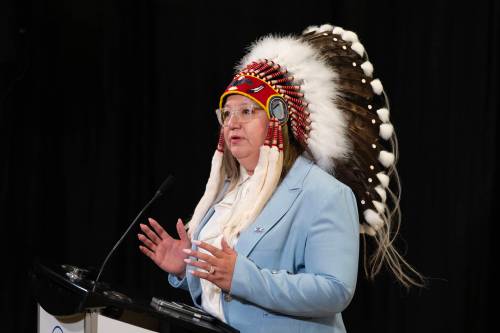
Stamp to celebrate 2Spirit pride
New Canada Post issue commemorates founding event of Two-Spirit Gathering

Advertisement
Read this article for free:
or
Already have an account? Log in here »
To continue reading, please subscribe:

Digital Subscription
One year of digital access for only $205*
- Enjoy unlimited reading on winnipegfreepress.com
- Read the E-Edition, our digital replica newspaper
- Access News Break, our award-winning app
- Play interactive puzzles
*First annual payment billed as $205.00 + GST for one year. This annual subscription will automatically renew at $233.00 + GST every 52 weeks (10% off the regular annual price of $259.35). Offer available to new and qualified returning subscribers only. Cancel any time.
To continue reading, please subscribe:
Add Free Press access to your Brandon Sun subscription for only an additional
$1 for the first 4 weeks*
- Enjoy unlimited reading on winnipegfreepress.com
- Read the E-Edition, our digital replica newspaper
- Access News Break, our award-winning app
- Play interactive puzzles
*Your next Brandon Sun subscription payment will increase by $1.00 and you will be charged $17.95 plus GST for four weeks. After four weeks, your payment will increase to $24.95 plus GST every four weeks.
Read unlimited articles for free today:
or
Already have an account? Log in here »
Hey there, time traveller!
This article was published 05/06/2025 (481 days ago), so information in it may no longer be current.
The summer of 1990 will forever loom large for Elder Albert McLeod.
That year, Indigenous leaders from all over North America — including McLeod, who helped organize the event — assembled at the third North American Native Gay & Lesbian Gathering (now known as the Annual International Two-Spirit Gathering) near Beausejour.
It was a powerful, transformative and intensely spiritual weekend, where attendees could be held by all the Indigenous history, culture and ceremony that had been stolen.
ALEX LUPUL / FREE PRESS FILES Elder Albert McLeod helped organize the 1990 North American Native Gay & Lesbian Gathering, where the term Two-Spirit was introduced to the lexicon.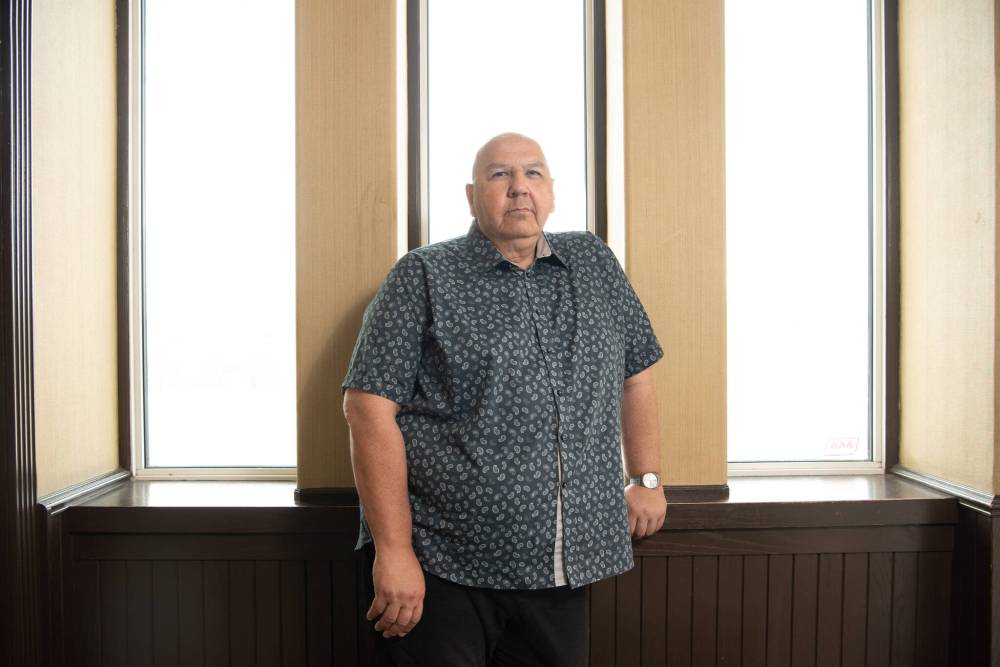
“You know, I was born in the ’50s, and grew up in the ’60s and ’70s, and we knew nothing about our Indigenous identity, our past. Many of us had lost our language, and it was really this process of forced assimilation to being white or western — and that didn’t fit with us. We were curious about our histories,” says McLeod, who turns 70 this year.
“We had asked, through ceremony, for this information about our identities.”
And what they received that weekend, McLeod says, was a gift.
It was there that Fisher River Cree Nation member Myra Laramee introduced the term two-spirit, which she says came to her in a vision.
Two-spirit was a revelation, a term that can describe someone’s sexual, gender and/or spiritual identity, informed by the Indigenous understandings of gender, spirituality and self-determination that colonialism sought to destroy.
Now, that historic event is being commemorated by Canada Post as part of Places of Pride, a four-stamp collection featuring illustrations honouring specific sites of LGBTTQ+ history in Canada.
Supplied Places of Pride stamp Two-Spirit commemorates a 1990 gathering near Beausejour that led to the birth of the term.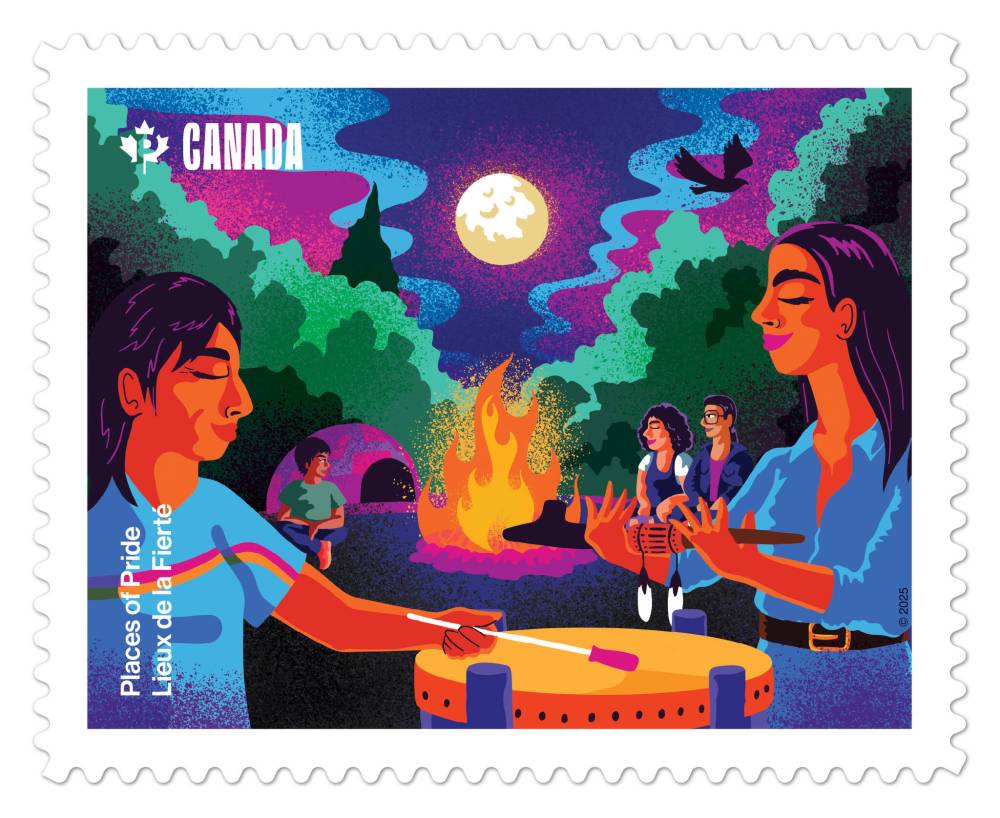
McLeod, one of the directors of 2Spirit Manitoba, worked with the Canada Post team on the Two-Spirit stamp, which depicts people participating in ceremony under a summer night sky. (The artwork is also featured as a mural at the Canadian Museum for Human Rights.)
“You see the big drum, you see the women’s fire, you see the pipe, and you see the sweat lodge, and there’s actually a hawk there — and the full moon. It happened on a full moon. So there’s all these elements at play that weekend that really changed our lives forever,” McLeod says, noting that many other Indigenous LGBT groups in North America changed their name to two-spirit by the following year, a reflection of just how resonant the term was, he says.
The coining and claiming of two-spirit was an act of liberation, he says.
“As Indigenous people it was our inalienable right and our inherent right to receive that (spiritual name), but because we were gay, that was something that was not given to us because of the form of homophobia and transphobia outside the Indigenous community and inside the Indigenous community. So we had to make that pathway ourselves.”
These days, thanks to the work of McLeod and others, two-spirit is a widely recognized term.
In 2017, former prime minister Justin Trudeau formally apologized for Canada’s role in the systematic criminalization, oppression and violence against LGBTTQ+ Canadians and used, explicitly, the term two-spirit.
In 2022, the Canadian government released its Federal 2SLGBTQI+ Action Plan, which saw 2S move to the front of the acronym — “which is historically accurate, because we are the first queers of the Americas,” McLeod says.
And the gift given in the summer of 1990 has since been passed down to subsequent generations of two-spirit people.
“It’s been 35 years, so a generation or more has passed, and we do see youth today who are in their 30s and they’re not carrying the burden that my generation carried. They are finishing high school. They are going to university. They do have careers. They have families. They have houses. They have children. So they’re getting on with their lives without this sort of barrier,” McLeod says.
“It really is a form of not having to carry that legacy of intergenerational trauma or the impact of Indian residential schools or day schools, and just live their life to the fullest but being protected at the same time for that expression or that identity.”
The Places of Pride stamps and collectibles are available now at canadapost.ca and at select postal outlets across Canada.
jen.zoratti@freepress.mb.ca
Jen Zoratti is a columnist and feature writer working in the Arts & Life department, as well as the author of the weekly newsletter NEXT. A National Newspaper Award finalist for arts and entertainment writing, Jen is a graduate of the Creative Communications program at RRC Polytech and was a music writer before joining the Free Press in 2013. Read more about Jen.
Every piece of reporting Jen produces is reviewed by an editing team before it is posted online or published in print – part of the Free Press‘s tradition, since 1872, of producing reliable independent journalism. Read more about Free Press’s history and mandate, and learn how our newsroom operates.
Our newsroom depends on a growing audience of readers to power our journalism. If you are not a paid reader, please consider becoming a subscriber.
Our newsroom depends on its audience of readers to power our journalism. Thank you for your support.
Jen Zoratti is a columnist and feature writer working in the Arts & Life department, as well as the author of the weekly newsletter NEXT. A National Newspaper Award finalist for arts and entertainment writing, Jen is a graduate of the Creative Communications program at RRC Polytech and was a music writer before joining the Free Press in 2013. Read more about Jen.
Every piece of reporting Jen produces is reviewed by an editing team before it is posted online or published in print – part of the Free Press‘s tradition, since 1872, of producing reliable independent journalism. Read more about Free Press’s history and mandate, and learn how our newsroom operates.
Our newsroom depends on a growing audience of readers to power our journalism. If you are not a paid reader, please consider becoming a subscriber.
Our newsroom depends on its audience of readers to power our journalism. Thank you for your support.
Advertisement Advertise With Us
Advertisement Advertise With Us