A burning question
How best to design a fire-wise landscape

Advertisement
Read this article for free:
or
Already have an account? Log in here »
To continue reading, please subscribe:

Digital Subscription
One year of digital access for only $205*
- Enjoy unlimited reading on winnipegfreepress.com
- Read the E-Edition, our digital replica newspaper
- Access News Break, our award-winning app
- Play interactive puzzles
*First annual payment billed as $205.00 + GST for one year. This annual subscription will automatically renew at $233.00 + GST every 52 weeks (10% off the regular annual price of $259.35). Offer available to new and qualified returning subscribers only. Cancel any time.
To continue reading, please subscribe:
Add Free Press access to your Brandon Sun subscription for only an additional
$1 for the first 4 weeks*
- Enjoy unlimited reading on winnipegfreepress.com
- Read the E-Edition, our digital replica newspaper
- Access News Break, our award-winning app
- Play interactive puzzles
*Your next Brandon Sun subscription payment will increase by $1.00 and you will be charged $17.95 plus GST for four weeks. After four weeks, your payment will increase to $24.95 plus GST every four weeks.
Read unlimited articles for free today:
or
Already have an account? Log in here »
Hey there, time traveller!
This article was published 14/06/2025 (417 days ago), so information in it may no longer be current.
As gardeners, we make thoughtful decisions when designing our landscapes. We consider existing features, follow basic design principles and choose what we think will be the most attractive plants that will make our gardens unique.
We also adhere to eco-friendly practices that support pollinators and improve soil conditions by applying organic mulch. When at last our garden tasks are completed in spring, we relax and spend time enjoying the beauty of our outdoor spaces.
Fire changes everything.
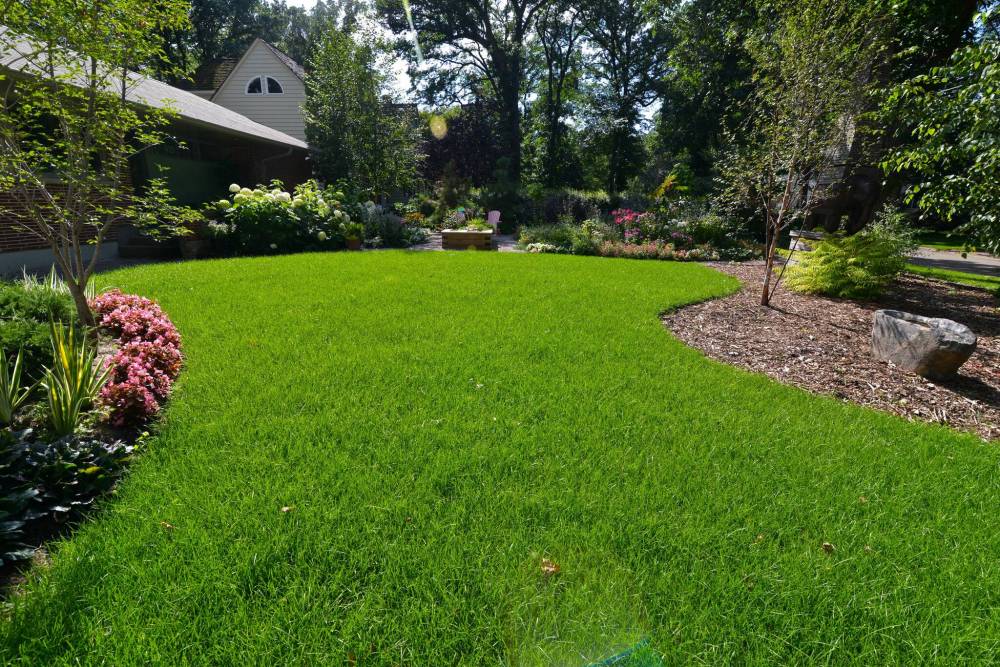
Becky Slater photo
A lush, hydrated lawn like this one increases resilience, while a lawn that is dried out is a fire risk.
At the time of this writing, there are 29 active wildfires in Manitoba as well as wildfires across Western Canada and parts of Ontario. In Winnipeg, wildfire smoke from communities hundreds of kilometres away is damaging air quality, but that’s only one of the impacts of wildfire season that we face.
As wildfires become more prevalent and intense in Canada and the United States, there is a greater focus on creating fire-wise landscapes — prioritizing the use of fire-resistant plants that can play a role in creating a defensible space to help protect homes and cottages.
As lists of fire-resistant plants proliferate on social media, it’s essential to understand that fire-resistance does not mean fire-proof.
While current research has identified specific characteristics that make some plants less combustible than others, the research continues to be updated.
FireSmart Canada is a national program that is supported by federal, provincial and territorial wildland fire management agencies and partners with municipal governments and the private sector.
The information on its website (firesmartcanada.ca) helps homeowners mitigate the risks and impacts of fires.
According to FireSmart Canada, fire-resistant plants have moist, supple leaves, accumulate minimal dead material, have a low amount of resin, and feature water-like sap with little or no odour.
Highly flammable plants, on the other hand, contain dry, dead material, or have stems, branches and leaves that contain volatile waxes, terpenes or oils. Plants that have resinous sap with a strong odour and plants with loose papery bark that can ignite readily are also problematic.

Bernadette Vangool photo
Nepeta dropmore hybrid catmint is a hardy, fire-smart perennial.
It’s also important to consider how plants are placed in the landscape and the use of organic mulches.
Tim Lynham is a forest fire researcher and fire scientist who worked for more than 35 years with Natural Resources Canada’s Canadian Forest Service. His house in Sudbury, Ont. is about a kilometre away from dense forest.
One year, Lynham spent the whole summer working at Norway House waterbombing fires.
“Now, Norway House is under threat from fires, so it’s kind of personal to me,” he says.
Lynham says coniferous plants such as Colorado blue spruce are more fire prone than broadleaf deciduous plants such as poplar and birch.
“Coniferous plants have oils in the green leafy material. If you take a fresh branch off a coniferous tree, for example, a balsam fir or a pine, and throw it on a fire, it crackles regardless of how much moisture content may be in the needles, because the oils in the needles overcome the moisture content and the needles burn.
“Broadleaf vegetation is a slightly better choice than plants that are coniferous or contain volatile oils, but when conditions are extreme — hot, dry, and droughty — then coniferous and broadleaf species can all be fire prone,” he says.

Colleen Zacharias photo
For a fire-smart landscape design, use low groundcovers and decorative rock in the area closest to your house, but keep organic mulch further away.
So, if you live in an area that has been close to wildfires, don’t plant coniferous trees and shrubs near your house.
His next piece of advice is another example of how our understanding of landscape resilience is changing.
“It is essential to not mulch your garden beds with organic mulches, such as wood chips or pine needles,” says Lynham. “Embers can travel 10 or 15 kilometres ahead of fire. You can have a wonderful distribution of broadleaf plants around your house, and then if you mulch the beds with wood chips, that is 100 times worse. If conditions are hot and dry, wood chips and pine needles are very combustible if embers should land on them.”
Fire-smart principles recommend replacing organic mulches with gravel mulch or a combination of plant mulch and decorative rock mulch.
Keeping plants well-hydrated, including your lawn, is important. A healthy green lawn that is watered regularly can be considered relatively fire-resistant, says Lynham.
“However, grass that loses its colour and becomes chlorotic and has a low moisture content is no longer fire-resistant, it is actually fire-prone.”
Leslie Cornell is a landscape horticulturist and president of Cornell Design Landscaping Ltd., which includes a garden centre and greenhouse in Moose Jaw, Sask. She represents Saskatchewan on the board of the Canadian Nursery Landscape Association and is on the professional development committee, which supports training to help landscapers better comply with FireSmart principles.
“FireSmart BC is developing an online course which will be available for landscape professionals across Canada,” Cornell explains.

Bailey Nurseries photo
Blizzard mockorange is a beautiful example of a fire-smart plant.
Registrants will learn which types of plants should be planted in the four priority zones identified by FireSmart. The non-combustible zone, for example, is the area that is within 0 to 1.5 metres from your house.
“You don’t want a cedar, juniper or mugo pine right beside your house,” says Cornell. “They are flammable and need to be planted further away. It is important to keep them trimmed and irrigated.”
Heike Stippler is the B.C. representative with the Canadian Nursery Landscape Association and owns Heike Designs Inc. in Whistler. Stippler and Cornell are both members of a working group devoted to plant watering and flammability research.
“Maintenance goes a long way in reducing (fire) risk versus removing all vegetation just to try to be fire smart,” she wrote in an email. “We need to all be smarter, not just fire smart.
“In the long run, we need to increase vegetation and restore the water cycle. We can use waterwise and drought-tolerant plants, but they still need to establish and be healthy and watered. Water has become a problem in drought times, and weather extremes are increasing.”
Creating a defensible space for wildfire safety means hydrating your plants. Avoid hazardous accumulations of deadwood and plant debris on your property. Prune tree branches that touch your roofline. Make sustainable plant choices and consider their placement carefully.

FireSmart Canada recommends that if you choose fire-smart plants with higher water requirements, group them together for more efficient water use. The FireSmart Guide to Landscaping includes an extensive list of fire-safe, low-water trees, shrubs, perennials and grasses.

Examples of fire-smart shrubs include Saskatoon serviceberry, false indigo, Aronia chokeberry, Redosier dogwood, beaked hazelnut, Cotinus smokebush, Philadelphus mock orange, potentilla, Nanking cherry, highbush cranberry, common lilac, Alpine currant, raspberry, snowberry, and more.
Examples of fire-smart perennials include yarrow, monkshood, hollyhock, lady’s mantle, swamp milkweed, Coreopsis tickseed, delphinium, Joe Pye weed, geranium sanguineum cranesbill, daylily hybrids, hosta, Nepeta catmint, Russian sage, Rudbeckia black-eyed Susan, and many more.
“We want to cosy our plants right up to our homes where we love them,” says Cornell, “but now we need to plant them further away.”
Colleen Zacharias
Gardening columnist
Colleen Zacharias writes about many aspects of gardening including trends, plant recommendations, and how-to information that is uniquely relevant to Prairie gardeners. She has written a column for the Free Press since 2010 and pens the monthly newsletter Winnipeg Gardener. Read more about Colleen.
Every piece of reporting Colleen produces is reviewed by an editing team before it is posted online or published in print — part of the Free Press‘s tradition, since 1872, of producing reliable independent journalism. Read more about Free Press’s history and mandate, and learn how our newsroom operates.
Our newsroom depends on a growing audience of readers to power our journalism. If you are not a paid reader, please consider becoming a subscriber.
Our newsroom depends on its audience of readers to power our journalism. Thank you for your support.
Colleen Zacharias
Gardening columnist
Colleen Zacharias writes about many aspects of gardening including trends, plant recommendations, and how-to information that is uniquely relevant to Prairie gardeners. She has written a column for the Free Press since 2010 and pens the monthly newsletter Winnipeg Gardener. Read more about Colleen.
Every piece of reporting Colleen produces is reviewed by an editing team before it is posted online or published in print — part of the Free Press‘s tradition, since 1872, of producing reliable independent journalism. Read more about Free Press’s history and mandate, and learn how our newsroom operates.
Our newsroom depends on a growing audience of readers to power our journalism. If you are not a paid reader, please consider becoming a subscriber.
Our newsroom depends on its audience of readers to power our journalism. Thank you for your support.
Advertisement Advertise With Us
Advertisement Advertise With Us