

US recalls top diplomat in Colombia as tensions with President Petro escalate
Advertisement
Read this article for free:
or
Already have an account? Log in here »
To continue reading, please subscribe:

Digital Subscription
One year of digital access for only $205*
- Enjoy unlimited reading on winnipegfreepress.com
- Read the E-Edition, our digital replica newspaper
- Access News Break, our award-winning app
- Play interactive puzzles
*First annual payment billed as $205.00 + GST for one year. This annual subscription will automatically renew at $233.00 + GST every 52 weeks (10% off the regular annual price of $259.35). Offer available to new and qualified returning subscribers only. Cancel any time.
To continue reading, please subscribe:
Add Free Press access to your Brandon Sun subscription for only an additional
$1 for the first 4 weeks*
- Enjoy unlimited reading on winnipegfreepress.com
- Read the E-Edition, our digital replica newspaper
- Access News Break, our award-winning app
- Play interactive puzzles
*Your next Brandon Sun subscription payment will increase by $1.00 and you will be charged $17.95 plus GST for four weeks. After four weeks, your payment will increase to $24.95 plus GST every four weeks.
Read unlimited articles for free today:
or
Already have an account? Log in here »
Hey there, time traveller!
This article was published 03/07/2025 (450 days ago), so information in it may no longer be current.
BOGOTA, Colombia (AP) — The Trump administration on Thursday recalled its top diplomat in Colombia for “urgent consultations” after recent comments from Colombia’s president appearing to question the U.S. position on an alleged plan to remove him from office.
The U.S. State Department said Thursday that the charge d’affaires at the U.S. embassy in Bogota, John McNamara, would be returning to Washington “following baseless and reprehensible statements from the highest levels of the government of Colombia.”
Colombian President Gustavo Petro responded in kind, recalling Colombia’s ambassador to Washington for consultation. He said he wants to talk to Amb. Daniel García Peña about progress on Colombia’s priorities in the bilateral relationship.
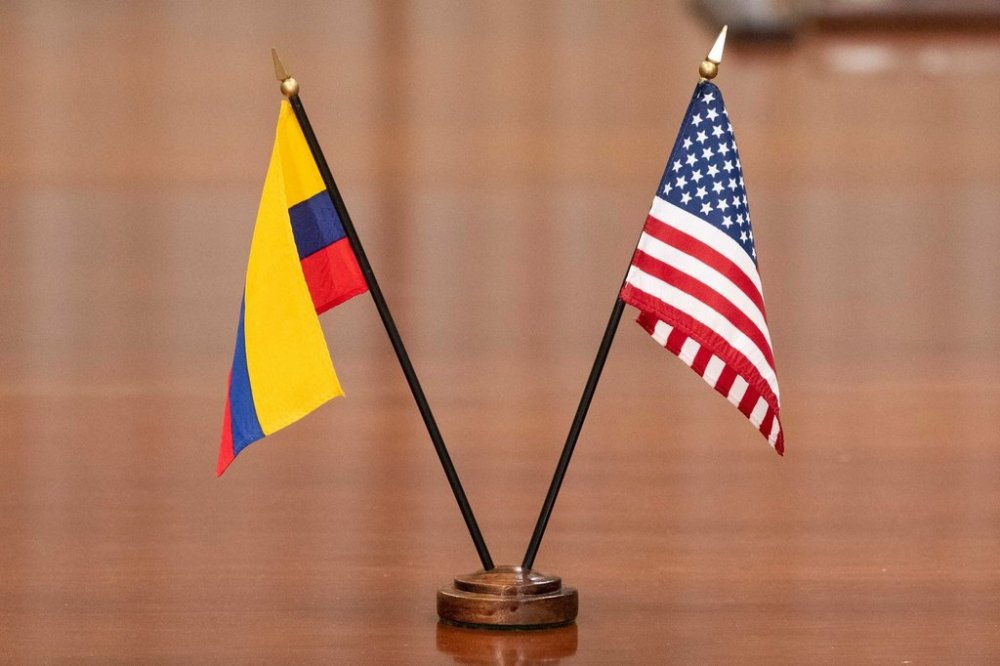
U.S. State Department spokeswoman Tammy Bruce said in a statement that the administration would also be “pursuing other measures to make clear our deep concern over the current state of our bilateral relationship.” The statement did not elaborate on the reasons for the recall.
Later on Thursday, U.S. Secretary of State Marco Rubio confirmed the move on X, writing that “Our nation is committed to the U.S.-Colombia bilateral relationship and the Colombian people. We will remain engaged on shared priorities, including security and stability.”
Petro has grappled this week with an apparent effort by current or former members of his administration to push him from office.
Colombia’s Attorney General’s Office said Tuesday that it had opened an investigation into a plan allegedly led by Petro’s own former Foreign Affairs Minister Álvaro Leyva. Spanish newspaper El País had published audio recordings over the weekend that appeared to contemplate such a plan.
Leyva had allegedly approached some U.S. lawmakers to rally international pressure on Petro.
On Wednesday, Petro said on X that there had been an attempted coup and he called on the U.S. justice system to investigate.
“The other times that they have wanted to kill me the previous U.S. administration helped me,” he wrote. “From here on, Bolivar’s sword follows its libertarian path, and the energy of the light and vibrant people. And the U.S. government?”
The leaked audio recordings indicated that Leyva had looked for support from Florida Congressmen Mario Díaz-Balart and Carlos Giménez. Both have denied any involvement.
Giménez responded Thursday on X, writing that “Petro cannot continue to threaten America and then think he can get away with it.”
Petro has previously denounced attempts to remove him from office, including by armed Colombian groups and a “soft” coup via institutional processes. In one case, he said the U.S. embassy alerted him so that it did come to pass.
Colombia has long been the United States’ key strategic partner in the region. But Petro’s election as Colombia’s first leftist president has tested that relationship.
Petro has declared the drug war a failure and rewritten Colombia’s antidrug policy, long supported and funded by the United States, for example lowering targets for eradication of coca plants.
This week, Petro also halted the extradition of a former leader of a dissident guerrilla faction that had already been approved by Colombia’s Supreme Court to face U.S. drug trafficking charges. Petro said he was needed to participate in ongoing peace talks.
In January, Petro aggravated U.S. President Donald Trump by refusing to accept two deportation flights aboard U.S. military aircraft. Eventually Colombia sent its own planes to pick them up.
____
AP journalist Matthew Lee in Washington contributed to this report.
____
Follow AP’s coverage of Latin America and the Caribbean at https://apnews.com/hub/latin-america