In the Sahara, a friendly dance competition carries on an ancient festival tradition
Advertisement
Read this article for free:
or
Already have an account? Log in here »
To continue reading, please subscribe:

Digital Subscription
One year of digital access for only $205*
- Enjoy unlimited reading on winnipegfreepress.com
- Read the E-Edition, our digital replica newspaper
- Access News Break, our award-winning app
- Play interactive puzzles
*First annual payment billed as $205.00 + GST for one year. This annual subscription will automatically renew at $233.00 + GST every 52 weeks (10% off the regular annual price of $259.35). Offer available to new and qualified returning subscribers only. Cancel any time.
To continue reading, please subscribe:
Add Free Press access to your Brandon Sun subscription for only an additional
$1 for the first 4 weeks*
- Enjoy unlimited reading on winnipegfreepress.com
- Read the E-Edition, our digital replica newspaper
- Access News Break, our award-winning app
- Play interactive puzzles
*Your next Brandon Sun subscription payment will increase by $1.00 and you will be charged $17.95 plus GST for four weeks. After four weeks, your payment will increase to $24.95 plus GST every four weeks.
Read unlimited articles for free today:
or
Already have an account? Log in here »
Hey there, time traveller!
This article was published 11/07/2025 (462 days ago), so information in it may no longer be current.
DJANET, Algeria (AP) — In one hand, the dancers hold swords symbolizing battle. In the other, a piece of cloth symbolizing peace. They dance a shuffling “step-step” to the beat of drums and chanting from the women encircling them, all adorned in their finest traditional garments and jewelry.
They’re performing the rituals of the 3,000-year-old annual Sebeiba festival of Djanet, a southeastern Algerian oasis town deep in the Sahara, just over 200 kilometers (about 125 miles) from the Libyan border.
Sebeiba is a core tradition of the Tuareg people, native to the Sahara and parts of West Africa. The Tuareg are Muslim, and their native language is Tamasheq, though many speak some combination of French, Modern Standard Arabic, Algerian Arabic (Darija) and English.
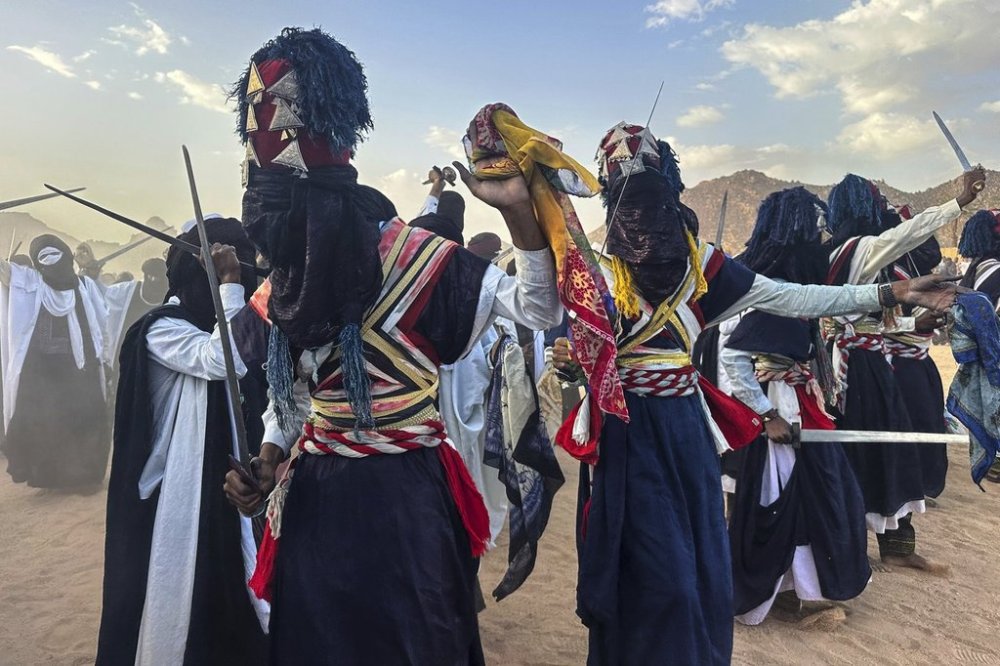
The festival lasts 10 days, and ends with a daylong dance competition between two neighborhoods in Djanet — Zelouaz, or Tsagit, and El Mihan, or Taghorfit. The winner is decided by judges from a third neighborhood, Adjahil, by selecting the group with the most beautiful costumes, dances, jewelry, poetry and songs.
Significance of the festival
The Tuaregs in Djanet say there are two legends explaining the significance of Sebeiba, though oral traditions vary. The first says the festival was put on to celebrate peace and joy after Moses defeated the Pharaoh in the Exodus story.
“In commemoration of this great historical event, when God saved Moses and his people from the tyranny of the oppressive Pharaoh, the people of Djanet came out and celebrated through dance,” said Ahmed Benhaoued, a Tuareg guide at his family’s tourism agency, Admer Voyages. He has lived in Djanet all his life.
The second legend says the festival commemorates the resolution of a historic rivalry between Zelouaz and El Mihan.
“The festival is a proud tradition of the Tuareg in Djanet,” Benhaoued said. “Some call it ‘the Sebeiba celebration,’ or ‘the war dance without bloodshed’ or ‘the dance of peace.’”
Today, Sebeiba is also a point of cultural pride. Recognized by UNESCO since 2014 as an Intangible Cultural Heritage of Humanity, Sebeiba coincides with Ashoura, a day marking the 10th day of Muharram, or the first month of the Islamic year. Some in Djanet fast for up to three days before Sebeiba.
This year, Ashoura and Sebeiba fell on July 6, when temperatures in Djanet reached about 38 C (100 F). Still, more than 1,000 people gathered to watch Sebeiba at a sandy square marking the center point between the two neighborhoods, where the festival is held each year.
Each group starts at one end of the square — Zelouaz to the north and El Mihan to the south.
The dancers are young men from the neighborhoods dressed in dark robes accented by bright yellow, red and blue accessories and tall, maroon hats called Tkoumbout adorned with silver jewelry.
The men’s dances and women’s chants have been passed down through generations. Children participate in the festivities by mimicking the older performers. Boys brandish miniature swords and scarves in their small hands and girls stand with the female drummers.
A friendly dance competition
This year, El Mihan won the dance competition. But Cheikh Hassani, director of Indigenous Institutional Dance of Sebeiba, emphasized that despite the naming of a winner, the festival remains a friendly celebration — meant above all to honor their ancestors in a spirit of unity.
“Sebeiba is not just a dance,” Hassani said. “People used to think you just come, you dance — no, it represents so much more. For the people of Djanet, it’s a sort of sacred day.”
While the most widely known part of Sebeiba is the dance competition on the last day, the nine days leading up to it are also full of celebration. Tuareg from Libya and from other cities in the Algerian Sahara come to gatherings each night, when the temperature has cooled, to watch the performers rehearse.
Hassani said the generational inheritance of the festival’s customs helps them keep the spirits of their ancestors alive.
“We can’t let it go,” he said. “This is our heritage, and today it’s become a heritage of all humanity, an international heritage.”
According to legend, Benhaoued said, there will be winds and storms if Sebeiba is not held.
“It is said that this actually happened once when the festival was not held, so a woman went out into the streets with her drum, beating it until the storm calmed down,” the Tuareg guide added.
About 50 foreign tourists joined the people of Djanet for the final dance competition, hailing mostly from European countries such as France, Poland and Germany. Several also came from the neighboring countries of Libya and Niger.
Djanet is one of many Algerian cities experiencing an increase in tourism over the past two years thanks to government efforts to boost the number of foreign visitors, especially to scenic sites like the Sahara which makes up 83% of the North African country’s surface area.
The government introduced a new visa-on-arrival program in January 2023 for all nonexempt foreign tourists traveling to the Sahara. Additionally, the national airline, Air Algerie, launched a flight between Paris and Djanet in December 2024 during the winter season, when tourists from across the world travel to Djanet for camping excursions deep into the Sahara.
“The Sebeiba isn’t just something for the people of Djanet,” Hassani said. “We have the honor of preserving this heritage of humanity. That’s an honor for us.”
___
Associated Press religion coverage receives support through the AP’s collaboration with The Conversation US, with funding from Lilly Endowment Inc. The AP is solely responsible for this content.
The Free Press acknowledges the financial support it receives from members of the city’s faith community, which makes our coverage of religion possible.