They shoot, they score
Women’s hockey tale’s charms emerge despite challenges

Advertisement
Read this article for free:
or
Already have an account? Log in here »
To continue reading, please subscribe:

Digital Subscription
One year of digital access for only $205*
- Enjoy unlimited reading on winnipegfreepress.com
- Read the E-Edition, our digital replica newspaper
- Access News Break, our award-winning app
- Play interactive puzzles
*First annual payment billed as $205.00 + GST for one year. This annual subscription will automatically renew at $233.00 + GST every 52 weeks (10% off the regular annual price of $259.35). Offer available to new and qualified returning subscribers only. Cancel any time.
To continue reading, please subscribe:
Add Free Press access to your Brandon Sun subscription for only an additional
$1 for the first 4 weeks*
- Enjoy unlimited reading on winnipegfreepress.com
- Read the E-Edition, our digital replica newspaper
- Access News Break, our award-winning app
- Play interactive puzzles
*Your next Brandon Sun subscription payment will increase by $1.00 and you will be charged $17.95 plus GST for four weeks. After four weeks, your payment will increase to $24.95 plus GST every four weeks.
Read unlimited articles for free today:
or
Already have an account? Log in here »
Before the stars come out to shine in Tracey Power’s national power play Glory, all that there is to see is an old barn, its wooden foundation exposed, with a sun-dappled expanse beneath it waiting to be transformed from earth to frozen playground.
Through the sustained spray of a run-of-the-mill garden hose there soon emerges the pastoral promise of a fresh sheet of ice — placid, even, equal — and the not-so-far-fetched fantasy of a level playing field.
Edel Esguerra / Supplied A hockey card set featuring athletes depicted in Glory. From left: Katie Welham, Cora Matheson, Jada Rifkin and Emily Meadows as Helen Schmuck, Hilda Ranscombe, Marm Schmuck and Nellie Ranscombe respectively.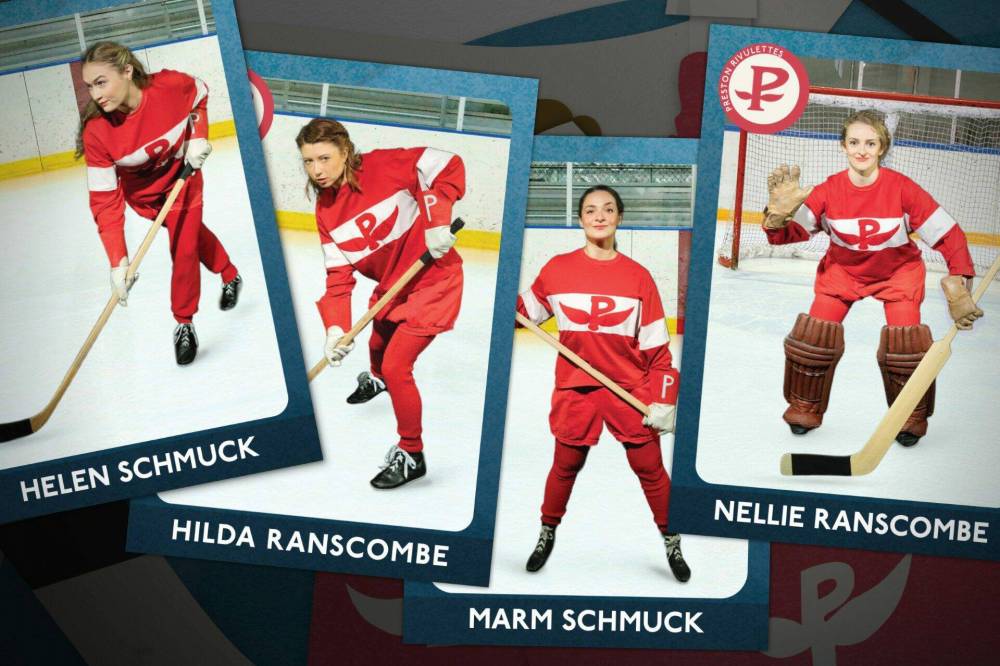
The game clock ticks back to 1932, when two sets of sisters dare to draft themselves into hockey history by forming the Preston Rivulettes. With the rise of fascism on the airwaves, and with the Canadian dollar still slumping in the aftermath of the stock market crash, the Ranscombe and Schmuck sisters (Cora Matheson, Emily Meadows, Katie Welham and Jada Rifkin) set out to prove their worth and earn their keep in small-town Ontario.
It’s no straightforward task: the men always get first dibs at ice availability, and at every stop along their barnstorming journey, commentators are quick to diminish their skills through sexist description.
“It is astonishing how dextrous these lipsticked puck-tossers have become,” booms the announcer at Maple Leaf Gardens.
Theatre review
Glory
Prairie Theatre Exchange
To Oct. 25
Three stars out of five
With the national unemployment rate teetering around 20 per cent, the women are concerned with winning bread before they start winning games in record numbers.
Nellie Ranscombe’s (Meadows, priceless as the club’s superstitious backstop) wages at the town shoe factory have been cut. Helen Schmuck (Welham, a joy) bristles at the expectations of modern femininity outlined in Chatelaine. Her sister Marm (a fiery Rifkin) aspires to university, but antisemitic quota systems quell her dreams.
Through Hilda Ranscombe’s (Power’s least dimensioned central character, played with pluck by Matheson) on-ice expertise, honed along the frozen Grand River, the Rivulettes begin to dream beyond their reality.
Dylan Hewlett / Supplied Glory cast members with hockey cards of their onstage roles: From left, Katie Welham, Emily Meadows, Jada Rifkin and Cora Matheson.
Every team needs a coach, and in Preston, the man for the job is Herb Fach (who else but Cory Wojcik?) a rough and tumble, Morris Buttermaker-type wrapped in a curling sweater.
Though he warms to the concept of girls playing what he perceives to be a man’s game, Fach serves as a check on the unfettered optimism of Hilda, who aims to fire wrist shots past Tiny Thompson, Clint Benedict and Roy (Shrimp) Worters as the first woman in the NHL.
“Do you really think the people of Preston are going to dig into their pockets to watch you play?” he asks.
While Glory — which runs at two hours and 20 minutes — is certainly worth the price of admission, the script presents challenges to director Mariam Bernstein, choreographer Victoria Exconde and composer Joseph Aragon owing to its multi-game structure.
All sports stories, whether depicted in film or on stage, must confront the challenge of differentiating between contests, and in Glory, when the four players and their coach are the only onstage characters, the game action approaches numbness through repetition.
The Rivulettes are put through their paces by swinging, often balletic choreography, stick-handling through matches in Port Dover, Toronto and Montreal against teams such as the Sailorettes, the Ladies and the Winnipeg Eatons; each game’s location and opponent is specified through on-ice projections.
As they push and glide across the playing surface, the players’ manoeuvring becomes more adept, their dominance revealing itself.
Of course, the audience can’t expect verisimilitude, but as the Rivulettes go from matchup to matchup, the production would do well to better moderate emotion through its arena soundtrack. Aragon’s brassy score, however bouyant and era-appropriate, begins to feel restrictive by the fourth game, and one wishes the skilled musician was given more licence to mirror the variety of in-game pathos and intrasquad drama.
Dylan Hewlett / Supplied Marm Schmuck (Jada Rifkin) celebrates in Glory.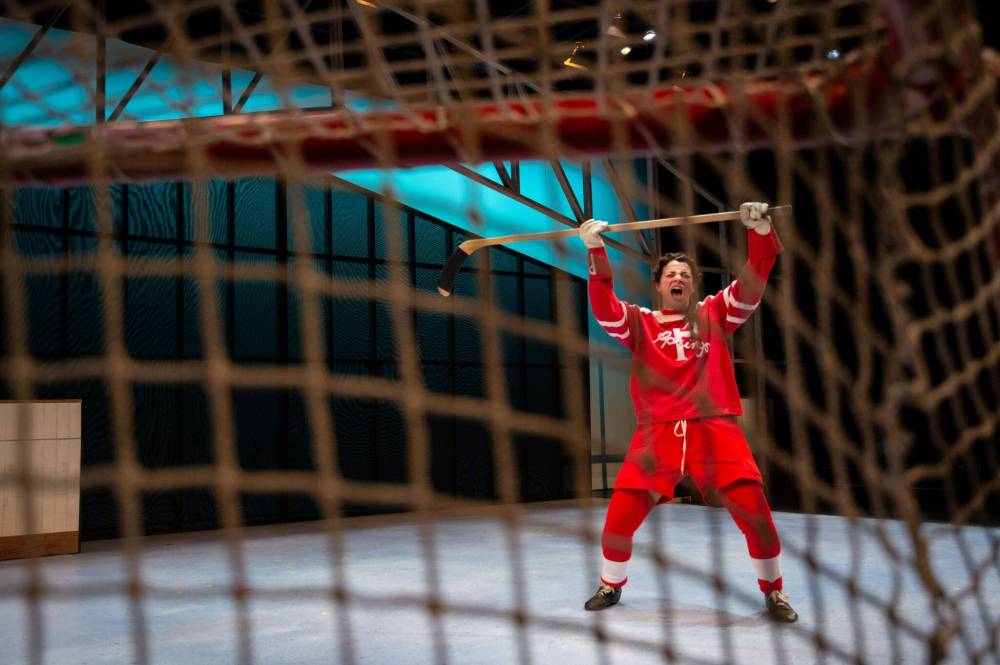
“How long do we play for?” an out of breath Helen asks midway through their first game against the Grimsby Peaches.
“Don’t say that out loud,” admonishes her sister Marm.
Played for a laugh, the question is the central one in Glory, a production whose primary concern relates to a window of opportunity that threatens for these players to swing closed almost as soon as their outstanding efforts crack it ajar.
It’s a relatable and challenging feeling for any person who has played a sport, or who feels “real-world” responsibilities — or arthritis — encroaching on their capacity to dream big, skate fast and jump high. But in the context of Glory, and the unique time signature of women’s professional lives, the question of “how long” is especially potent.
How long until society at large begins to see my value? How long until we get to compete at the highest level? How long until a new season begins on the frozen river?
ben.waldman@freepress.com
If you value coverage of Manitoba’s arts scene, help us do more.
Your contribution of $10, $25 or more will allow the Free Press to deepen our reporting on theatre, dance, music and galleries while also ensuring the broadest possible audience can access our arts journalism.
BECOME AN ARTS JOURNALISM SUPPORTER
Click here to learn more about the project.
Ben Waldman is a National Newspaper Award-nominated reporter on the Arts & Life desk at the Free Press. Born and raised in Winnipeg, Ben completed three internships with the Free Press while earning his degree at Ryerson University’s (now Toronto Metropolitan University’s) School of Journalism before joining the newsroom full-time in 2019. Read more about Ben.
Every piece of reporting Ben produces is reviewed by an editing team before it is posted online or published in print — part of the Free Press‘s tradition, since 1872, of producing reliable independent journalism. Read more about Free Press’s history and mandate, and learn how our newsroom operates.
Our newsroom depends on a growing audience of readers to power our journalism. If you are not a paid reader, please consider becoming a subscriber.
Our newsroom depends on its audience of readers to power our journalism. Thank you for your support.
If you value coverage of Manitoba’s arts scene, help us do more.
Your contribution of $10, $25 or more will allow the Free Press to deepen our reporting on theatre, dance, music and galleries while also ensuring the broadest possible audience can access our arts journalism.
BECOME AN ARTS JOURNALISM SUPPORTER
Click here to learn more about the project.
Ben Waldman is a National Newspaper Award-nominated reporter on the Arts & Life desk at the Free Press. Born and raised in Winnipeg, Ben completed three internships with the Free Press while earning his degree at Ryerson University’s (now Toronto Metropolitan University’s) School of Journalism before joining the newsroom full-time in 2019. Read more about Ben.
Every piece of reporting Ben produces is reviewed by an editing team before it is posted online or published in print — part of the Free Press‘s tradition, since 1872, of producing reliable independent journalism. Read more about Free Press’s history and mandate, and learn how our newsroom operates.
Our newsroom depends on a growing audience of readers to power our journalism. If you are not a paid reader, please consider becoming a subscriber.
Our newsroom depends on its audience of readers to power our journalism. Thank you for your support.
Related Articles
Women’s hockey pioneers face off on PTE stage
Advertisement Advertise With Us
Advertisement Advertise With Us