How a tree-killing beetle chose wrong human to fly into, revealing presence in B.C.

Advertisement

Advertise with us

VANCOUVER - The tiny beetle could scarcely have picked a worse human to fly into.

Read this article for free:


or

Already have an account? Log in here »

To continue reading, please subscribe:

Subscribe and receive a limited-edition Free Press branded hat or tote.

Digital Subscription

One year of digital access for only $205*

  • Enjoy unlimited reading on winnipegfreepress.com
  • Read the E-Edition, our digital replica newspaper
  • Access News Break, our award-winning app
  • Play interactive puzzles

*First annual payment billed as $205.00 + GST for one year. This annual subscription will automatically renew at $233.00 + GST every 52 weeks (10% off the regular annual price of $259.35). Offer available to new and qualified returning subscribers only. Cancel any time.

To continue reading, please subscribe:

Add Free Press access to your Brandon Sun subscription for only an additional

$1 for the first 4 weeks*

  • Enjoy unlimited reading on winnipegfreepress.com
  • Read the E-Edition, our digital replica newspaper
  • Access News Break, our award-winning app
  • Play interactive puzzles
Start now

*Your next Brandon Sun subscription payment will increase by $1.00 and you will be charged $17.95 plus GST for four weeks. After four weeks, your payment will increase to $24.95 plus GST every four weeks.

Hey there, time traveller!
This article was published 13/07/2025 (397 days ago), so information in it may no longer be current.

VANCOUVER – The tiny beetle could scarcely have picked a worse human to fly into.

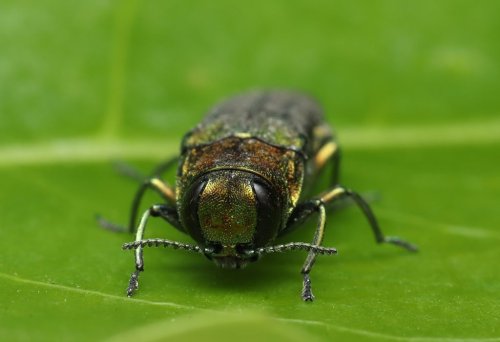
Amateur entomologist Andrew Short was sitting on a bench in downtown Vancouver in June 2023 when the unfamiliar metallic green beetle hit him and fell to the ground.

He said he “needed to know what it was,” so he captured it, took it home to photograph, and later handed it over to authorities — who confirmed the insect to be the first emerald ash borer collected in Canada west of Manitoba.
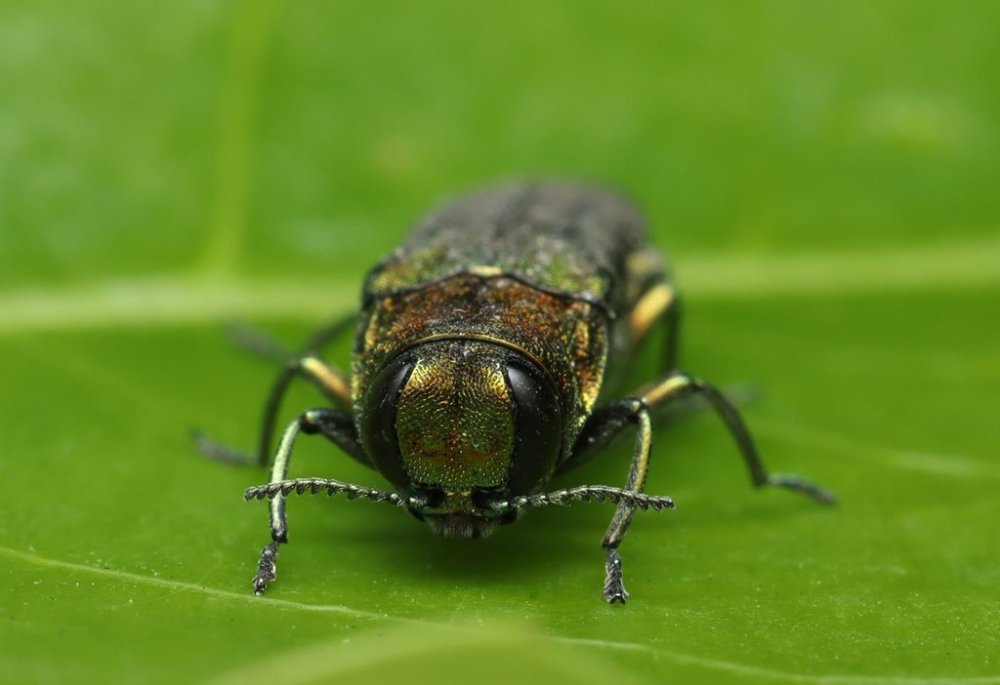
An emerald ash borer that was found by Andrew Short in Vancouver, on June 15, 2023, is seen in a handout photo. The amateur entomologist's discovery revealed the first infestation of the beetle in British Columbia. THE CANADIAN PRESS/Handout — Andrew Short (Mandatory Credit)

Short’s fortuitous encounter set in motion a chain reaction of research aimed at understanding and clamping down on the pest that has devastated ash forests across North America, killing millions of trees in Canada and the United States.

“I just happened to be in the right place at the right time. So, if that’s what some people consider fate, then I guess it was,” he said in an interview.

Short makes a hobby of searching for insects and plants, examining how they interact and photographing them.

“I’m quite versed in invasive species and what they can do, but I certainly hadn’t considered for a moment that I’d ever have a run-in with an emerald ash borer,” he said.

“It’s kind of a strange feeling to realize that you’ve found something that’s that important.”

A study published this spring in the peer-reviewed journal BioInvasions Records describes Short’s role in the beetle’s discovery in Vancouver, and subsequent findings that included “heavily infested” trees in Andy Livingstone Park, about 300 metres from the site of his encounter near BC Place stadium.

The study suggests emerald ash borers, which are native to East Asia, were likely first present in the downtown Vancouver park “no later than 2020.”

Lead author Chris MacQuarrie, a forest entomologist with Natural Resources Canada, said Short was “the best person” for the beetle to have run into — if not from the beetle’s perspective.

“There are lots of green beetles and people think they’ve found it and they turn it in and we’re really happy when it’s not (an emerald ash borer). But this time, it was.”

MacQuarrie said it’s “really rare” to find an adult emerald ash borer, which measures up to about 1.4 centimetres.

He said the discovery in Vancouver represents a “big jump” from pre-existing infestations in Canada and the United States.

MacQuarrie said Short had the “presence of mind” to capture the beetle, which he tucked into a makeshift container using material in his backpack, then took it home to photograph before enlisting the help of another hobbyist entomologist to identify it.

All they could conclude, Short said, was that it “was something that shouldn’t have been here.”

Short submitted a suspected invasive species report along with photographs of the beetle to the Canadian Food Inspection Agency.

He eventually met with someone from the agency and handed over the bug, which he had frozen.

After the agency confirmed Short’s beetle was an ash borer, MacQuarrie said he and other researchers met in Vancouver last year to investigate.

They set traps and took samples from trees near the bench. While the traps did not capture any adult ash borers, branch samples yielded 19 larvae.

MacQuarrie said the closest infestation in Canada is in Winnipeg, though there is another population in Oregon.

The researchers could not determine how the beetle was introduced to Vancouver, although the pest is commonly dispersed via infested wood. An infested tree found in nearby Burnaby last year suggests the beetles in Vancouver could be an “extension” of an older infestation that went undetected, the study says.

The beetles often go undetected for years in new places, with sick or dead trees usually the first sign of infestation.

The findings in Vancouver suggest there may be other undetected populations in western North America, the study says.

Short’s discovery has given researchers the opportunity to study the beetle’s behaviour in Vancouver. It grows faster in warmer conditions, and researchers “don’t really know” how fast it may kill trees in Vancouver’s maritime climate, MacQuarrie said.

Early detection allows for mitigation measures such as insecticides, removing infected trees, diversifying the tree canopy and educating the public, he said.

The Vancouver finding has sparked interest elsewhere, MacQuarrie added, with a British forestry researcher starting work with Canadian counterparts to examine how the beetle is behaving in European ash species in the city.

Short said some people think his bug-catching hobby is “weird.”

But it’s calming, he said, slowing down and focusing on what is right in front of you.

“You don’t have to look far to find really cool things.”

This report by The Canadian Press was first published July 13, 2025.
Report Error Submit a Tip

More Stories

How a tree-killing beetle chose wrong human to fly into, revealing presence in B.C.

Brenna Owen, The Canadian Press 5 minute read Preview

How a tree-killing beetle chose wrong human to fly into, revealing presence in B.C.

Brenna Owen, The Canadian Press 5 minute read Sunday, Jul. 13, 2025

VANCOUVER - The tiny beetle could scarcely have picked a worse human to fly into.

Amateur entomologist Andrew Short was sitting on a bench in downtown Vancouver in June 2023 when the unfamiliar metallic green beetle hit him and fell to the ground.

He said he "needed to know what it was," so he captured it, took it home to photograph, and later handed it over to authorities — who confirmed the insect to be the first emerald ash borer collected in Canada west of Manitoba.

Short's fortuitous encounter set in motion a chain reaction of research aimed at understanding and clamping down on the pest that has devastated ash forests across North America, killing millions of trees in Canada and the United States.

Read
Sunday, Jul. 13, 2025

WRHA directs care homes to accommodate surge of hospital patients

Malak Abas 3 minute read Preview

WRHA directs care homes to accommodate surge of hospital patients

Malak Abas 3 minute read 12:18 PM CDT

The Winnipeg Regional Health Authority has directed three long-term care centres to make space for hospital patients, citing “exceptionally high demand for care across the health-care system.”

“Riverview Health Centre, Deer Lodge Centre and Misericordia Health Centre have been asked to identify additional temporary capacity for patients who no longer require an acute-care hospital bed but continue to need an appropriate level of care before they can transition to their next care setting,” a WRHA spokesperson told the Free Press Thursday.

“This whole-of-system response will help create additional capacity in acute-care hospitals, supporting patient flow and timely access to emergency departments and other hospital services.”

The spokesperson described the measures as part of “standard surge protocol,” atypical and temporary, but did not provide a timeline of how long patients would be staying at the health-care centres.

Read
12:18 PM CDT

Wyatt vows to ‘absolutely’ continue serving as city councillor despite latest sex-crime charges

Joyanne Pursaga 5 minute read Preview

Wyatt vows to ‘absolutely’ continue serving as city councillor despite latest sex-crime charges

Joyanne Pursaga 5 minute read Updated: Yesterday at 5:35 PM CDT

Transcona Coun. Russ Wyatt vowed Thursday to continue doing his job after more criminal charges were laid against him this week, while the mayor called for “better tools” to address elected officials who face serious allegations.

Wyatt, 56, was charged Monday with sexual assault and administering a noxious substance in an October 2023 incident. He was previously charged with sexual assault and administering a noxious substance in March, based on allegations tied to a 2025 gathering.

On Thursday, Wyatt arrived at city hall and quickly walked to his office at 10:20 a.m., nearly an hour after the East Kildonan-Transcona community committee meeting he planned to attend was scheduled to begin.

He answered few questions from reporters.

Read
Updated: Yesterday at 5:35 PM CDT

Mourinho’s return to Real Madrid a classic rebound

Jerrad Peters 6 minute read Preview

Mourinho’s return to Real Madrid a classic rebound

Jerrad Peters 6 minute read 1:37 PM CDT

Not quite a month ago, nearly two million people lined the streets of Madrid to see the World Cup paraded by the Spanish national team. It might as well have been another lifetime.

By the time the Plaza de Cibeles was swept up and sprayed down, the country’s attention had shifted to the only thing — or person — it seemed anyone wanted to be talking about: José Mourinho.

And they haven’t stopped talking about him. He hasn’t let them.

On June 11, the same day the World Cup kicked off in Mexico City, Mourinho was appointed head coach of Real Madrid for a second time. In his initial stint at the sport’s biggest club, which had ended 13 years prior, he’d won the Copa del Rey his first season, La Liga in his second and nothing in his third.

Read
1:37 PM CDT

‘No CUSMA, no booze-ma’: Kinew

Malak Abas 4 minute read Preview

‘No CUSMA, no booze-ma’: Kinew

Malak Abas 4 minute read Wednesday, Aug. 12, 2026

With the next round of tariffs set to hit Canadian goods next week, and a new report suggesting Manitobans could be severely impacted if the Canada-U.S.-Mexico agreement on trade breaks down, Premier Wab Kinew pledged Wednesday to keep working with the U.S. ambassador — and keep American booze off Manitoba shelves, for now.

Read
Wednesday, Aug. 12, 2026

Manitoba’s police watchdog has decided not to authorize charges against a Winnipeg Police Service officer who allegedly bloodied a man’s nose while he was in custody.

The Independent Investigation Unit of Manitoba announced Friday the involved officer would not be charged after a man said he was hit in the head while in his holding cell, because there was no likelihood of conviction.

The man was arrested on Dec. 31 for violating a court order. He was taken to police headquarters, where he was lodged in a holding cell. The IIU’s report says the man urinated on himself, causing his clothing to become wet. He was given a blanket and his wet clothing was removed.

At some point during the night he was awoken by a guard and ordering him to follow for fingerprints. He refused and asked to speak with a supervisor, because he felt embarrassed for not wearing any clothing.