These tips from experts can help your teenager navigate AI companions

Advertisement

Advertise with us

As artificial intelligence technology becomes part of daily life, adolescents are turning to chatbots for advice, guidance and conversation. The appeal is clear: Chatbots are patient, never judgmental, supportive and always available.

Read this article for free:


or

Already have an account? Log in here »

To continue reading, please subscribe:

Subscribe and receive a limited-edition Free Press branded hat or tote.

Digital Subscription

One year of digital access for only $205*

  • Enjoy unlimited reading on winnipegfreepress.com
  • Read the E-Edition, our digital replica newspaper
  • Access News Break, our award-winning app
  • Play interactive puzzles

*First annual payment billed as $205.00 + GST for one year. This annual subscription will automatically renew at $233.00 + GST every 52 weeks (10% off the regular annual price of $259.35). Offer available to new and qualified returning subscribers only. Cancel any time.

To continue reading, please subscribe:

Add Free Press access to your Brandon Sun subscription for only an additional

$1 for the first 4 weeks*

  • Enjoy unlimited reading on winnipegfreepress.com
  • Read the E-Edition, our digital replica newspaper
  • Access News Break, our award-winning app
  • Play interactive puzzles
Start now

*Your next Brandon Sun subscription payment will increase by $1.00 and you will be charged $17.95 plus GST for four weeks. After four weeks, your payment will increase to $24.95 plus GST every four weeks.

Hey there, time traveller!
This article was published 22/07/2025 (433 days ago), so information in it may no longer be current.

As artificial intelligence technology becomes part of daily life, adolescents are turning to chatbots for advice, guidance and conversation. The appeal is clear: Chatbots are patient, never judgmental, supportive and always available.

That worries experts who say the booming AI industry is largely unregulated and that many parents have no idea about how their kids are using AI tools or the extent of personal information they are sharing with chatbots.

New research shows more than 70% of American teenagers have used AI companions and more than half converse with them regularly. The study by Common Sense Media focused on “AI companions,” like Character. AI, Nomi and Replika, which it defines as “digital friends or characters you can text or talk with whenever you want,” versus AI assistants or tools like ChatGPT, though it notes they can be used the same way.
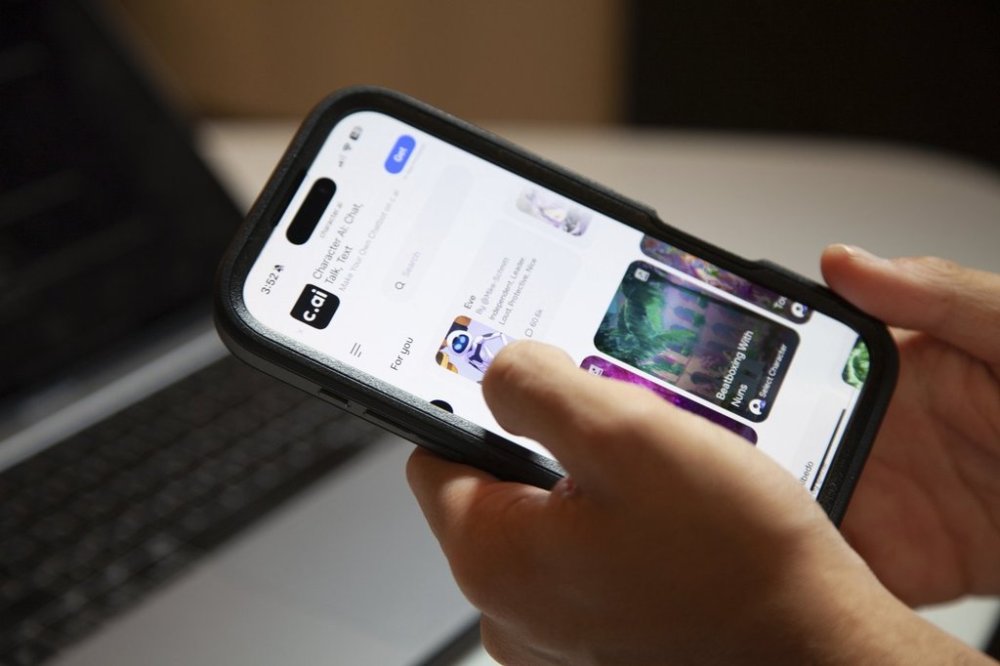
Bruce Perry, 17, demonstrates Character AI, an artificial intelligence chatbot software that allows users to chat with popular characters such as EVE from Disney's 2008 animated film, WALL-E, Tuesday, July 15, 2025, in Russellville, Ark. (AP Photo/Katie Adkins)

It’s important that parents understand the technology. Experts suggest some things parents can do to help protect their kids:

— Start a conversation, without judgment, says Michael Robb, head researcher at Common Sense Media. Approach your teen with curiosity and basic questions: “Have you heard of AI companions?” “Do you use apps that talk to you like a friend?” Listen and understand what appeals to your teen before being dismissive or saying you’re worried about it.

— Help teens recognize that AI companions are programmed to be agreeable and validating. Explain that’s not how real relationships work and that real friends with their own points of view can help navigate difficult situations in ways that AI companions cannot.

“One of the things that’s really concerning is not only what’s happening on screen but how much time it’s taking kids away from relationships in real life,” says Mitch Prinstein, chief of psychology at the American Psychological Association. “We need to teach kids that this is a form of entertainment. It’s not real, and it’s really important they distinguish it from reality and should not have it replace relationships in your actual life.”

The APA recently put out a health advisory on AI and adolescent well-being, and tips for parents.

— Parents should watch for signs of unhealthy attachments.

“If your teen is preferring AI interactions over real relationships or spending hours talking to AI companions, or showing that they are becoming emotionally distressed when separated from them — those are patterns that suggest AI companions might be replacing rather than complementing human connection,” Robb says.

— Parents can set rules about AI use, just like they do for screen time and social media. Have discussions about when and how AI tools can and cannot be used. Many AI companions are designed for adult use and can mimic romantic, intimate and role-playing scenarios.

While AI companions may feel supportive, children should understand the tools are not equipped to handle a real crisis or provide genuine mental health support. If kids are struggling with depression, anxiety, loneliness, an eating disorder or other mental health challenges, they need human support — whether it is family, friends or a mental health professional.

— Get informed. The more parents know about AI, the better. “I don’t think people quite get what AI can do, how many teens are using it and why it’s starting to get a little scary,” says Prinstein, one of many experts calling for regulations to ensure safety guardrails for children. “A lot of us throw our hands up and say, ‘I don’t know what this is!’ This sounds crazy!’ Unfortunately, that tells kids if you have a problem with this, don’t come to me because I am going to diminish it and belittle it.”

Older teenagers have advice, too, for parents and kids. Banning AI tools is not a solution because the technology is becoming ubiquitous, says Ganesh Nair, 18.

“Trying not to use AI is like trying to not use social media today. It is too ingrained in everything we do,” says Nair, who is trying to step back from using AI companions after seeing them affect real-life friendships in his high school. “The best way you can try to regulate it is to embrace being challenged.”

“Anything that is difficult, AI can make easy. But that is a problem,” says Nair. “Actively seek out challenges, whether academic or personal. If you fall for the idea that easier is better, then you are the most vulnerable to being absorbed into this newly artificial world.”

___

The Associated Press’ education coverage receives financial support from multiple private foundations. AP is solely responsible for all content. Find AP’s standards for working with philanthropies, a list of supporters and funded coverage areas at AP.org.


Report Error Submit a Tip

More Stories

Charges laid after St. Boniface hospital assault

1 minute read Yesterday at 12:40 PM CDT

A man has been charged after a serious assault at St. Boniface Hospital on Saturday.

Just after 1 a.m. Sept. 26, two men were having an argument that escalated to a physical fight in which the victim sustained serious upper-body injuries, the Winnipeg Police Service stated in a news release Sunday.

When police arrived, a 36-year-old man was being detained by security personnel. The incident didn't involve hospital staff and no one else was hurt, the release stated.

James Anthony Junior Clark, 36, was arrested and charged with assault causing bodily harm and two counts of violating a probation order.

Uncaring hubby fell flat at first hurdle

Maureen Scurfield 4 minute read 2:00 AM CDT

DEAR MISS LONELYHEARTS: I re-rented my favourite summer cabin this fall because I’m trying to finish my thesis. My husband of just over a year was very annoyed with me for going on my own, but didn’t say much about it because I paid.

I thought we were both OK with this arrangement, until I got the flu up at the lake very badly and couldn’t keep anything down. I felt faint. I phoned him and he said he was at a party with the guys. I could hear music and girls laughing.

He wouldn’t come for me, so at 4 a.m. when I was getting even more sick and scared, I drove back to the city unannounced.

I went straight to my parents’ house and pretty much fell through the door. Mom said to me when she grabbed me: “This is not right. You could have died in the ditch. Where is your husband?”

Is another goalie on Jets’ wish list?

Ken Wiebe 7 minute read Preview

Is another goalie on Jets’ wish list?

Ken Wiebe 7 minute read Yesterday at 6:59 PM CDT

Kevin Cheveldayoff and company are down to the short strokes.

With the opening-day roster due on Monday afternoon, the Winnipeg Jets took steps on the weekend to get down to the final number.

As it stood on Sunday, the Jets were down to 24 healthy players in training camp after centre Danny Zhilkin and defenceman Henry Thrun were placed on waivers.

With a maximum of 23 spots available, the only things left to determine are whether the Jets are interested in claiming a more experienced goalie to serve as the backup to Stuart Skinner and if centre Brayden Yager will break camp with the big club.

Read
Yesterday at 6:59 PM CDT

Province invests $3.8M in culinary arts training facility for francophone high school students

Kelly-Anne Riess 3 minute read Preview

Province invests $3.8M in culinary arts training facility for francophone high school students

Kelly-Anne Riess 3 minute read Yesterday at 12:10 PM CDT

A new dedicated culinary arts training facility will give francophone high school students a place to learn the trade in French.

The Manitoba government announced this week that it is providing $3.8 million toward the purchase of a property at 170 Marion St. and beginning design work for its renovation.

The facility will be the first dedicated vocational education site operated by Division scolaire franco-manitobaine, and the first fully French-language culinary arts program for Grade 11 and 12 students, preparing them for work in the restaurant and service sector.

“French-language education is a fundamental part of Manitoba’s identity and strength,” Education Minister Tracy Schmidt said in a news release. “It is an exciting step that will help strengthen both the francophone community and our skilled workforce.”

Read
Yesterday at 12:10 PM CDT

Positive anticipation is growing about major housing developments underway in Winnipeg’s downtown

Gabrielle Piché 10 minute read Preview

Positive anticipation is growing about major housing developments underway in Winnipeg’s downtown

Gabrielle Piché 10 minute read Friday, Sep. 25, 2026

If traffic is light and the wind is down, Somia Sadiq is able to hear the roar of Winnipeg Jets fans twice: first through her window, then on TV.

From her apartment view high above downtown, she can look out at Graham Avenue’s painted pedestrian landscape, see construction cranes and hear the heavy equipment at work as massive housing projects take shape at The Forks, at what used to be Portage Place shopping centre and at the former Hudson’s Bay building.

Sadiq has lived at 300 Main for 2 1/2 years, a few steps from the city’s famous, windy and reopened-to-pedestrians Portage Avenue intersection. At 42 storeys, it’s the tallest building in Winnipeg.

She is among 18,000 downtown residents who will soon be joined by thousands of others attracted to the city’s core by the new wave of major construction projects.

Read
Friday, Sep. 25, 2026

These tips from experts can help your teenager navigate AI companions

Jocelyn Gecker, The Associated Press 5 minute read Preview

These tips from experts can help your teenager navigate AI companions

Jocelyn Gecker, The Associated Press 5 minute read Wednesday, Jul. 23, 2025

As artificial intelligence technology becomes part of daily life, adolescents are turning to chatbots for advice, guidance and conversation. The appeal is clear: Chatbots are patient, never judgmental, supportive and always available.

That worries experts who say the booming AI industry is largely unregulated and that many parents have no idea about how their kids are using AI tools or the extent of personal information they are sharing with chatbots.

New research shows more than 70% of American teenagers have used AI companions and more than half converse with them regularly. The study by Common Sense Media focused on “AI companions,” like Character. AI, Nomi and Replika, which it defines as “digital friends or characters you can text or talk with whenever you want,” versus AI assistants or tools like ChatGPT, though it notes they can be used the same way.

It’s important that parents understand the technology. Experts suggest some things parents can do to help protect their kids:

Read
Wednesday, Jul. 23, 2025