A symbol of friendship, a sense of optimism Despite cross-border tensions, it’s mostly business as usual for International Peace Garden staff, volunteers
Read this article for free:
or
Already have an account? Log in here »
To continue reading, please subscribe:
Monthly Digital Subscription
$0 for the first 4 weeks*
- Enjoy unlimited reading on winnipegfreepress.com
- Read the E-Edition, our digital replica newspaper
- Access News Break, our award-winning app
- Play interactive puzzles
*No charge for 4 weeks then price increases to the regular rate of $19.00 plus GST every four weeks. Offer available to new and qualified returning subscribers only. Cancel any time.
Monthly Digital Subscription
$4.75/week*
- Enjoy unlimited reading on winnipegfreepress.com
- Read the E-Edition, our digital replica newspaper
- Access News Break, our award-winning app
- Play interactive puzzles
*Billed as $19 plus GST every four weeks. Cancel any time.
To continue reading, please subscribe:
Add Free Press access to your Brandon Sun subscription for only an additional
$1 for the first 4 weeks*
*Your next subscription payment will increase by $1.00 and you will be charged $16.99 plus GST for four weeks. After four weeks, your payment will increase to $23.99 plus GST every four weeks.
Read unlimited articles for free today:
or
Already have an account? Log in here »
INTERNATIONAL PEACE GARDEN — From fentanyl and asylum seekers to trade wars and talk of annexation, the Canada–U.S. border is a pressure point in our countries’ squabbles right now.
On Thursday, President Donald Trump’s executive order raising tariffs to 35 per cent on exports that are not compliant with the Canada-U.S.-Mexico trade agreement kicked in, adding to the economic pain Canada has been feeling from its longtime neighbour and ally.
CONRAD SWEATMAN / FREE PRESS On Saturday, U.S. and Canadian residents are invited to the garden to shake hands across the shared border.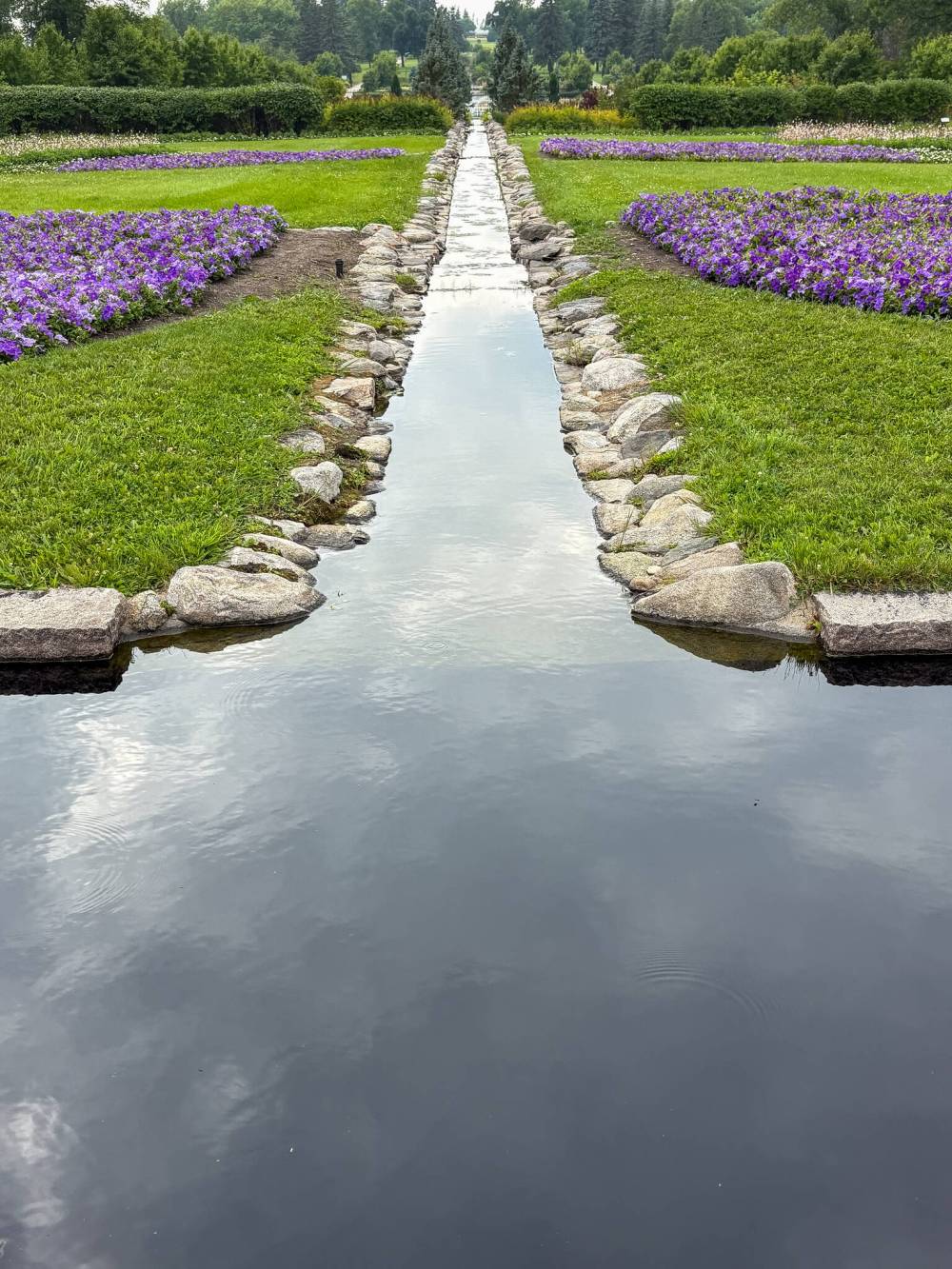
It’s only the latest salvo targeting Canada since Trump declared a national emergency in February at the U.S.-Canada border in response to what his administration alleges is a flood of human and drug smuggling from Canada flowing south.
Yet, for all this tension, the fact remains: the 49th parallel traces the world’s longest undefended border. Customs agents have grown twitchier, but there’s still limited border walls and fences and certainly no turreted watchtowers, standing army presence or demilitarized zone.
Historically, “friendship” has been a watchword for our soft borders.
Its most potent symbol is rooted at the International Peace Garden, nearly 1,000 hectares of stunning landscape at the border just south of Boissevain that attracts 100,000 tourists, music students, nature lovers and conference attendees every year.
The fault line between Canada and the U.S. crosses through the garden, but visitors move back and forth across it without an inspection by a customs agent.
On Saturday, U.S. and Canadian residents are invited to the garden to shake hands across the shared border in what the garden’s CEO Tim Chapman describes as a show of dedication to peace and co-operation between Canada and the U.S, despite the recent friction.
“It’s something we want to do every year,” Chapman told the North Dakota Monitor.
He said he hopes that as many as 1,000 Americans and 1,000 Canadians will participate in the handshake, scheduled for 11 a.m., in a ceremony that includes singing both national anthems.
It’s probably not coincidental that the garden’s origins dovetail with the countries’ strengthening security alliance.
In 1938, on the brink of the Second World War, U.S. president Franklin Roosevelt announced that the U.S. would not stand idly by if the Canada were attacked by a foreign power. Prime Minister Mackenzie King meanwhile pledged that Canada would do everything it could to ensure its soil could never be used to stage an attack on the U.S.
The agreement had a resounding effect on U.S.-Canadian defensive co-operation and is considered a foundation for the North American Aerospace Defense Command. The binational partnership — the Canadian command is headquartered in Winnipeg — has continued to monitor and defend North American airspace since early in the Cold War.
FRED MCGUINNESS COLLECTION/SJ MCKEE ARCHIVES/BRANDON UNIVERSITY The grand opening of the International Peace Garden in 1932.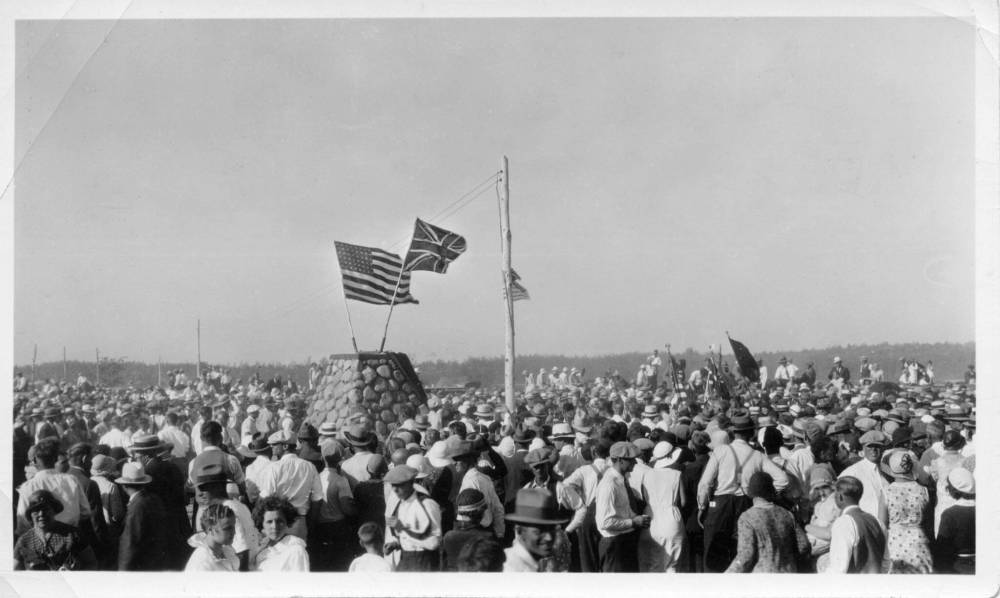
The International Peace Garden, like NORAD, is also descended from an interwar agreement. Only it was gardeners, not statesmen, who led the charge.
“A few of them were just fascinated by the world’s longest unfortified border,” Chapman tells the Free Press. “And (it’s) like… ‘What do we have in common? Oh, we’re one of the few countries in the world with a massive border, and we’re not constantly attacking one another.’”
Spearheaded by horticulturist Henry R. Moore, the idea attracted the support of powerful philanthropic families on both sides of the border and the Manitoba and North Dakota governments.
An estimated 50,000 people travelled to the site to witness the groundbreaking and dedication ceremony on July 14, 1932.
CONRAD SWEATMAN / FREE PRESS The Hands of Peace at the International Peace Garden.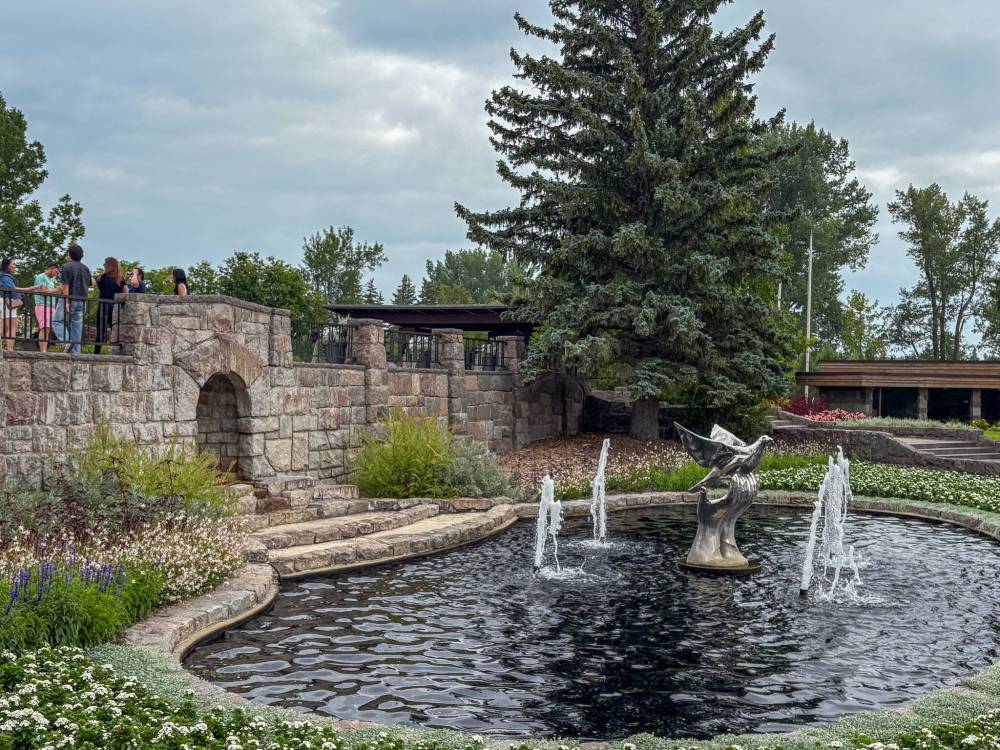
Today, the non-profit’s garden is a site of international conferences, music and cultural camps and meetings between American and Canadian officials amid calming flora and monuments with cosy names such as the Peace Chapel, the Friendship Rock and the Hands of Peace.
“If people can solve differences in more natural settings than your typical G8 setting… your thought process is better. You’re less likely to jump down someone’s throat,” says Chapman.
Those who work at the International Peace Garden — some 120 yearly volunteers and 50 staff members during the summer season — describe a uniquely binational culture there.
Many of them are gardeners, helping to cultivate the 100,000 or so flowers planted each year, often in striking patterns. They work on the GPS-run floral clock with its estimated 3,000 blooms, the Don Vitko Conservatory — home to thousands of rare and beautiful cacti and succulents — and other areas.
Some fly in just for the spring or summer, others live in the neighbouring towns of Boissevain and Dunseith, N.D.; places with similar, and generally conservative, cultures.
TIM SMITH / THE BRANDON SUN FILES The International Peace Garden attracts 100,000 tourists, music students, nature lovers and conference attendees every year.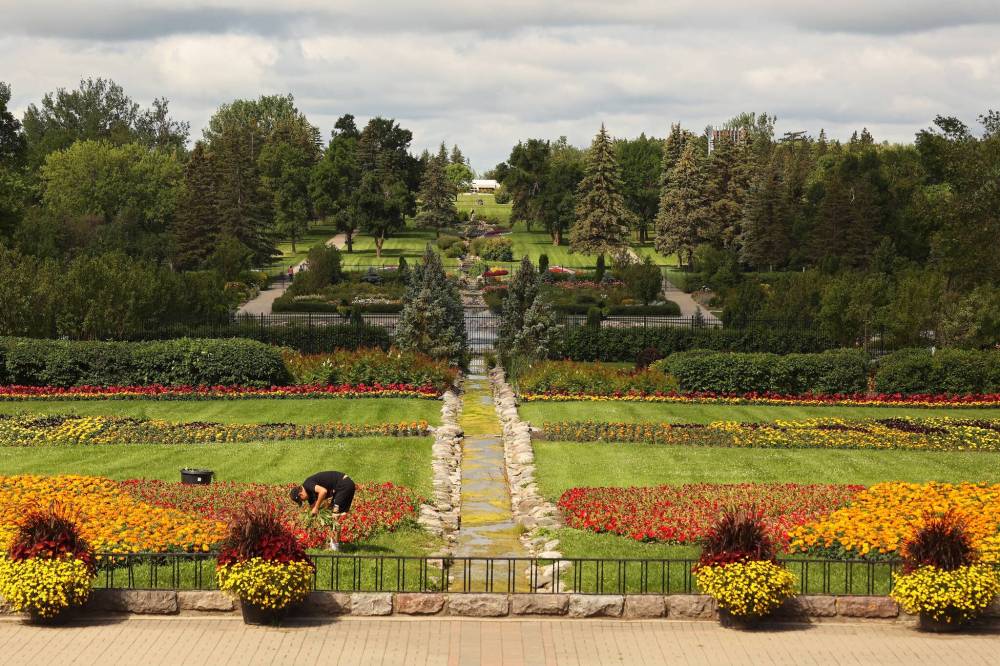
Volunteers and visitors from either side of the border can access the garden without passing through Customs, though they do so on their way back. Some, like Chapman (who’s American), even send their kids to school across the border.
At the southernmost corner is its music camp. At least a dozen flags fly in its centre, representing the nationalities of the students, staff and faculty assembled and the camp’s cosmopolitan spirit.
“It’s the life of the camp,” says Randy Hall, the camp’s director of student activities. “This was my 49th year dealing with the music camp and it couldn’t be a more fitting place (for his daughter’s wedding),” he says, as volunteers finish setting up for the ceremony.
“She’s been here at camp every summer since she’s been born.”
The strain of cross-border unease is nevertheless beginning to show a little for those who tend the garden and its programs. Chapman recalls Canadians calling the office in the spring to say they wouldn’t be visiting the garden in protest against Trump’s trade policies and rhetoric.
“Not that I needed to be right, (but) all I was saying is, ‘The garden will still be here. It’s going to exist and have the same mission,’” he says. “But also, think about the local economics of it.”
He’s referring to the benefits that tourism brings to nearby towns.
The site recently offered Canadians 20 per cent off at its gift shop due to the weaker loonie. Some Americans objected to the gesture and defiantly swiped their cards in the Canadian terminal.
Debra McCollum, IPG’s education volunteer coordinator.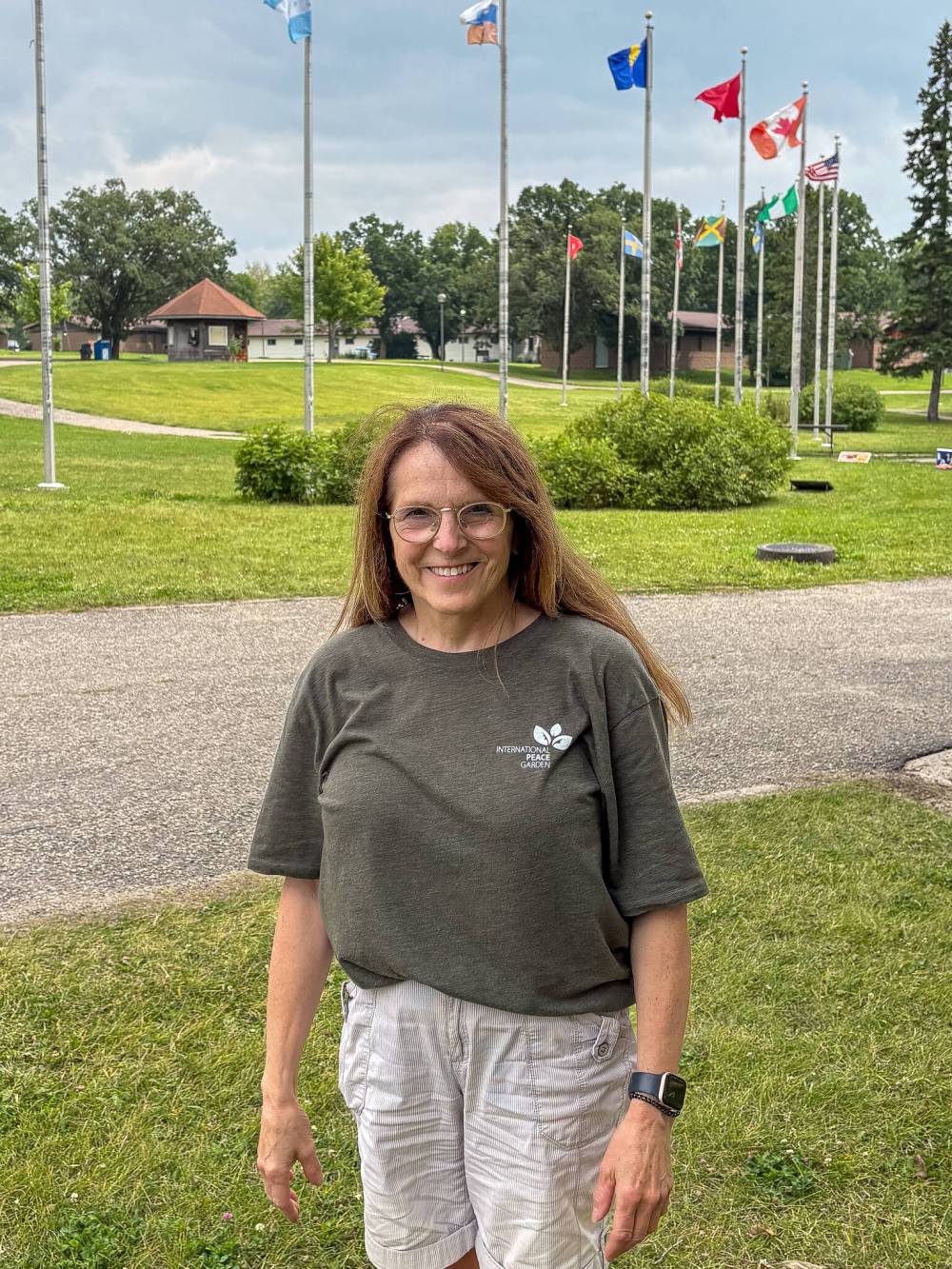
Debra McCollum, IPG’s education volunteer co-ordinator, who lives in southern Manitoba, finds these subtle ripples on everyday relationships troubling.
“It’s my 33rd summer here and it’s a part of who I am. The peace it represents, the peace (it) symbolizes between Canada and the United States — that’s a part of me as a Canadian,” she says.
For a stereotypically polite people, Canadians’ “elbows up” rhetoric seems excessive to her.
“I mean, it’s strong. It’s almost bordering on physical aggression…. That’s just not something that we would even think about here,” she says.
“We’re in this beautiful nature setting, and we love people coming to see us, and people love coming for a lot of the same reasons — so you’re not in that frame of mind.”
A complex web of cross-border institutions bridge the United States and Canada, covering not just trade, border security and continental defence but seemingly everything in between.
Civil servants and representatives have often worked closely with their counterparts across the 49th parallel.
Despite their cordiality and their constituents’ history of close trade, Premier Wab Kinew and North Dakota Governor Kelly Armstrong also remain, inevitably, at cross-purposes.
Liberal economists may insist that steep tariffs violate modern Economics 101, spreading inefficiencies and dragging countries into cycles of self-defeating brinkmanship.
Yet, rational or not, here we are in a “trade war,” with Armstrong strongly endorsing Trump and his tariff policies.
CONRAD SWEATMAN / FREE PRESS Tim Chapman, CEO of the International Peace Garden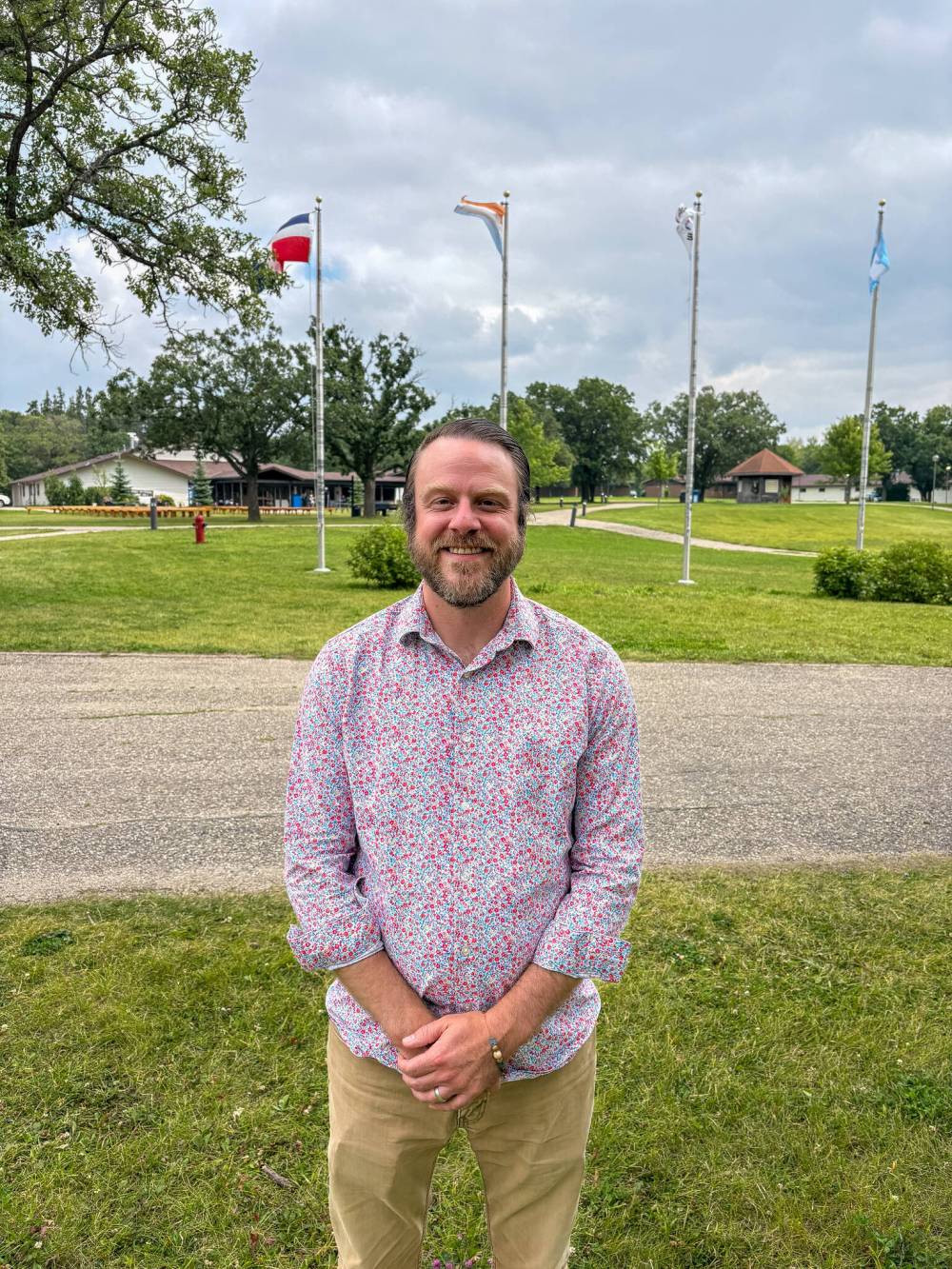
Regarding the garden’s future — funded equally by the North Dakota and Manitoba governments and depending heavily on their co-operation, Chapman is confident the centre will hold.
“That’s one thing that’s always really impressed me here. Even if North Dakota’s government tends to lean right, Manitoba left… it seems like going back decades, the province and the state have really set an awesome example of cherishing the fact that it is a shared space,” he says.
The IPG may seem like a comparatively low-stakes collaboration. But Chapman says its relaxed quality also makes it an ideal setting for many deliberations and negotiations.
“There are good studies out of Japan… about the intersection of peace and nature,” he says. “You get people outside or in more natural settings, in general, human thought process improves.”
Premiers and governors have met on the garden’s grounds, and Chapman says that the International Joint Commission, a bilateral governmental organization addressing the extensive waters and waterways along and across the border, often meets there.
He adds that representatives from North Dakota’s trade office have reached out to the IPG about using it for future meetings with their counterparts in Manitoba.
Though both offices have their hands tied by Ottawa and Washington when it comes to tariffs, he hopes reason — friendship even — will steer co-operation within those tricky limits.
“I think regardless of politics, people who really are involved in cross-border business and understand trade prefer that rhetoric not be where it is right now,” Chapman says. “Especially if you live in a border town or a border state or province, you know the impact.
“We do really depend on each other.”
conrad.sweatman@freepress.mb.ca

Conrad Sweatman is an arts reporter and feature writer. Before joining the Free Press full-time in 2024, he worked in the U.K. and Canadian cultural sectors, freelanced for outlets including The Walrus, VICE and Prairie Fire. Read more about Conrad.
Our newsroom depends on a growing audience of readers to power our journalism. If you are not a paid reader, please consider becoming a subscriber.
Our newsroom depends on its audience of readers to power our journalism. Thank you for your support.
Related Articles
Created to salute Canada-U.S. bond, peace garden now seems a place out of time