Florida’s first black bear hunt in a decade approved despite strong opposition

Advertisement

Advertise with us

ST. PETERSBURG, Fla. (AP) — The first black bear hunt in Florida in a decade will take place in December under a rule adopted Wednesday by state wildlife officials despite strong opposition to the eventual use of dogs and targeting the animals in baited locations.

Read this article for free:


or

Already have an account? Log in here »

To continue reading, please subscribe:

Subscribe and receive a limited-edition Free Press branded hat or tote.

Digital Subscription

One year of digital access for only $205*

  • Enjoy unlimited reading on winnipegfreepress.com
  • Read the E-Edition, our digital replica newspaper
  • Access News Break, our award-winning app
  • Play interactive puzzles

*First annual payment billed as $205.00 + GST for one year. This annual subscription will automatically renew at $233.00 + GST every 52 weeks (10% off the regular annual price of $259.35). Offer available to new and qualified returning subscribers only. Cancel any time.

To continue reading, please subscribe:

Add Free Press access to your Brandon Sun subscription for only an additional

$1 for the first 4 weeks*

  • Enjoy unlimited reading on winnipegfreepress.com
  • Read the E-Edition, our digital replica newspaper
  • Access News Break, our award-winning app
  • Play interactive puzzles
Start now

*Your next Brandon Sun subscription payment will increase by $1.00 and you will be charged $17.95 plus GST for four weeks. After four weeks, your payment will increase to $24.95 plus GST every four weeks.

Hey there, time traveller!
This article was published 13/08/2025 (402 days ago), so information in it may no longer be current.

ST. PETERSBURG, Fla. (AP) — The first black bear hunt in Florida in a decade will take place in December under a rule adopted Wednesday by state wildlife officials despite strong opposition to the eventual use of dogs and targeting the animals in baited locations.

The Florida Fish and Wildlife Conservation Commission voted unanimously in favor of the plan during a meeting that drew 168 people for a public hearing in the Panhandle town of Havana, with both supporters and opponents present. The panel had given preliminary approval in May, citing a need to manage growing bear populations.

“We make decisions based on science,” said commission chair Rodney Barreto.
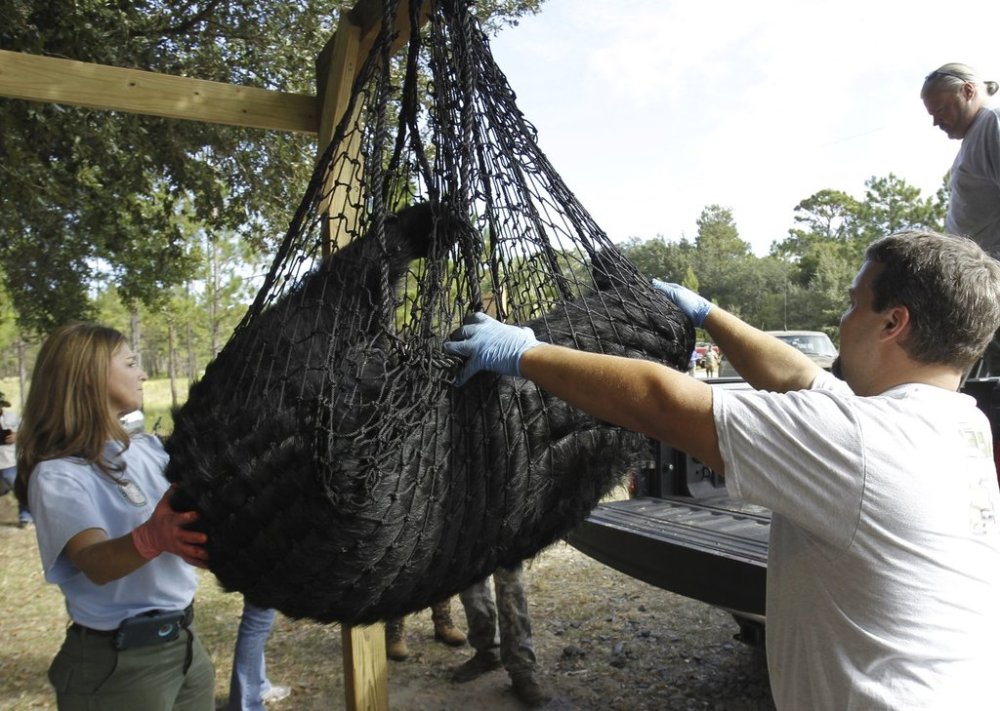
FILE - In this Oct. 24, 2015 photo, a black bear is weighed by FWC Biologists Alyssa Simmons and Mike Orlando at the Rock Springs Run Wildlife Management Area near Lake Mary, Fla. (Luis Santana/Tampa Bay Times via AP, file)

Opponents called the hunt cruel, unnecessary and an excuse for hunters to bag a trophy animal when the real issue is the encroaching human population in bear habitat as Florida continues to grow.

“Not all the hunters support this hunt. We’d like to see nature in balance,” said Lauren Jorgensen, whose family owns a ranch in rural Suwannee County.

There are an estimated 4,000 black bears in Florida, one of the few states with sizable populations that do not have a bear hunting season. Several pro-hunt speakers noted that bears are much more commonly seen in many areas than in the past, causing interactions with humans that provoke fear and concern.

Ottice Amison, a member of the Franklin County Commission, said residents there report bears on porches, rooting through garbage cans, roaming neighborhoods and playgrounds.

“The reality is that the frequency and severity of bear interactions continues to rise,” Amison told the wildlife commission. “Right now, too many of our residents see bears as threats and pests.”

There has been only one documented fatal black bear attack in Florida, the May mauling of 89-year-old Robert Markel and his daughter’s dog in a rural part of Collier County, in southwest Florida.

The plan adopted Wednesday has more stringent rules than the previous Florida hunt in 2015, in which hunting permits were provided to anyone who could pay for them. That led to a chaotic event shut down days early after 300-plus bears were killed, including at least 38 females with cubs, meaning the young bears probably died too.

Hunt opponents predict this year will be more of the same.

“This decision reflects political pressure, not ecological necessity or public will,” said Susannah Randolph, director of the Sierra Club Florida chapter.

Under the new rule, there would be a random drawing of permits with a limit of 187. Hunters could kill only one bear each and only in certain parts of Florida where the bear population is large enough. There would be no killing of cubs and none of females with cubs, according to the FWC staff.

A permit would cost $100 for Florida residents and $300 for nonresidents.

For 2025, the plan is to hold the hunt from Dec. 6 to Dec. 28. In the future, the FWC foresees a bear hunt between Oct. 1 and Dec. 31, subject to more studies about the effect of hunting and the population of the animals. In future years, hunters could use up to six dogs each to pursue bears.

Private landowners with 5,000 acres (2,023 hectares) or more could hold what the FWC calls a “bear harvest program” on their property under the proposal. Bears could be hunted at bait feeding stations on private property. Also, bowhunting will be allowed under rules similar to those for deer.

In addition, Florida allows hunting of alligators from mid-August to November, along with year-round removal of invasive pythons from private land and designated public land managed by the FWC. The state also has an annual python challenge offering prizes and recognition for capturing pythons in the Florida Everglades.

Report Error Submit a Tip

More Stories

Puzzles Palace

1 minute read Monday, Jul. 27, 2026

To solve our puzzles, please subscribe with this special offer: |

United Way, other charities fight for dollars as donor base shrinks

Scott Billeck 7 minute read Preview

United Way, other charities fight for dollars as donor base shrinks

Scott Billeck 7 minute read Yesterday at 2:00 AM CDT

Winnipeg’s charitable sector is being squeezed from both sides: demand for help is growing while the pool of donors to meet that need is shrinking.

The imbalance is increasingly being carried by a relatively small group of deep-pocketed donors. Last year, 600 people — about three per cent of United Way Winnipeg’s individual donors — accounted for roughly $8 million, or 55 per cent of individual donations.

The fundraising pitch isn’t getting any easier.

Homelessness and public drug use have become increasingly visible, household budgets remain strained and the problems charities are trying to address can seem so entrenched that donors may reasonably wonder what difference another contribution can make.

Read
Yesterday at 2:00 AM CDT

Steinbach Credit Union member warns others after scammer steals $10K

Scott Billeck 5 minute read Preview

Steinbach Credit Union member warns others after scammer steals $10K

Scott Billeck 5 minute read Yesterday at 5:19 PM CDT

A Winnipeg single mother whose bank account was drained of nearly $10,000 says Steinbach Credit Union needs to warn its members about what she believes is a broader security problem.

The woman, who is not being named to protect her identity, said a scammer gained access to her account earlier this week after calling SCU’s contact centre, claiming to be her and successfully completing the credit union’s authentication process.

She said she knows of at least six others who have experienced similar incidents in which callers impersonate SCU account holders and pass the authentication checks.

The woman discovered something was wrong when her minor son asked why money had been transferred out of an account they jointly hold.

Read
Yesterday at 5:19 PM CDT

Cabernet Sauvignon star of wine festival

Ben Sigurdson 5 minute read Preview

Cabernet Sauvignon star of wine festival

Ben Sigurdson 5 minute read 3:00 AM CDT

The Winnipeg Wine Festival will celebrate the king of red wine grapes next weekend — the theme of this year’s festival, which takes place Sept. 25 and 26 at the RBC Convention Centre, is Cabernet Sauvignon.

Cab Sauv, as it’s also known, is the world’s most widely planted wine grape of any colour, first coming to prominence in the 1800s in France’s Bordeaux region, where the grape is still popular. Rather than single-variety wines, Bordeaux reds tend to be blends, with those coming from the left bank of the Gironde estuary being Cabernet-dominant, while right-bank wines are Merlot-dominant, with Cabernet Sauvignon playing a supporting role. Cabernet and Merlot work well together and many other countries have followed suit in blending the two.

A team at University of California Davis put Cabernet Sauvignon through a DNA test in 1996 and discovered its parent grapes are Cabernet Franc and Sauvignon Blanc — it’s likely that at some point the two varieties, planted next to each other in some vineyard, crossed and mutated and became the grape we know today. (Someone growing grapes in the 19th century must have had an inkling of what was up, as the grape has been called Cabernet Sauvignon since long before the DNA test.)

Flavour-wise, most Cabernet Sauvignon wines are big and bold, with a core of deep dark berry flavours, some graphite and spice notes and relatively bright acidity. It’s a grape that is well-suited to barrel aging, with most examples seeing at least some time in wood.

Read
3:00 AM CDT

Near-future U.S. the setting for surreal dual-world storyline

Reviewed by Morley Walker 4 minute read Preview

Near-future U.S. the setting for surreal dual-world storyline

Reviewed by Morley Walker 4 minute read 2:01 AM CDT

It’s not every day you encounter a seriously intended literary novel that attempts to dramatize a mind-bending physics theory like quantum entanglement.

But then the B.C.-born-and-raised Emily St. John Mandel is not your everyday Canadian literary writer.

In her late 40s, she has lived in the U.S. for her entire writing career. She is best known for her 2014 dystopian novel Station Eleven, about a Shakespearean acting troupe navigating a pandemic-ravaged America.

Her new outing, her seventh, Exit Party, shares DNA with detective and sci-fi genres more than with conventional literary fiction.

Read
2:01 AM CDT

Gillingham in lead with decided voters

Nicole Buffie 6 minute read Preview

Gillingham in lead with decided voters

Nicole Buffie 6 minute read Yesterday at 6:55 PM CDT

A cloud of uncertainty is hanging over Winnipeg as October’s municipal election nears.

Three months after a poll showed more than 40 per cent of Winnipeggers wanted to see someone other than current mayor Scott Gillingham elected, a new Abacus Data poll indicates more than half of Winnipeg voters are undecided heading into next month’s civic election.

Of decided voters, 55 per cent favour Gillingham compared to 23 per cent for former councillor and provincial cabinet minister Kevin Klein and 11 per cent for funeral director Mike Vogiatzakis.

Of all respondents, just over 50 per cent said they were unsure while 13 per cent said they will not vote.

Read
Yesterday at 6:55 PM CDT