Newfoundland town’s water supply runs dry amid parched conditions driving wildfires

Advertisement

Advertise with us

ST. JOHN'S - A Newfoundland community's water supply temporarily ran dry over the weekend amid parched conditions that have fuelled wildfires and prompted several towns to restrict water use.

Read this article for free:


By clicking the button above, an account will be created and you will begin to receive some of our recommended newsletters. You may opt out of any newsletter by visiting your Email and Communication Preferences page or by clicking "unsubscribe" at the bottom of any email.

or

Already have an account? Log in here »

To continue reading, please subscribe:

Digital Subscription

One year of digital access for only $1.44 a week*

  • Enjoy unlimited reading on winnipegfreepress.com
  • Read the E-Edition, our digital replica newspaper
  • Access News Break, our award-winning app
  • Play interactive puzzles

*Billed as $5.77 plus GST every four weeks. After 52 weeks, price increases to the regular rate of $19.95 plus GST every four weeks. Offer available to new and qualified returning subscribers only. Cancel any time.

To continue reading, please subscribe:

Add Free Press access to your Brandon Sun subscription for only an additional

$1 for the first 4 weeks*

  • Enjoy unlimited reading on winnipegfreepress.com
  • Read the E-Edition, our digital replica newspaper
  • Access News Break, our award-winning app
  • Play interactive puzzles
Start now

*Your next Brandon Sun subscription payment will increase by $1.00 and you will be charged $17.95 plus GST for four weeks. After four weeks, your payment will increase to $24.95 plus GST every four weeks.

Hey there, time traveller!
This article was published 21/08/2025 (428 days ago), so information in it may no longer be current.

ST. JOHN’S – A Newfoundland community’s water supply temporarily ran dry over the weekend amid parched conditions that have fuelled wildfires and prompted several towns to restrict water use.

Roger Snook, mayor of Sunnyside, N.L., said the taps went dry on Saturday, after the town’s water reservoir ran empty during a summer of abnormally dry conditions and stretches of searing heat. He and four other volunteers worked all day Sunday to pump water from a pond back into the reservoir to get the town’s taps running again.

“This is the first time in Sunnyside history that this has ever happened,” the mayor said in an interview. “Mother Nature is playing with us at her best.”
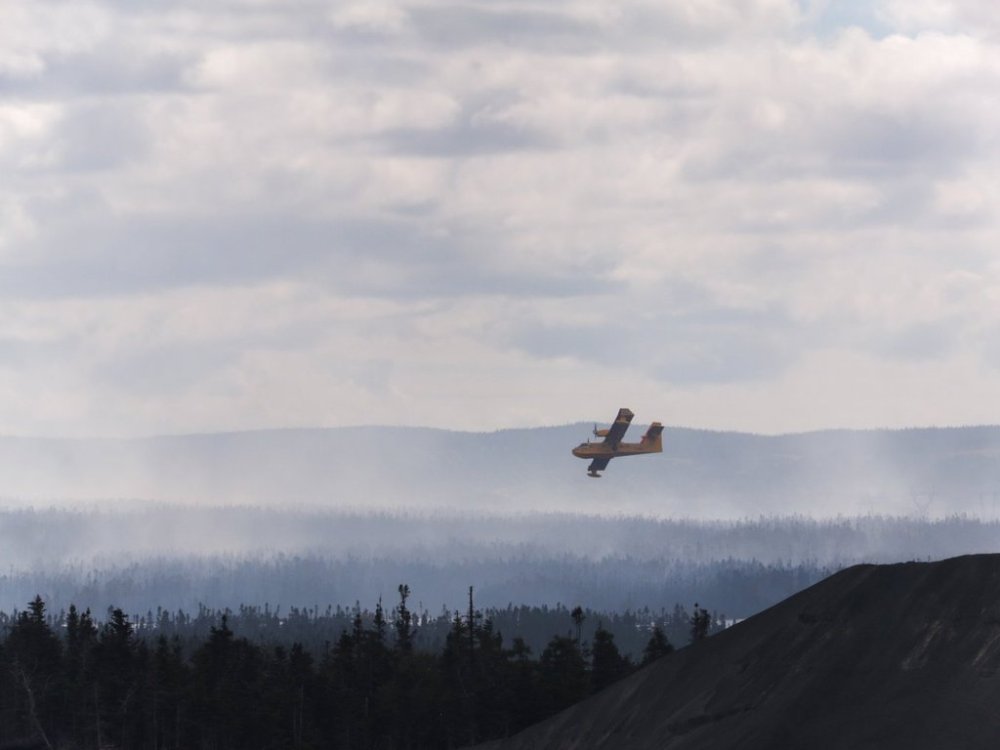
A water bomber flies over a wildfire in the Paddy's Pond area just outside St. John's, N.L., on Wednesday, Aug. 13, 2025. THE CANADIAN PRESS/Elling Lien

Other towns in eastern Newfoundland have advised residents to stop using water for non-essential reasons such as washing their cars. Last week in Bonavista, the town council outright banned such use.

“This is not a precaution — it’s a necessity,” town officials said in a social media post on Aug. 13. “If water usage does not decrease immediately, there is a high potential that all community water services will be temporarily shut off to conserve our remaining supply.”

Several months of above-average rainfall or snowfall are needed to avoid a repeat of this summer’s parched conditions, said Eddie Sheerr, a meteorologist based in St. John’s. The city has received about 43 per cent of the average rainfall for June, July and August, he said in a recent interview. 

“The winter was relatively snowless across much of the province,” he said. “And typically throughout May and sometimes June, we get these foggy dam patterns, which we didn’t really have a lot of.”

Normally, the summer air is hot and humid. This year, there was barely any moisture, coupled with several days in a row with temperatures above 30 C, he said. The dry conditions and gusty winds were perfect fuel for a wildfire season that began in May and was still going in the later weeks of August.

“We are due for a heavy (snowy) winter and hopefully it’s this year,” he said.

Much of Atlantic Canada has seen below-average rainfall this summer, leaving the soil parched deep below its surface, said Sara Sadri, an associate professor with the University of Prince Edward Island’s School of Climate Change and Adaptation.

The conditions are part of a broader pattern driven by climate change, she said. 

Sadri agreed that Newfoundland and Labrador — and the rest of Atlantic Canada — will need a sustained period of above-normal precipitation to recover from this unusually dry summer. But climate change is driving more frequent swings between very wet and very dry conditions, with more precipitation falling over short periods from large storms. In heavy downpours, much of the water is lost to run-off, and less is absorbed into the ground to replenish the soil, she said.

“A steady situation is what we really need,” Sadri said. “A cooler winter with gradual snow melt in the spring would also support a recovery.”

Governments should expect more dry conditions in the summer and keep an eye out for them so they can prepare, she said.

She suggested provincial governments invest in regional, high-resolution satellite data for drought monitoring. The federal government maintains the Canadian Drought Monitor to offer a national overview, but its data is typically a month old, she said.

Local and provincial governments can be better prepared for drought by adopting practices to retain moisture in the soil, such as covering soil important for growing crops. They can also start collecting and storing rainwater, she said.

“Having extra water in reservoir somewhere is very important,” she said.

This report by The Canadian Press was first published Aug. 21, 2025.

Report Error Submit a Tip

More Stories

Outbreak should never have happened

Editorial 4 minute read Preview

Outbreak should never have happened

Editorial 4 minute read Yesterday at 2:00 AM CDT

The headline offered a vague sense that something had been accomplished, but it most certainly did not describe anything worth celebrating:

“Manitoba declares measles outbreak over.”

The news item in the Oct. 17 Free Press noted provincial public health officials had confirmed Manitoba’s last laboratory-confirmed case of measles was identified in August, and that the absence of any new cases since had allowed for the aforementioned declaration.

The end of the outbreak — which began in February 2025 and included a significant stretch this year during which Manitoba experienced more measles cases than any other province — is certainly worth noting. But it bears reminding that the real story here is that this province, and others across Canada, experienced a resurgence of this highly communicable but successfully eradicated disease in the first place.

Read
Yesterday at 2:00 AM CDT

Family history, solo sojourns paved path for celebrated author’s latest novel

Ben Sigurdson 7 minute read Preview

Family history, solo sojourns paved path for celebrated author’s latest novel

Ben Sigurdson 7 minute read 2:01 AM CDT

It’s 1967 and Lee Clarke has just been kicked out of UCLA when he receives his draft letter in the mail. Rather than report for basic training, he hops in a car and sets off across America on an amphetamine-fuelled road trip to bid farewell to his fractured, dysfunctional family before crossing the border into Canada.

Such is the premise for B.C.-born, Portland-based Patrick deWitt’s sixth novel Dodge City, published in September by House of Anansi. He’s in Winnipeg tonight at McNally Robinson Booksellers’ Grant Park location to launch the book.

The 51-year-old deWitt came to prominence with his sophomore novel, 2011’s The Sisters Brothers. The book was a critical and commercial success, winning the author the Governor General’s Literary Award for Fiction, the Rogers Writers’ Trust Fiction Prize and the Stephen Leacock Medal for Humour, and was adapted for the big screen in a film starring John C. Reilly and Joaquin Phoenix.

His 2018 novel French Exit was also adapted for cinema, and his 2023 novel The Librarianist won deWitt the Leacock Medal for the second time. Dodge City is deWitt’s fourth novel to make the Giller Prize long list.

Read
2:01 AM CDT

Living a lie takes a toll on whole family

Maureen Scurfield 4 minute read Yesterday at 2:00 AM CDT

Dear Miss Lonelyhearts: My wife is no longer my life partner! To my mind, she’s just the mother of my children. She still lives with us and does the major part of the child care.

This summer she discovered I had a girlfriend, but she didn’t want to “break up our family,” as I earn a lot of money. Now she’s treating me like garbage. She’s pleasant to the kids and our cleaning help, but she doesn’t speak much to me, and is disposed to giving me lists for groceries and medication pickups via email, so I pay for almost everything.

The kids seem fine so far, because we haven’t broken up our family and we haven’t changed how we treat each other in front of them. We’re polite and we never fight.

Then just last weekend, my wife finally let me know she’d recently met someone she’s “seeing privately.” It’s a guy we both know from a sports activity the kids enjoy. That just makes me sick — and is upsetting me far more than breaking up.

Exchange welcomes new gallery

Jen Zoratti 3 minute read Preview

Exchange welcomes new gallery

Jen Zoratti 3 minute read Wednesday, Oct. 21, 2026

Co-owned by Laura Porath and Mike Page, Lucent Gallery + Design Studio celebrates its grand opening, Thursday.

Read
Wednesday, Oct. 21, 2026

Henderson crosswalk has glaring safety gap, say researchers months after pedestrian killed

Maggie Macintosh 5 minute read Preview

Henderson crosswalk has glaring safety gap, say researchers months after pedestrian killed

Maggie Macintosh 5 minute read Yesterday at 2:00 AM CDT

Six months after a fatal collision at a crosswalk on Henderson Highway, two traffic safety researchers question why the intersection remains an outlier that is missing key flashing lights.

The City of Winnipeg is being urged to install “backflashers” to better protect road users moving in all directions at the intersection where a 32-year-old father died in the spring.

“It’s these little, mundane, non-sexy engineering problems that can cause everything right up to fatality,” said Curt Pankratz, an associate professor at the University of Winnipeg who studies traffic engineering and policymaking.

On April 19, shortly before sunrise, Gabe Beardy was struck when he was crossing the six-lane thoroughfare at Neil Avenue.

Read
Yesterday at 2:00 AM CDT

Don’t let good health reforms fade or fossilize

Alan Menkis 5 minute read 2:00 AM CDT

When Canada’s health ministers left Winnipeg on Oct. 16, they took with them a promise to keep talking. The federal health minister did not commit to long-term funding. She offered one-year extensions for programs that were about to run out, and asked officials to begin work on “the next 10 years.”

The provinces, in the words of Manitoba Health Minister Uzoma Asagwara, wanted to avoid “fiscal cliffs” and needed “predictable, stable, sustainable funding.”

Both sides have a point. And both are talking almost entirely about money — how much, for how long, under what formula.

Missing from the conversation is the question that decides whether any of it works — once the money flows, who must answer for what it does, or does not, achieve? We have been here before. In 2002, a Senate committee chaired by Michael Kirby warned that new federal money “must be used to buy change, not merely to support the system as it is presently structured.” It proposed an independent national health care commissioner, reporting every year to the public on how the system and the health of Canadians were faring.