Scientists give harsh grades to Trump administration work aimed at undoing a key climate finding
Advertisement
Read this article for free:
or
Already have an account? Log in here »
To continue reading, please subscribe:

Digital Subscription
One year of digital access for only $205*
- Enjoy unlimited reading on winnipegfreepress.com
- Read the E-Edition, our digital replica newspaper
- Access News Break, our award-winning app
- Play interactive puzzles
*First annual payment billed as $205.00 + GST for one year. This annual subscription will automatically renew at $233.00 + GST every 52 weeks (10% off the regular annual price of $259.35). Offer available to new and qualified returning subscribers only. Cancel any time.
To continue reading, please subscribe:
Add Free Press access to your Brandon Sun subscription for only an additional
$1 for the first 4 weeks*
- Enjoy unlimited reading on winnipegfreepress.com
- Read the E-Edition, our digital replica newspaper
- Access News Break, our award-winning app
- Play interactive puzzles
*Your next Brandon Sun subscription payment will increase by $1.00 and you will be charged $17.95 plus GST for four weeks. After four weeks, your payment will increase to $24.95 plus GST every four weeks.
Read unlimited articles for free today:
or
Already have an account? Log in here »
Hey there, time traveller!
This article was published 26/08/2025 (388 days ago), so information in it may no longer be current.
WASHINGTON (AP) — Two key documents from the Trump administration aimed at revoking the long-standing finding that climate change is dangerous were filled with errors, bias and distortions, according to dozens of scientists surveyed by The Associated Press.
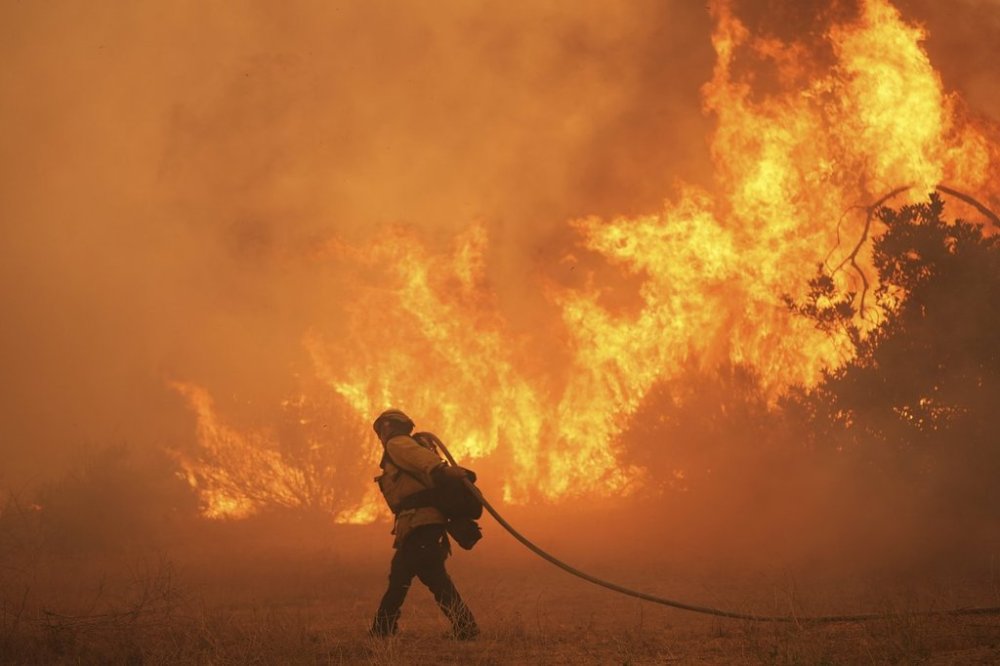
One of the reports argues that sea ice decline in the Arctic has been small, but uses data from the Antarctic to make the point. It uses a French-focused study on climate-related crop losses for a claim about the U.S. — a generalization the author said didn’t work because of significant differences in climate and agriculture. And after saying decades-old wildfire statistics aren’t reliable, the report reproduces them in a graphic anyway, making it appear fires were worse a century ago than they have been more recently.
Scientists noted those basic errors, but the most common critique from the vast majority of the 64 who answered AP’s questions was that the Environmental Protection Agency and the Department of Energy ignored, twisted or cherry-picked information to manufacture doubt about the severity and threat of climate change.
Jennifer Marlon, director of data science at the Yale Program on Climate Change Communication, was among those.
“The work and conclusions appear biased. The data and graphs use classic mis- and disinformation techniques,” she said. “It is almost a user’s guide on how to lie with figures.”
The Trump administration in July proposed revoking a 2009 government finding that climate change is a threat to public health and welfare, a concept known as the “endangerment” finding that is backed by mainstream science. Overturning it could pave the way for cutting a range of rules that limit pollution from cars, power plants and other sources.
One of the Trump administration reports, by the Department of Energy, suggests climate models used by scientists to predict warming have overreached, that long-term trends for disasters generally don’t show much change and that climate has little impact on the economy. The DOE document also said there are advantages to a world with more carbon, like increased plant growth.
AP reached out to some 350 scientists by email — nearly all the lead authors of research cited in the Trump administration’s work, plus another 139 climate experts in science, health and economics who are prominent in the field. Fifty-three of the 64 scientists who responded — including outside researchers not mentioned by the reports — gave the EPA and DOE documents a negative review. Seven praised them. The remaining four took no clear position.
In 15 cases, scientists whose work was cited said it was misused, misinterpreted or taken out of context.
When EPA was asked to respond to the scientists’ critiques, the agency said it had considered a variety of sources and information in assessing whether the predictions and assumptions baked into the 2009 finding that climate change is a public threat are “accurate and consistent.” The Energy Department said it was committed to “a more thoughtful and science-based conversation.”
White House spokesperson Taylor Rogers said the Trump administration “is producing Gold Standard Science research driven by verifiable data” and that the endangerment finding had long been misused to justify expensive regulations “that have jeopardized our economic and national security.”
The public has until Sept. 2 to comment on the Energy Department report and until Sept. 22 for the EPA’s proposal to revoke the endangerment finding. Then the Trump administration must consider that feedback before a final decision.
Overturning the finding could undermine environmental standards such as a rule that requires reducing emissions from some coal-fired power plants by 90%, or one limiting methane releases from the heaviest polluting oil and gas wells. Another regulation at stake is a requirement that new car emissions be cut roughly in half by the 2032 model year.
Environmental groups are already challenging the documents in court.
The Trump administration argues that climate science is alarmist
The EPA’s report arguing to overturn the endangerment finding relied heavily on the Energy Department’s work. That DOE report is what most scientists surveyed by the AP focused on. Together, the two Trump administration documents maintain that while climate change is real, its future effects are unclear and likely weaker than projected by many mainstream scientists. The administration also contends that U.S. cuts in greenhouse gas emissions, which largely come from burning fuels like oil and coal, would mean little globally. The U.S. is the world’s second-largest emitter behind China.
Marlon, the Yale researcher, singled out the flawed wildfire data and said the proper thing for scientists to do is not to show such information. “The report instead plots this unreliable data,” she said.
The document also erroneously claimed that the area burned by wildfire in the U.S. hadn’t increased since 2007. Marlon ran the data herself to confirm that it had, though more slowly than in prior years. Data from the National Interagency Fire Center shows that the 10-year average annual burn rate was 6.5 million acres in 2007; in 2024, it was almost 7.6 million acres.
When discussing sea ice, the Trump reports refer to the wrong part of the world.
“Arctic sea ice extent has declined by about 5% since 1980,” the Energy Department report said. But the report linked to a National Snow and Ice Data Center chart for the Southern Hemisphere, which means Antarctica. Antarctic sea ice has in fact declined about 5% in that time, but Arctic sea ice shrank by more than 40%.
“It suggests sloppy work,” said data center senior scientist Walt Meier.
Report authors respond to criticism
That error and any others that are found will be corrected, the report authors said.
“The report’s preface states clearly that it is not meant to be a comprehensive review of climate science but rather is focused on important data and topics that have been underreported or overlooked in media and political discussions,” the DOE report’s authors said in a joint statement provided by co-author Ross McKitrick, a professor at the University of Guelph in Canada specializing in environmental economics.
“Generic accusations of bias or cherry-picking are not helpful for serious scientific discussions,” they said.
The EPA’s report drew heavily on the Energy Department document for its science, citing it twice as often as it cited the United Nations’ Intergovernmental Panel on Climate Change, which has hundreds of scientists and editors that produce a massive document written over several years and was a key source for the 2009 endangerment finding. The Energy Department document was begun in March and published in July. Its preface says the aim is to “include evidence and perspectives that challenge the mainstream consensus.”
Pat Parenteau, an environmental law expert and former director of the Environmental Law School at Vermont Law & Graduate School, said agencies are required to make a “reasoned analysis” when they reverse a policy like the endangerment finding.
“Reasoned means objective. I don’t know how it could mean anything else other than that,” he said, adding that he didn’t believe the Trump administration reports were objective.
The National Academy of Sciences, a collection of private, nonprofit institutions set up to provide independent and objective analysis for policymakers, says it’s preparing a fast-tracked special report on the latest evidence on whether greenhouse gas emissions endanger public health.
Many experts said the reports were biased
Nineteen scientists used variations of the phrase “cherry pick” to describe the administration’s reports.
“I will surely not be alone in saying these reports cherry-pick information to minimize the threat of climate change,” said Steven Sherwood, a professor and climate researcher at the University of New South Wales. He said the reports were well written and easy to understand, then added: “But being biased in selecting what to show, they are not honest efforts to portray the broader picture, but instead read as efforts to persuade against concern about carbon emissions.”
Francois Bareille, a French economist whose work was referenced in the Energy Department’s report, said the work was fundamentally flawed. “These documents do not reflect genuine scientific rigor, but rather a misleading reinterpretation of peer-reviewed research.”
Bareille said the Energy report misused his research on French agriculture, which concluded that previous research on climate-related crop losses was overly pessimistic. Bareille said his findings “cannot be generalized to other regions, such as the U.S., where both climate conditions and agricultural systems differ significantly.”
One portion of the Energy report argued that ocean acidification should more accurately be called “ocean neutralization.” The authors reasoned that ocean life “appear to be resilient” to such changes.
Ocean acidification happens as waters absorb rising carbon dioxide, which damages marine life with shells, such as coral, oysters and mollusks. That harm risks disrupting food webs.
Stony Brook University’s Stephen Schwartz, former chief scientist of the Department of Energy’s Atmospheric Science Program, said using a more benign term such as “neutralization” would be “ludicrous.” And Waleed Abdalati, who served as NASA chief scientist during the Obama administration, said: “The simple fact is that carbon dioxide is making the oceans more acidic, which carries harmful effects.”
Tim Gallaudet, chief of the National Oceanic and Atmospheric Administration during the first Trump administration, praised the recent administration reports and singled out the issue of ocean acidification. He agreed with the word “neutralization” and said recent studies have shown smaller or nonexistent harms when compared with previous science.
One economics expert cited in the report praised it, saying it departed from unnecessarily alarmist findings of other national and international climate assessments.
“The problem is that mainstream ‘climate science’ is pretty worthless. Hopelessly politicized, mired in groupthink and virtue signaling,” said James Davidson, a professor at the University of Exeter. His work was cited to dispute the mainstream scientific finding that rising carbon dioxide levels in the past drove warming.
Davidson said the Department of Energy’s authors are skeptical of the current consensus and hold beliefs that previously would have been ignored.
“In other words, they and the so-called ‘mainstream’ have changed places for the moment,” he said.
Scientists grade the reports from A to F
Asked to grade the administration documents as if they were produced by undergraduates, 19 of the 42 scientists who responded to that question assigned the work an F, for failing. The reports earned five As along with an A-minus. Some criticized the question as silly or ridiculous, with one saying it suggests “your goal here is not journalism but team sport.”
“I would give them both a D on truth and an A on deviousness,” wrote climate scientist Jennifer Francis of the Woodwell Climate Research Center. She said the analysis was twisted to support the desired narrative.
“The EPA report gets an ‘R’ for ridiculous,” she said.
The DOE report argues that worst-case climate models often used by scientists to describe the consequences of doing nothing to reduce emissions exaggerate how much the world has already warmed and how much more it will heat up.
In that section, the Energy Department report cited climate scientist Zeke Hausfather four times, including a graphic of his.
Hausfather wrote in a blog that the report used one less important figure “to reinforce the point they were trying to make, and never actually referred to the broader conclusion of the paper that old models had by-and-large performed quite well,” Hausfather wrote. “The actual content of my paper went counter to the narrative they were trying to present, and thus was ignored.”
He added: “That’s why I’ve publicly called this process a farce.”
When asked to respond, a DOE spokesperson encouraged Hausfather to submit his concerns as part of the public comment process.
___
Data journalist M.K. Wildeman contributed to this story.
___
The Associated Press’ climate and environmental coverage receives financial support from multiple private foundations. AP is solely responsible for all content. Find AP’s standards for working with philanthropies, a list of supporters and funded coverage areas at AP.org.