Pakistani rescuers use drones to help evacuate thousands as floods devastate Punjab

Advertisement

Advertise with us

JHANG, Pakistan (AP) — Emergency workers in Pakistan's Punjab province used drones to find people stranded on rooftops by massive floods as the government expanded its rescue operation with more than 900,000 evacuated, officials said Monday.

Read this article for free:


or

Already have an account? Log in here »

To continue reading, please subscribe:

Subscribe and receive a limited-edition Free Press branded hat or tote.

Digital Subscription

One year of digital access for only $205*

  • Enjoy unlimited reading on winnipegfreepress.com
  • Read the E-Edition, our digital replica newspaper
  • Access News Break, our award-winning app
  • Play interactive puzzles

*First annual payment billed as $205.00 + GST for one year. This annual subscription will automatically renew at $233.00 + GST every 52 weeks (10% off the regular annual price of $259.35). Offer available to new and qualified returning subscribers only. Cancel any time.

To continue reading, please subscribe:

Add Free Press access to your Brandon Sun subscription for only an additional

$1 for the first 4 weeks*

  • Enjoy unlimited reading on winnipegfreepress.com
  • Read the E-Edition, our digital replica newspaper
  • Access News Break, our award-winning app
  • Play interactive puzzles
Start now

*Your next Brandon Sun subscription payment will increase by $1.00 and you will be charged $17.95 plus GST for four weeks. After four weeks, your payment will increase to $24.95 plus GST every four weeks.

Hey there, time traveller!
This article was published 01/09/2025 (364 days ago), so information in it may no longer be current.

JHANG, Pakistan (AP) — Emergency workers in Pakistan’s Punjab province used drones to find people stranded on rooftops by massive floods as the government expanded its rescue operation with more than 900,000 evacuated, officials said Monday.

The Pakistan Meteorological Department warned of more heavy rain in Punjab’s flood-hit districts and elsewhere in the country, where weeks of above-normal rainfall and the release of huge volumes of water from dams in neighboring India last week caused rivers to overflow into low-lying regions.

Authorities say Punjab, the country’s most populous province, is facing its biggest floods on record.
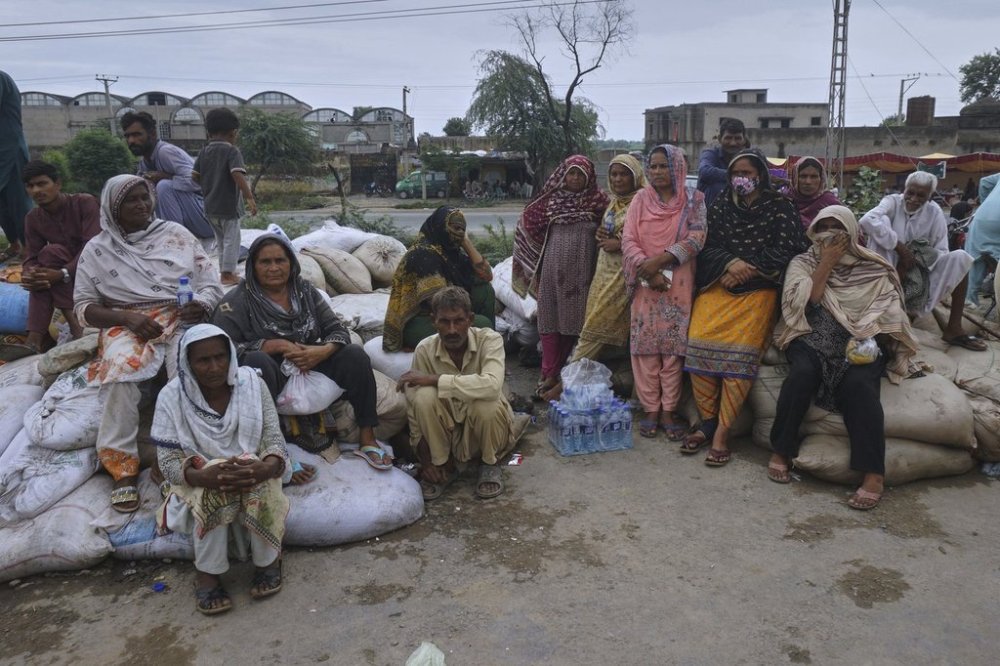
Villagers shelter after being evacuated from a flooded area after torrential rains and rising water level in the rivers due to sudden water releases from Indian dams in Pindi Bhattian, Pakistan, Sunday, Aug. 31, 2025. (AP Photo/A. Rizvi)

In Multan and Jhang districts, residents on Monday waded through floodwaters carrying their belongings to roadsides and higher ground. They said they had waited for rescuers before crossing on their own nearly 5-foot (1 1/2-meter) -deep water to reach safety, while many others remained stranded.

Since last week, rescuers, backed by the military and emergency services, have evacuated more than 900,000 people from more than 3,100 flood-hit villages, said Irfan Ali Kathia, director general of the Punjab Disaster Management Authority. More than 600,000 farm animals were also moved to safety, he told a news conference.

“We are handling an unprecedented situation, and we are responding to Punjab’s biggest-ever floods by using the latest technology and all available resources to save lives,” Kathia told The Associated Press. The Punjab government said drones were deployed this week in Multan, Jhang and other districts.

“Our priority is to save lives and ensure a steady supply of essential items to survivors,” Kathia said. The deluge has swamped Narowal, Sialkot and Kasur districts while entire villages have been submerged in Jhang and Multan.

‘Everything is gone’

On roadside embankments, displaced families complained of being abandoned.

“We have been destroyed. Everything is gone in the flood,” said Haleema Bibi, 54, who fled her damaged home in Jhang with seven relatives. They now shelter under the open sky without tents or food.

“Whatever we had to eat has nearly finished. You can see how miserably we are living,” she told The Associated Press.

Allah Ditta, a farmer from the same district, said he and his neighbors slept on plastic sheets and carts. “Rescuers came once by boat, but no one has brought us supplies. We keep looking to the road, hoping someone will come with help,” he said.

Farmer Malik Ramzan said authorities advised villagers to move to safer places, but no rescue camps were established. He said robbers often loot abandoned houses, another reason he chose to remain in his flooded home in Rajanpur district.

Authorities in Punjab say they had set up more than 1,000 relief camps, but government figures show that only about 36,550 evacuees are housed in them. It is unclear where the vast majority were staying.

Evacuations also took place in southern Sindh province, where Chief Minister Murad Ali Shah warned of a possible “super flood” of the Indus River if water levels top 900,000 cubic feet per second.

Heavy rains and a sudden cloudburst on Monday inundated several neighborhoods in Islamabad, leaving roads under water and vehicles stranded, according to local media reports. Television footage showed the main streets of the Pakistani capital transformed into streams as cars struggled to move through the floodwaters.

Deadly floods also hit northern Indian states

Officials blame the catastrophic flooding on weeks of heavier-than-normal monsoon rains, compounded by cross-border waters released from India’s swollen rivers and dams last week. The Ravi, Chenab and Sutlej rivers rose simultaneously, inundating swaths of farmland and villages.

India had alerted Pakistan about the water release, marking the rivals’ first public diplomatic contact since a military crisis brought them to the brink of war in May.

Punjab, home to some 150 million people and the country’s main wheat-growing region, has recorded 41 flood-related deaths in 10 days — far fewer than the catastrophic 2022 floods — but damage is widespread.

Pakistan’s weather center said Punjab received 26.5% more monsoon rainfall between July 1 and Aug. 27 compared with the same period last year. Nationwide, at least 854 people have died in rain-related incidents since late June.

In India, at least five people were killed in landslides triggered by torrential rain in northern Uttarakhand and Himachal Pradesh states, officials said Monday. Rains lashed several parts of India’s Punjab state that borders Pakistan, prompting authorities to shut schools and colleges until Wednesday.

Last month, at least 125 people were killed and scores injured in floods in Indian-controlled Kashmir.

Pakistan’s monsoon season typically lasts until the end of September.

___

Associated Press writers Munir Ahmed in Islamabad and Asim Tanveer in Multan, Pakistan and Sibi Arasu in Bengaluru, India, contributed to this report.

Report Error Submit a Tip

More Stories

‘Fine wine’: Vintage Collaros shows up in big win over Als after 38th birthday

Ken Wiebe 6 minute read Preview

‘Fine wine’: Vintage Collaros shows up in big win over Als after 38th birthday

Ken Wiebe 6 minute read Yesterday at 10:29 AM CDT

Zach Collaros was in no mood for I-told-you-so’s.

There were no references – either thinly veiled or direct – to the naysayers, many of whom thought the Blue Bombers were in deep trouble as the league-leading Montreal Alouettes rolled into town on a roll for a matchup on Friday that could have left Winnipeg with a sub-.500 record heading into the Labour Day Classic.

No, that’s not Collaros’ style or part of how he operates.

After outduelling Alouettes quarterback Davis Alexander in a convincing 44-28 victory, Collaros stood in front of a group of reporters and displayed almost no emotion, despite delivering what can easily be described as his best showing of the season.

Read
Yesterday at 10:29 AM CDT

Pakistani rescuers use drones to help evacuate thousands as floods devastate Punjab

K.m. Chaudhry And Babar Dogar, The Associated Press 4 minute read Preview

Pakistani rescuers use drones to help evacuate thousands as floods devastate Punjab

K.m. Chaudhry And Babar Dogar, The Associated Press 4 minute read Monday, Sep. 1, 2025

JHANG, Pakistan (AP) — Emergency workers in Pakistan's Punjab province used drones to find people stranded on rooftops by massive floods as the government expanded its rescue operation with more than 900,000 evacuated, officials said Monday.

The Pakistan Meteorological Department warned of more heavy rain in Punjab’s flood-hit districts and elsewhere in the country, where weeks of above-normal rainfall and the release of huge volumes of water from dams in neighboring India last week caused rivers to overflow into low-lying regions.

Authorities say Punjab, the country's most populous province, is facing its biggest floods on record.

In Multan and Jhang districts, residents on Monday waded through floodwaters carrying their belongings to roadsides and higher ground. They said they had waited for rescuers before crossing on their own nearly 5-foot (1 1/2-meter) -deep water to reach safety, while many others remained stranded.

Read
Monday, Sep. 1, 2025

New businesses start to creep up in former Winnipeg Slurpee shops

Tiago Resko 5 minute read Preview

New businesses start to creep up in former Winnipeg Slurpee shops

Tiago Resko 5 minute read Thursday, Aug. 27, 2026

The remnants of 7-Eleven can still be seen as new businesses move into spaces where Slurpee machines and taquitos once ruled.

As fresh paint dries on several new ventures — such as a pizza place and a convenience store with a name that might make a customer do a double-take — holes across Winnipeg once occupied by the international convenience chain are slowly being filled.

Business at a Domino’s Pizza in Elmwood, formerly a 7-Eleven, has been booming since it opened June 1, the store manager said.

“The issues that 7-Eleven would have had might be different than what we would have. They were dealing with a lot of theft where people can just walk in and out, but Domino’s isn’t set up that way,” said Paul Hemmerling.

Read
Thursday, Aug. 27, 2026

History not meant to be nice and comforting

Allan Levine 5 minute read 2:01 AM CDT

History is messy. On one hand, it offers uplifting stories of success, courage, human achievement, invention, ingenuity, compassion and kindness. Think of Dr. Jonas Salk and his development of the first successful polio vaccine. Or Viola Desmond, who asserted her civil rights against racial segregation in Nova Scotia.

On the other hand, history is also dark, ugly, mean-spirited and a catalogue of hardships, tragedy and brutality. Consider slavery, the Holocaust, the First and Second World Wars and residential schools — to list only a very few examples of the bloodshed, cruelty, death and depravity that has frequently defined history.

Anyone who has extensively studied history or read a history book knows that the past is complex and rarely black and white; that men and women, whether they are politicians, activists, businessmen, journalists, lawyers and judges, have their good and bad sides. Human perfection is elusive and there are few saints.

Most of us understand this except, it seems, U.S. President Donald Trump and his White House officials. They don’t like presentations of U.S. history, for example, that highlight slavery and the slaughter of Indigenous peoples, key elements of the American past for hundreds of years.

Health care needs long-term planning

Editorial, Aug. 31 4 minute read Preview

Health care needs long-term planning

Editorial, Aug. 31 4 minute read 2:01 AM CDT

If there’s been a throughline in the past 30 years of Manitoba politics — apart from the fact the electorate has bounced between NDP and Progressive Conservative governments — it’s that the state of provincial health care is almost always in the headlines.

Remember the “hallway medicine” catchphrase used by Gary Doer’s New Democrats in the 1999 provincial election campaign? It’s not that far removed from the “ER bottlenecks” that Manitobans, especially Winnipeggers, must deal with today.

In a recent Free Press examination of emergency room medicine (Condition critical, Aug. 22), Dr. Alecs Chochinov, a former director of emergency medicine at St. Boniface Hospital, attributed the bottleneck problem to “access block,” meaning that more personal-care home beds and home-care services are needed to free up acute-care hospital beds and enable patients to move more quickly through emergency rooms.

So, how should access block be addressed and who should direct the implementation of long-term investment and solutions?

Read
2:01 AM CDT

Trump: Ozymandias revisited?

John R. Wiens 5 minute read 2:01 AM CDT

In 1818, Percy Bysshe Shelley, inspired by the shattered statue of the most powerful Egyptian Pharaoh, Ramses II, wrote the sonnet Ozymandias as a comment on human hubris and impermanence. It provides a fitting epithet for the imperialistic forays of the current United States’ president and would-be autocrat, Donald J. Trump.

What Ramses and Trump have in common is unrestrained hubris and unlimited delusion.

Ramses says: “My name is O, King of Kings. Look at my works you Mighty and despair.”

Trump’s hubris and bluster on limits to his power: “There is one thing. My own morality. My own mind. It’s the only thing that can stop me.” On Truth Social, Trump declared himself the “most powerful person that has EVER walked this planet.”