Pakistani rescuers use drones to help evacuate thousands as floods devastate Punjab

Advertisement

Advertise with us

JHANG, Pakistan (AP) — Emergency workers in Pakistan's Punjab province used drones to find people stranded on rooftops by massive floods as the government expanded its rescue operation with more than 900,000 evacuated, officials said Monday.

Read this article for free:


or

Already have an account? Log in here »

To continue reading, please subscribe:

Subscribe and receive a limited-edition Free Press branded hat or tote.

Digital Subscription

One year of digital access for only $205*

  • Enjoy unlimited reading on winnipegfreepress.com
  • Read the E-Edition, our digital replica newspaper
  • Access News Break, our award-winning app
  • Play interactive puzzles

*First annual payment billed as $205.00 + GST for one year. This annual subscription will automatically renew at $233.00 + GST every 52 weeks (10% off the regular annual price of $259.35). Offer available to new and qualified returning subscribers only. Cancel any time.

To continue reading, please subscribe:

Add Free Press access to your Brandon Sun subscription for only an additional

$1 for the first 4 weeks*

  • Enjoy unlimited reading on winnipegfreepress.com
  • Read the E-Edition, our digital replica newspaper
  • Access News Break, our award-winning app
  • Play interactive puzzles
Start now

*Your next Brandon Sun subscription payment will increase by $1.00 and you will be charged $17.95 plus GST for four weeks. After four weeks, your payment will increase to $24.95 plus GST every four weeks.

Hey there, time traveller!
This article was published 01/09/2025 (378 days ago), so information in it may no longer be current.

JHANG, Pakistan (AP) — Emergency workers in Pakistan’s Punjab province used drones to find people stranded on rooftops by massive floods as the government expanded its rescue operation with more than 900,000 evacuated, officials said Monday.

The Pakistan Meteorological Department warned of more heavy rain in Punjab’s flood-hit districts and elsewhere in the country, where weeks of above-normal rainfall and the release of huge volumes of water from dams in neighboring India last week caused rivers to overflow into low-lying regions.

Authorities say Punjab, the country’s most populous province, is facing its biggest floods on record.
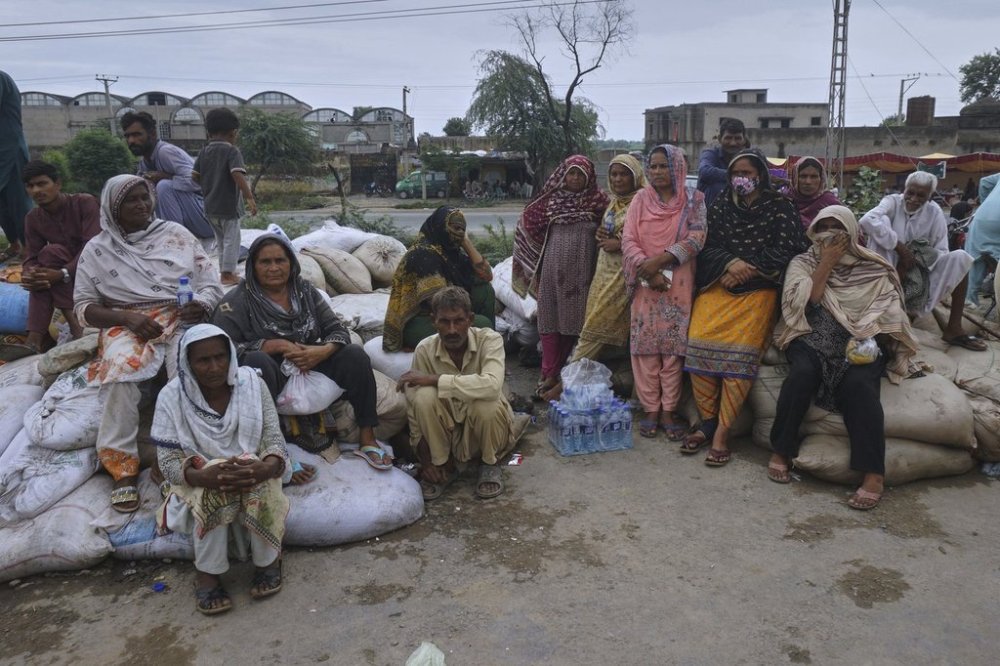
Villagers shelter after being evacuated from a flooded area after torrential rains and rising water level in the rivers due to sudden water releases from Indian dams in Pindi Bhattian, Pakistan, Sunday, Aug. 31, 2025. (AP Photo/A. Rizvi)

In Multan and Jhang districts, residents on Monday waded through floodwaters carrying their belongings to roadsides and higher ground. They said they had waited for rescuers before crossing on their own nearly 5-foot (1 1/2-meter) -deep water to reach safety, while many others remained stranded.

Since last week, rescuers, backed by the military and emergency services, have evacuated more than 900,000 people from more than 3,100 flood-hit villages, said Irfan Ali Kathia, director general of the Punjab Disaster Management Authority. More than 600,000 farm animals were also moved to safety, he told a news conference.

“We are handling an unprecedented situation, and we are responding to Punjab’s biggest-ever floods by using the latest technology and all available resources to save lives,” Kathia told The Associated Press. The Punjab government said drones were deployed this week in Multan, Jhang and other districts.

“Our priority is to save lives and ensure a steady supply of essential items to survivors,” Kathia said. The deluge has swamped Narowal, Sialkot and Kasur districts while entire villages have been submerged in Jhang and Multan.

‘Everything is gone’

On roadside embankments, displaced families complained of being abandoned.

“We have been destroyed. Everything is gone in the flood,” said Haleema Bibi, 54, who fled her damaged home in Jhang with seven relatives. They now shelter under the open sky without tents or food.

“Whatever we had to eat has nearly finished. You can see how miserably we are living,” she told The Associated Press.

Allah Ditta, a farmer from the same district, said he and his neighbors slept on plastic sheets and carts. “Rescuers came once by boat, but no one has brought us supplies. We keep looking to the road, hoping someone will come with help,” he said.

Farmer Malik Ramzan said authorities advised villagers to move to safer places, but no rescue camps were established. He said robbers often loot abandoned houses, another reason he chose to remain in his flooded home in Rajanpur district.

Authorities in Punjab say they had set up more than 1,000 relief camps, but government figures show that only about 36,550 evacuees are housed in them. It is unclear where the vast majority were staying.

Evacuations also took place in southern Sindh province, where Chief Minister Murad Ali Shah warned of a possible “super flood” of the Indus River if water levels top 900,000 cubic feet per second.

Heavy rains and a sudden cloudburst on Monday inundated several neighborhoods in Islamabad, leaving roads under water and vehicles stranded, according to local media reports. Television footage showed the main streets of the Pakistani capital transformed into streams as cars struggled to move through the floodwaters.

Deadly floods also hit northern Indian states

Officials blame the catastrophic flooding on weeks of heavier-than-normal monsoon rains, compounded by cross-border waters released from India’s swollen rivers and dams last week. The Ravi, Chenab and Sutlej rivers rose simultaneously, inundating swaths of farmland and villages.

India had alerted Pakistan about the water release, marking the rivals’ first public diplomatic contact since a military crisis brought them to the brink of war in May.

Punjab, home to some 150 million people and the country’s main wheat-growing region, has recorded 41 flood-related deaths in 10 days — far fewer than the catastrophic 2022 floods — but damage is widespread.

Pakistan’s weather center said Punjab received 26.5% more monsoon rainfall between July 1 and Aug. 27 compared with the same period last year. Nationwide, at least 854 people have died in rain-related incidents since late June.

In India, at least five people were killed in landslides triggered by torrential rain in northern Uttarakhand and Himachal Pradesh states, officials said Monday. Rains lashed several parts of India’s Punjab state that borders Pakistan, prompting authorities to shut schools and colleges until Wednesday.

Last month, at least 125 people were killed and scores injured in floods in Indian-controlled Kashmir.

Pakistan’s monsoon season typically lasts until the end of September.

___

Associated Press writers Munir Ahmed in Islamabad and Asim Tanveer in Multan, Pakistan and Sibi Arasu in Bengaluru, India, contributed to this report.
Report Error Submit a Tip

More Stories

Winnipeg venues saying no to AI-made advertisements

Sheldon Birnie 8 minute read Preview

Winnipeg venues saying no to AI-made advertisements

Sheldon Birnie 8 minute read 6:00 AM CDT

Although the days when telephone poles and notice boards across the city were thick with gig posters, either slopped up with wheat paste or wrapped tight with packing tape, are behind us, the art of making an appealing visual ad for live music events is still a vital part of the local creative scene.

However, a widespread backlash against a new kind of slop — the use of generative AI images — has been building, especially among creatives when it comes to promoting live music.

“Live music is and always has been a DIY type of scene, especially locally,” says Evan Simpson, who has been working as a graphic designer for nearly a decade.

“For years people have been making their own flyers, or if they have the budget, hiring a designer or artist to come up with some artwork for their flyers. It’s a whole ecosystem, a scene supporting itself. If you take away the visual side of it, the spark, individuality and uniqueness of each gig poster is lost. What a sad world it would be if all art were made by AI.”

Read
6:00 AM CDT

50 years ago, we thought we could change the world

Robert Milan and Miriam Cooley 8 minute read Preview

50 years ago, we thought we could change the world

Robert Milan and Miriam Cooley 8 minute read 2:00 AM CDT

Winnipeg, 50 years ago.

We began as a small loose unorganized group of teaching friends and educators who shared the same political and social convictions.

We defined ourselves as socialists, feminists and political activists. We were a cross section of educational minds — language arts and social studies teachers, an art teacher, an early childhood educator, a Winnipeg school trustee, a school principal — making our group quite representative of school culture at the time.

Our questions and discussions about politics, education and society arose from a diversity of backgrounds, yet reflected a progressive cohesiveness. The political climate in Manitoba helped bring us together. Sterling Lyon was premier and his Conservative government was pursuing policies that we strongly opposed. To us, his government represented a determined assault on many of the social and political values we believed in, particularly related to education. Eventually we decided that perhaps we should do more than talk. And so the Socialist Teachers Education Movement — STEM — was born.

Read
2:00 AM CDT

The port of Churchill — but done right

Editorial 4 minute read Preview

The port of Churchill — but done right

Editorial 4 minute read Saturday, Sep. 12, 2026

The seagoing grain carrier wasn’t christened with a champagne bottle. There was no confetti or streamers. Nevertheless, the Aug. 31 event marking the first shipment of grain to be loaded at the Port of Churchill since 2020 was celebrated like the launch of a brand new vessel.

The presence of the federal minister of northern and arctic affairs, provincial cabinet ministers and leaders and elders from several northern First Nations signalled that the fast-tracked process of refurbishing and buffing up Manitoba’s deep-water seaport gem is gaining momentum.

For OneNorth, the partnership of 29 First Nations and 12 northern communities which owns the Port of Churchill and the Hudson Bay Railway (both operated by the Arctic Gateway Group) the event heralded a new beginning. It’s been eight years since OneNorth purchased the port and railroad, and six years since grain was moved by rail through Manitoba and then by ship to European markets. Two more grain shipments, plus shipments of potash and critical minerals, will continue through the fall.

When Prime Minister Mark Carney solicited the premiers to suggest “nation-building” projects following his election in 2025, Premier Wab Kinew pitched a Manitoba trade corridor that would move wheat, critical minerals, potash and energy (oil or liquid natural gas) through the Port of Churchill.

Read
Saturday, Sep. 12, 2026

Menstruation, consent move up in sex-ed lesson plan

Maggie Macintosh 5 minute read Preview

Menstruation, consent move up in sex-ed lesson plan

Maggie Macintosh 5 minute read 6:00 AM CDT

Manitoba’s newest curriculum introduces the menstrual cycle earlier and repeatedly calls for explicit lessons on how students can give, seek, and decline to provide their consent.

The education department has released its sweeping proposal to overhaul how exercise, nutrition and sexuality are taught between kindergarten and Grade 12.

Grade 5 has long served as a key turning point for “the talk,” said J Fiedler, a sexual and reproductive health educator who provided input on the new curriculum.

“There’s no ‘the talk’ anymore. Now, there’s continuations of multiple ‘talks,’ which can hopefully reduce stress for students and stigma that people experience talking about sexuality.”

Read
6:00 AM CDT

Long-running creative endeavour

Aaron Epp 6 minute read Preview

Long-running creative endeavour

Aaron Epp 6 minute read 6:00 AM CDT

Brazen browsers are always welcome at the Paper Gallery.

“A lot of people just love to come and look,” says Julie Pedersen Ross, who owns the Winnipeg gift shop. “They always tell us, ‘Oh, I have an hour — I’m so excited to be here and just look around.’”

Situated in River Heights at 1437 Corydon Ave., the Paper Gallery features more than 2,000 different greeting cards that staff have hand-selected. There’s also stationery and a range of gifts.

Whether you’re looking for candles, picture frames, children’s books and toys, kitchenware, party supplies, bath products, journals, reading glasses or novelty gifts, it’s likely the Paper Gallery has a fun, functional item to suit your needs.

Read
6:00 AM CDT

Canadians loving Carney’s decision to stand tall against floundering U.S. bully

Tom Brodbeck 5 minute read Preview

Canadians loving Carney’s decision to stand tall against floundering U.S. bully

Tom Brodbeck 5 minute read Friday, Sep. 11, 2026

It’s hard to imagine a more dramatic political contrast than the one unfolding on opposite sides of the Canada-U.S. border.

Mark Carney is fighting a trade war with Donald Trump, taking the occasional verbal punch from the American president and imposing retaliatory tariffs on U.S. products.

And the prime minister is being rewarded for it politically.

Trump, meanwhile, is fighting pretty much everyone he can find — including some of America’s closest allies — and his own voters are increasingly giving him the political equivalent of a raised middle finger. That’s quite a tale of two leaders.

Read
Friday, Sep. 11, 2026