AI shakes up the call center industry, but some tasks are still better left to the humans
Advertisement
Read this article for free:
or
Already have an account? Log in here »
To continue reading, please subscribe:
Digital Subscription
One year of digital access for only $1.44 a week*
- Enjoy unlimited reading on winnipegfreepress.com
- Read the E-Edition, our digital replica newspaper
- Access News Break, our award-winning app
- Play interactive puzzles
*Billed as $5.77 plus GST every four weeks. After 52 weeks, price increases to the regular rate of $19.95 plus GST every four weeks. Offer available to new and qualified returning subscribers only. Cancel any time.
To continue reading, please subscribe:
Add Free Press access to your Brandon Sun subscription for only an additional
$1 for the first 4 weeks*
- Enjoy unlimited reading on winnipegfreepress.com
- Read the E-Edition, our digital replica newspaper
- Access News Break, our award-winning app
- Play interactive puzzles
*Your next Brandon Sun subscription payment will increase by $1.00 and you will be charged $17.95 plus GST for four weeks. After four weeks, your payment will increase to $24.95 plus GST every four weeks.
Read unlimited articles for free today:
or
Already have an account? Log in here »
Hey there, time traveller!
This article was published 07/09/2025 (408 days ago), so information in it may no longer be current.
NEW YORK (AP) — Armen Kirakosian remembers the frustrations of his first job as a call center agent nearly 10 years ago: the aggravated customers, the constant searching through menus for information and the notes he had to physically write for each call he handled.
Thanks to artificial intelligence, the 29-year-old from Athens, Greece, is no longer writing notes or clicking on countless menus. He often has full customer profiles in front of him when a person calls in and may already know what problem the customer has before even saying “hello.” He can spend more time actually serving the customer.
“A.I. has taken (the) robot out of us,” Kirakosian said.
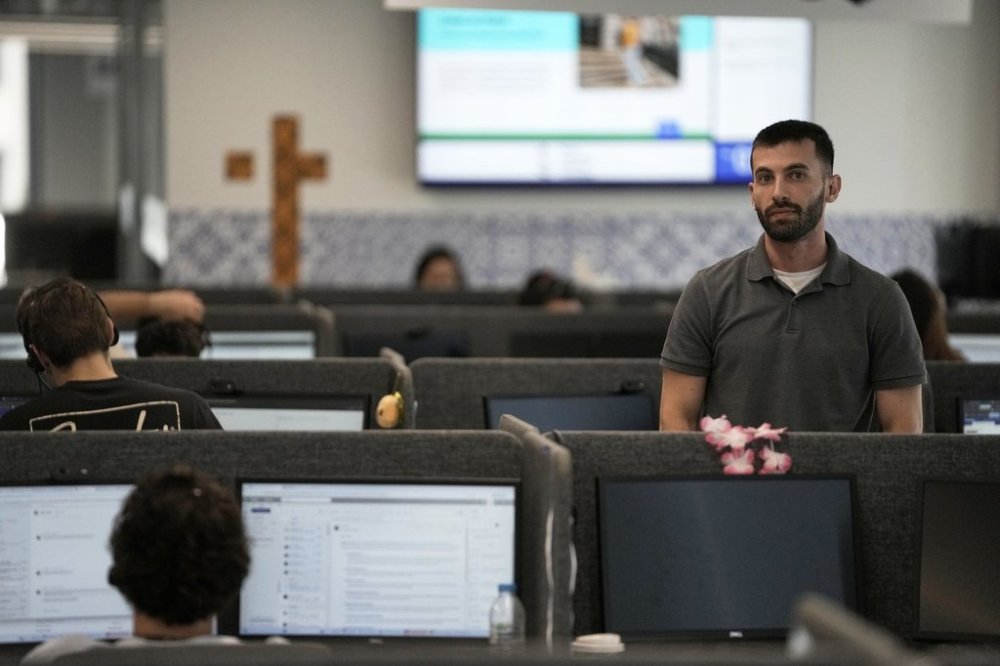
Roughly 3 million Americans work in call center jobs, and millions more work in call centers around the world, answering billions of inquiries a year about everything from broken iPhones to orders for shoes. Kirakosian works for TTEC, a company that provides third party customer service lines in 22 countries to companies in industries such as autos and banking that need extra capacity or have outsourced their call center operations.
Answering these calls can be thankless work. Roughly half of all customer service agents leave the job after a year, according to McKinsey, with stress and monotonous work being among the reasons employees quit.
Much of what these agents deal with is referred to in the industry as “break/fix,” which means something is broken — or wrong or confusing — and the customer expects the person on the phone to fix the problem. Now, it’s a question of who will be tasked with the fix: a human, a computer, or a human augmented by a computer.
Already, AI agents have taken over more routine call center tasks. Some jobs have been lost and there have been dire forecasts about the future job market for these individuals, ranging from modest single-percentage point losses, to as many as half of all call center jobs going away in the next decade. The drop likely won’t match the more dire predictions, however, because it’s become evident that the industry will still need humans, perhaps with even higher levels of learning and training, as some customer service issues become increasingly harder to solve.
Some finance companies have already experimented with going in heavily with AI for their customer service issues.
Klarna, the Swedish buy now, pay later company, replaced 700 of their roughly 3,000 customer service agents with chatbots and AI in 2024. The results were mixed. While the company did save money, Klarna found there was still a need for higher skilled human agents in certain circumstances, such as complicated issues related to identity theft. Earlier this year, Klarna hired seven internal freelancers to handle these issues.
Earlier this year, Klarna hired a handful of customer service employees back to the firm, acknowledging there were certain issues that AI couldn’t handle as well as a real person, like identity theft.
“Our vision of an AI-first contact center, where AI agents handle the majority of conversations and fewer, better trained and better paid human agents support only the most complex tasks, is quickly becoming a reality,” said Gadi Shamia of Replicant, an AI-software company that trains chatbots to sound more human, in an interview with consultants at McKinsey.
The call center customer’s experience, while improved, is still far from perfect.
The initial customer service call has long been handled through interactive voice response systems, known in the industry as IVR. Customers interact with IVR when they’re told “press one for sales, press two for support, press five for billing.” These crude systems got an update in the 2010s, when customers could prompt the system by saying “sales” or “support” or simple phrases like “I’d like to pay a bill” instead of navigating through a labyrinthian set of menu options.
But customers have little patience for these menus, leading them to “zero out,” which is call center slang for when a customer hits the zero button on their their keypad in hopes of reaching a human. It’s also not uncommon that after a customer “zeros out” they will be put on hold and transferred because they did not end up in the right place for their request.
Aware of Americans’ collective impatience with IVR, Democratic Sen. Ruben Gallego of Arizona and Republican Jim Justice of West Virginia have introduced the “Keep Call Centers in America Act,” which would require clear ways to reach a human agent, and provide incentives to companies that keep call center jobs in the U.S.
Companies are trying to roll out telephone systems that broadly understand customer service requests and predict where to send a customer without navigating a menu. OpenAI, the maker of ChatGPT, is coming out with its “ChatGPT Agent” service for users that’s able to understand phrases like “I need to find a hotel for a wedding next year, please give me options for clothing and gifts.”
Bank of America says it has had increasing success in integrating such features into “Erica,” its chatbot that debuted in 2018. When Erica cannot handle a request, the agent transfers the customer directly to the right department. Erica is now also predictive and analytical, and knows for instance that a customer may repeatedly have a low balance and may need better help budgeting or may have multiple subscriptions to the same service.
Bank of America said this month that Erica has been used 3 billion times since its creation and is increasingly taking on a higher case load of customer service requests. The chatbot’s moniker comes from the last five letters of the company’s name.
James Bednar, vice president of product and innovation at TTEC, has spent much of his career trying to make customer service calls less painful for the caller as well as the company. He said these tools could eventually kill off IVR for good, ending the need for anyone to “zero out.”
“We’re getting to the point where AI will get you to the right person for your problem without you having to route through those menus,” Bednar said.