The rise of AI tools forces schools to reconsider what counts as cheating
Advertisement
Read this article for free:
or
Already have an account? Log in here »
To continue reading, please subscribe:

Digital Subscription
One year of digital access for only $205*
- Enjoy unlimited reading on winnipegfreepress.com
- Read the E-Edition, our digital replica newspaper
- Access News Break, our award-winning app
- Play interactive puzzles
*First annual payment billed as $205.00 + GST for one year. This annual subscription will automatically renew at $233.00 + GST every 52 weeks (10% off the regular annual price of $259.35). Offer available to new and qualified returning subscribers only. Cancel any time.
To continue reading, please subscribe:
Add Free Press access to your Brandon Sun subscription for only an additional
$1 for the first 4 weeks*
- Enjoy unlimited reading on winnipegfreepress.com
- Read the E-Edition, our digital replica newspaper
- Access News Break, our award-winning app
- Play interactive puzzles
*Your next Brandon Sun subscription payment will increase by $1.00 and you will be charged $17.95 plus GST for four weeks. After four weeks, your payment will increase to $24.95 plus GST every four weeks.
Read unlimited articles for free today:
or
Already have an account? Log in here »
Hey there, time traveller!
This article was published 11/09/2025 (345 days ago), so information in it may no longer be current.
The book report is now a thing of the past. Take-home tests and essays are becoming obsolete.
Student use of artificial intelligence has become so prevalent, high school and college educators say, that to assign writing outside of the classroom is like asking students to cheat.
“The cheating is off the charts. It’s the worst I’ve seen in my entire career,” says Casey Cuny, who has taught English for 23 years. Educators are no longer wondering if students will outsource schoolwork to AI chatbots. “Anything you send home, you have to assume is being AI’ed.”

The question now is how schools can adapt, because many of the teaching and assessment tools that have been used for generations are no longer effective. As AI technology rapidly improves and becomes more entwined with daily life, it is transforming how students learn and study and how teachers teach, and it’s creating new confusion over what constitutes academic dishonesty.
“We have to ask ourselves, what is cheating?” says Cuny, a 2024 recipient of California’s Teacher of the Year award. “Because I think the lines are getting blurred.”
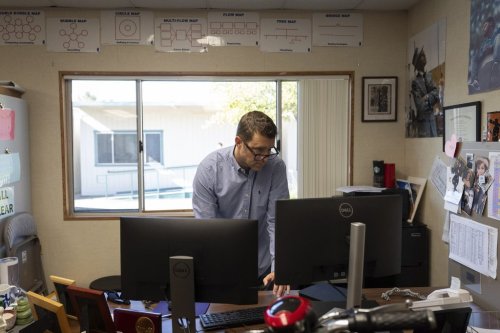
Cuny’s students at Valencia High School in southern California now do most writing in class. He monitors student laptop screens from his desktop, using software that lets him “lock down” their screens or block access to certain sites. He’s also integrating AI into his lessons and teaching students how to use AI as a study aid “to get kids learning with AI instead of cheating with AI.”
In rural Oregon, high school teacher Kelly Gibson has made a similar shift to in-class writing. She is also incorporating more verbal assessments to have students talk through their understanding of assigned reading.
“I used to give a writing prompt and say, ‘In two weeks, I want a five-paragraph essay,’” says Gibson. “These days, I can’t do that. That’s almost begging teenagers to cheat.”
Take, for example, a once typical high school English assignment: Write an essay that explains the relevance of social class in “The Great Gatsby.” Many students say their first instinct is now to ask ChatGPT for help “brainstorming.” Within seconds, ChatGPT yields a list of essay ideas, plus examples and quotes to back them up. The chatbot ends by asking if it can do more: “Would you like help writing any part of the essay? I can help you draft an introduction or outline a paragraph!”
Students are uncertain when AI usage is out of bounds
Students say they often turn to AI with good intentions for things like research, editing or help reading difficult texts. But AI offers unprecedented temptation, and it’s sometimes hard to know where to draw the line.
College sophomore Lily Brown, a psychology major at an East Coast liberal arts school, relies on ChatGPT to help outline essays because she struggles putting the pieces together herself. ChatGPT also helped her through a freshman philosophy class, where assigned reading “felt like a different language” until she read AI summaries of the texts.
“Sometimes I feel bad using ChatGPT to summarize reading, because I wonder, is this cheating? Is helping me form outlines cheating? If I write an essay in my own words and ask how to improve it, or when it starts to edit my essay, is that cheating?”
Her class syllabi say things like: “Don’t use AI to write essays and to form thoughts,” she says, but that leaves a lot of grey area. Students say they often shy away from asking teachers for clarity because admitting to any AI use could flag them as a cheater.
Schools tend to leave AI policies to teachers, which often means that rules vary widely within the same school. Some educators, for example, welcome the use of Grammarly.com, an AI-powered writing assistant, to check grammar. Others forbid it, noting the tool also offers to rewrite sentences.
“Whether you can use AI or not depends on each classroom. That can get confusing,” says Valencia 11th grader Jolie Lahey. She credits Cuny with teaching her sophomore English class a variety of AI skills like how to upload study guides to ChatGPT and have the chatbot quiz them, and then explain problems they got wrong.
But this year, her teachers have strict “No AI” policies. “It’s such a helpful tool. And if we’re not allowed to use it that just doesn’t make sense,” Lahey says. “It feels outdated.”
Schools are introducing guidelines, gradually
Many schools initially banned use of AI after ChatGPT launched in late 2022. But views on the role of artificial intelligence in education have shifted dramatically. The term “AI literacy” has become a buzzword of the back-to-school season, with a focus on how to balance the strengths of AI with its risks and challenges.
Over the summer, several colleges and universities convened their AI task forces to draft more detailed guidelines or provide faculty with new instructions.
The University of California, Berkeley emailed all faculty new AI guidance that instructs them to “include a clear statement on their syllabus about course expectations” around AI use. The guidance offered language for three sample syllabus statements — for courses that require AI, ban AI in and out of class, or allow some AI use.
“In the absence of such a statement, students may be more likely to use these technologies inappropriately,” the email said, stressing that AI is “creating new confusion about what might constitute legitimate methods for completing student work.”
Carnegie Mellon University has seen a huge uptick in academic responsibility violations due to AI, but often students aren’t aware they’ve done anything wrong, says Rebekah Fitzsimmons, chair of the AI faculty advising committee at the university’s Heinz College of Information Systems and Public Policy.
For example, one student who is learning English wrote an assignment in his native language and used DeepL, an AI-powered translation tool, to translate his work to English. But he didn’t realize the platform also altered his language, which was flagged by an AI detector.
Enforcing academic integrity policies has become more complicated, since use of AI is hard to spot and even harder to prove, Fitzsimmons said. Faculty are allowed flexibility when they believe a student has unintentionally crossed a line, but are now more hesitant to point out violations because they don’t want to accuse students unfairly. Students worry that if they are falsely accused, there is no way to prove their innocence.

Over the summer, Fitzsimmons helped draft detailed new guidelines for students and faculty that strive to create more clarity. Faculty have been told a blanket ban on AI “is not a viable policy” unless instructors make changes to the way they teach and assess students. A lot of faculty are doing away with take-home exams. Some have returned to pen and paper tests in class, she said, and others have moved to “flipped classrooms,” where homework is done in class.
Emily DeJeu, who teaches communication courses at Carnegie Mellon’s business school, has eliminated writing assignments as homework and replaced them with in-class quizzes done on laptops in “a lockdown browser” that blocks students from leaving the quiz screen.
“To expect an 18-year-old to exercise great discipline is unreasonable,” DeJeu said. “That’s why it’s up to instructors to put up guardrails.”
___
The Associated Press’ education coverage receives financial support from multiple private foundations. AP is solely responsible for all content. Find AP’s standards for working with philanthropies, a list of supporters and funded coverage areas at AP.org.