Endangered pink river dolphins face a rising mercury threat in the Amazon
Advertisement
Read this article for free:
or
Already have an account? Log in here »
To continue reading, please subscribe:

Digital Subscription
One year of digital access for only $205*
- Enjoy unlimited reading on winnipegfreepress.com
- Read the E-Edition, our digital replica newspaper
- Access News Break, our award-winning app
- Play interactive puzzles
*First annual payment billed as $205.00 + GST for one year. This annual subscription will automatically renew at $233.00 + GST every 52 weeks (10% off the regular annual price of $259.35). Offer available to new and qualified returning subscribers only. Cancel any time.
To continue reading, please subscribe:
Add Free Press access to your Brandon Sun subscription for only an additional
$1 for the first 4 weeks*
- Enjoy unlimited reading on winnipegfreepress.com
- Read the E-Edition, our digital replica newspaper
- Access News Break, our award-winning app
- Play interactive puzzles
*Your next Brandon Sun subscription payment will increase by $1.00 and you will be charged $17.95 plus GST for four weeks. After four weeks, your payment will increase to $24.95 plus GST every four weeks.
Read unlimited articles for free today:
or
Already have an account? Log in here »
Hey there, time traveller!
This article was published 16/09/2025 (332 days ago), so information in it may no longer be current.
PUERTO NARINO, Colombia (AP) — A flash of pink breaks the muddy surface of the Amazon River as scientists and veterinarians, waist-deep in the warm current, patiently work a mesh net around a pod of river dolphins. They draw it tighter with each pass, and a spray of silver fish glistens under the harsh sun as they leap to escape the net.
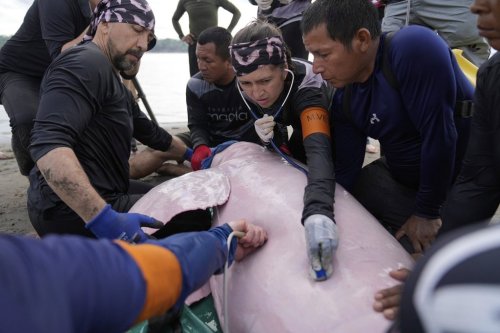
When the team hauls a dolphin into a boat, it thrashes as water streams from its pink-speckled sides and the crew quickly ferries it to the sandy riverbank where adrenaline-charged researchers lift it onto a mat. They have 15 minutes — the limit for how long a dolphin can safely be out of the water — to complete their work.
Fernando Trujillo, a marine biologist leading the effort, kneels beside the animal’s head, shielding its eye with a small cloth so it can’t see what’s happening. He rests his hand gently on the animal and speaks in low tones.

“They’ve never felt the palm of a hand. We try to calm them,” said Trujillo, sporting a pink dolphin bandana. “Taking a dolphin out of the water, it’s a kind of abduction.”
One person counts the dolphin’s breaths. Another wets its skin with a sponge while the others conduct multiple medical tests that will help show how much mercury is coursing through the Amazon’s most graceful predators.
Mercury threat spreads through the Amazon food chain
Trujillo directs the Omacha Foundation, a conservation group focused on aquatic wildlife and river ecosystems, and leads health evaluations of river dolphins. It’s a painstaking operation involving experienced fishermen, veterinarians and locals that takes months of planning and happens a couple of times a year.
“We take blood and tissue samples to assess mercury,¨ Trujillo told The Associated Press from the Colombian riverside town of Puerto Narino. “Basically, we’re using dolphins as sentinels for the river’s health.”
Mercury contamination comes mainly from illegal gold mining — a growing industry across the Amazon Basin — and forest clearing that washes mercury that naturally occurs in soil into waterways.
The miners use mercury to separate gold from sediment, then dump the sludge back into rivers, where it enters fish eaten by people and dolphins. Rising global gold prices have fueled a mining boom, and mercury pollution in remote waterways has increased.
Mercury can damage the brain, kidneys, lungs and immune system and cause mood swings, memory loss and muscle weakness in people, according to the World Health Organization and the U.S. Environmental Protection Agency. Pregnant women and young children are most at risk, with prenatal exposure linked to developmental delays and reduced cognitive function.
“The maximum any living being should have is 1 milligram per kilogram,” Trujillo said. “Here, we’re seeing 20 to 30 times that amount.”
In previous years, his team found 16 to 18 milligrams per kilogram of mercury in dolphins, which can suffer the same neurological damage, organ damage and other problems as humans. In Colombia’s Orinoco River, levels in some dolphins have reached as high as 42, levels scientists say are among the most extreme ever recorded in the species.
Trujillo said it’s difficult to prove the toxin is directly killing dolphins. Further studies are underway, he added, noting that “any mammal with a huge amount of mercury will die.”
When Trujillo and his team tested their own blood three years ago, his results showed more than 36 times the safe limit — 36.4 milligrams per kilogram — a level he attributes to decades working in mercury-affected areas and a diet heavy in fish. With medical assistance, his levels have dropped to about 7 milligrams.
“Mercury is an invisible enemy until it builds up to a sufficient amount, then it starts to affect the central nervous system,” Trujillo told AP after his team managed to capture and test four pink dolphins. “We’re already seeing evidence of it in Indigenous communities.”
A series of scientific studies and reports — including work by the International Pollutants Elimination Network and academic researchers — have found high mercury exposure among Indigenous peoples across the Amazon, including in Brazil, Peru, Colombia, Suriname and Bolivia. Hair samples showed averages well above WHO’s safe threshold of 1 part per million, with one Colombian community registering more than 22 milligrams per kilogram.
Dolphin populations in this part of the Amazon have plunged, with Trujillo’s monitoring showing a 52% decline in pink dolphins and a 34% drop in gray river dolphins, a different species, in recent decades. The International Union for Conservation of Nature listed the pink dolphin as endangered in 2018. Trujillo said exact numbers for the Amazon are unknown, but his organization estimates 30,000 to 45,000 across the basin.
Pink river dolphins also face threats from overfishing, accidental entanglement in nets, boat traffic, habitat loss and prolonged drought.
Colombia says it’s tackling illegal mining and mercury pollution. It banned mercury use in mining in 2018, ratified the Minamata Convention aimed at reducing mercury in the environment and submitted an action plan in 2024. Authorities cite joint operations with Brazil and recent enforcement sweeps, but watchdogs say efforts remain uneven and illegal mining persists across much of the country.
Other Amazon nations say they’re stepping up. Brazil has launched raids and moved to restrict satellite internet used by illegal gold-mining camps that use mercury, aiming to disrupt logistics and supply lines. Peru recently seized a record 4 tons of smuggled mercury. Ecuador, Suriname and Guyana have filed action plans to cut mercury use in small-scale gold mining.
A delicate operation to test dolphins safely
The dolphin testing operation relies on José “Mariano” Rangel, a charismatic former fisherman from Venezuela. He leads the charge when it’s time to haul the animals — which can weigh as much as 160 kilograms (about 353 pounds) — into the small boats. It’s a moment that can end with a stinging blow to the jaw as the dolphins thrash to break free.
“The most difficult part of the captures is enclosing the dolphins,” Rangel said.
A portable ultrasound machine scans lungs, heart and other vital organs for disease. The team checks for respiratory problems, internal injuries and signs of reproduction, photograph the animals’ skin and scars, swab blowholes and genital openings for bacterial cultures, and collect tissue for mercury testing. Microchips are implanted so researchers can identify each animal and avoid duplicating tests.
Omacha has recorded antimicrobial resistance — bacteria that can’t be killed by common medicines — and respiratory problems. They have also identified possible emerging diseases, such as papilloma virus, that could pose risks to both dolphins and humans.

After a long morning hauling and testing dolphins, the scientists return to a laboratory in Puerto Narino that’s covered with posters of dolphins and manatees and the bones and skulls of dolphins and other animals. They test some samples, prepare others to send to larger facilities and end their day repairing nets and refilling kits to do it all again at dawn.
For Trujillo, each capture, scan and blood test is part of a larger fight.
“We are one step away from being critically endangered and then extinct,” Trujillo said.
___
The Associated Press’ climate and environmental coverage receives financial support from multiple private foundations. AP is solely responsible for all content. Find AP’s standards for working with philanthropies, a list of supporters and funded coverage areas at AP.org.