Daring drama asks ‘What would you die for?’
Experimental work explores uncomfortable questions with wisdom, humour
Advertisement
Read this article for free:
or
Already have an account? Log in here »
To continue reading, please subscribe:

Digital Subscription
One year of digital access for only $205*
- Enjoy unlimited reading on winnipegfreepress.com
- Read the E-Edition, our digital replica newspaper
- Access News Break, our award-winning app
- Play interactive puzzles
*First annual payment billed as $205.00 + GST for one year. This annual subscription will automatically renew at $233.00 + GST every 52 weeks (10% off the regular annual price of $259.35). Offer available to new and qualified returning subscribers only. Cancel any time.
To continue reading, please subscribe:
Add Free Press access to your Brandon Sun subscription for only an additional
$1 for the first 4 weeks*
- Enjoy unlimited reading on winnipegfreepress.com
- Read the E-Edition, our digital replica newspaper
- Access News Break, our award-winning app
- Play interactive puzzles
*Your next Brandon Sun subscription payment will increase by $1.00 and you will be charged $17.95 plus GST for four weeks. After four weeks, your payment will increase to $24.95 plus GST every four weeks.
Read unlimited articles for free today:
or
Already have an account? Log in here »
Hey there, time traveller!
This article was published 21/09/2025 (365 days ago), so information in it may no longer be current.
Theatre at its core best should provoke, push those that witness it out of cosy cocoons of expectation, and challenge preconceived notions and assumptions, all within the construct of engaging storytelling.
It should also inspire with the power of possibility, harnessing the art form itself to shake up the status quo, whether onstage or off.
Theatre Projects Manitoba’s daring season-opener, O.G.I. (The Only Good Indian), checked all those boxes and more during Saturday’s matinee, held at the intimate Colin Jackson Studio Theatre, with its third performance of an 11-show run featuring Winnipeg actor/playwright/director Debbie Patterson.
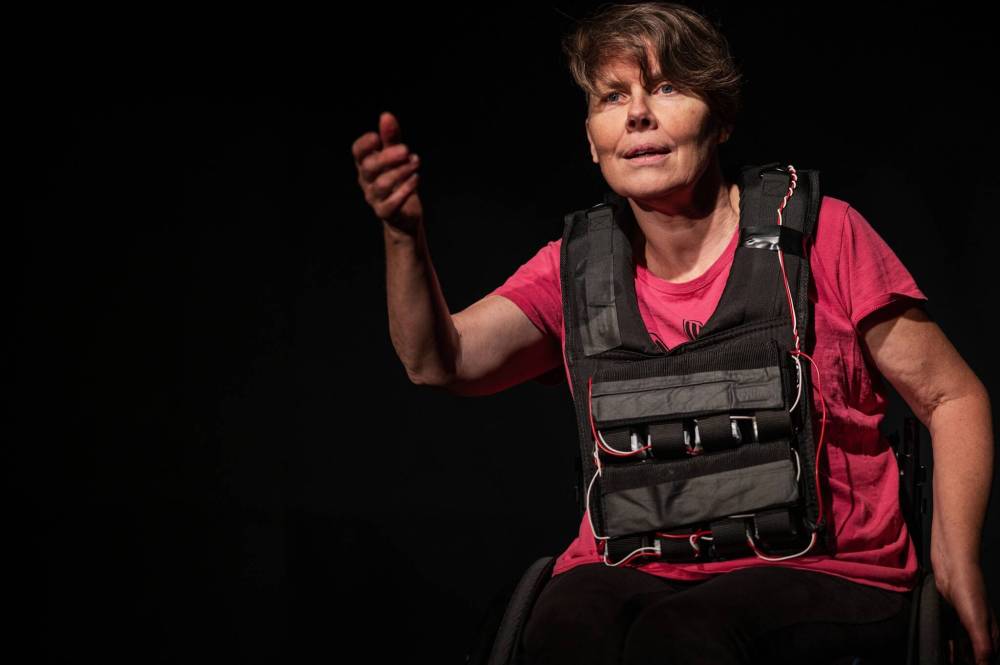
Pablo Riquelme photo
Debbie Patterson delivers an impassioned monologue in O.G.I.
There are actually five “different” plays in this experimental production, co-created in 2017 by Toronto’s Pandemic Theatre founders Jivesh Parasram and Tom Arthur Davis and titled after the infamous quote by former prime minister Sir John A. Macdonald (among others).
Five actors, including Parasram and Davis, as well as three local thespians — Patterson, Eric Plamondon and Hazel Venzon — take turns throughout the run to strap on a suicide vest and ask audience members to enter into the radicalized headspace of a suicide bomber.
Each actor delivers a unique penned, semi-autobiographical monologue (the program notes state these are fictionalized characters) that is equal parts drama, meditation and TED Talk, exploring topical issues of colonization and occupation (mostly) as settlers on Turtle Island.
Only Métis actor Plamondon, who performed at Saturdays’s evening performance, received carte blanche to reinvent the project in whichever way he wished, as O.G.I.’s inaugural Indigenous performer.
Common script elements written by Parasram and Davis are interwoven throughout each performance, adding cohesive narrative glue while thematically knitting the entire production together, as audience members are confronted with the existential question: “What would you die for?”
Patterson, a pillar of Winnipeg’s theatre community and the founder of Sick & Twisted Theatre, shares her own experience as a disabled person living with multiple sclerosis, typically perceived as “an other” in a well-intentioned though often still pitying society of ablest do-gooders.
She immediately eschews such micro-aggressive monikers as “differently abled” and “person with a disability” as she spins about the stage in her wheelchair, making one question one’s own terms of reference.
Lighting a candle — evoking votive candles traditionally lit in Catholicism as a prayer of intention, call for saintly intercession or remembrance of the dead — at the top of the show infuses a sense of ritual or private confessional. A series of slide projections of scene/chapter titles, including “Hate Crimes” and “Suicide Me,” include photographic images that add further visual punch.

Pablo Riquelme photo
Métis actor Eric Plamondon is one of five performers who takes turns throughout the run to strap on a suicide vest and ask audience members to enter into the radicalized headspace of a suicide bomber.Patterson draws on her decades of stagecraft to deliver a well paced, compelling narrative, wisely laced with the sugar of humour and wit to make the medicine — harder-hitting questions about societal biases and inter-generational trauma — more palatable.
She’s also unflinching in talking about “performative femininity,” and delivers insights about the sex lives of the disabled, including her own.
Her no-holds-barred delivery recalls the actor’s prior original plays Sargent & Victor & Me (2014) and How it Ends (2019), using prose that’s both vernacular and poetic, with strategically placed F-bombs.
Several sections shudder with truth, including Patterson’s analysis of societal norms and reactions to the disabled, often viewed as “in the way,” as a medical emergency, or even as self-inflating opportunities “to do a good deed for the cripple.”
One can’t help but cheer when the actor, frequently asked by strangers how they can help, resolutely assures us that she’s “killing it.”
Patterson also reveals stories of her Indigenous ancestors, including Anne, her great-great-great grandmother. We hear about her mother’s best friend growing up, Betty, a “chubby, Indigenous girl who could play Bach like an angel,” who was scooped up as a young girl from her northern community and sexually abused by her adoptive father, a minister.
A section about the destructive forces of organized religion, and especially the “occupation” of Christianity that historically attempted to “kill the Indian” during one of Canada’s darkest chapters, extensively detailed by the Truth and Reconciliation Commission in its 2015 report, is delivered with missionary zeal, potentially making some audience members squirm (not necessarily a bad thing).
More circling back to O.G.I.’s theme of colonization/occupation would be welcome, as would more harrowing references to her strapped-on bomb, ticking closer toward oblivion. However, Patterson’s recollections of growing up as the child of a sexual predator are powerful.
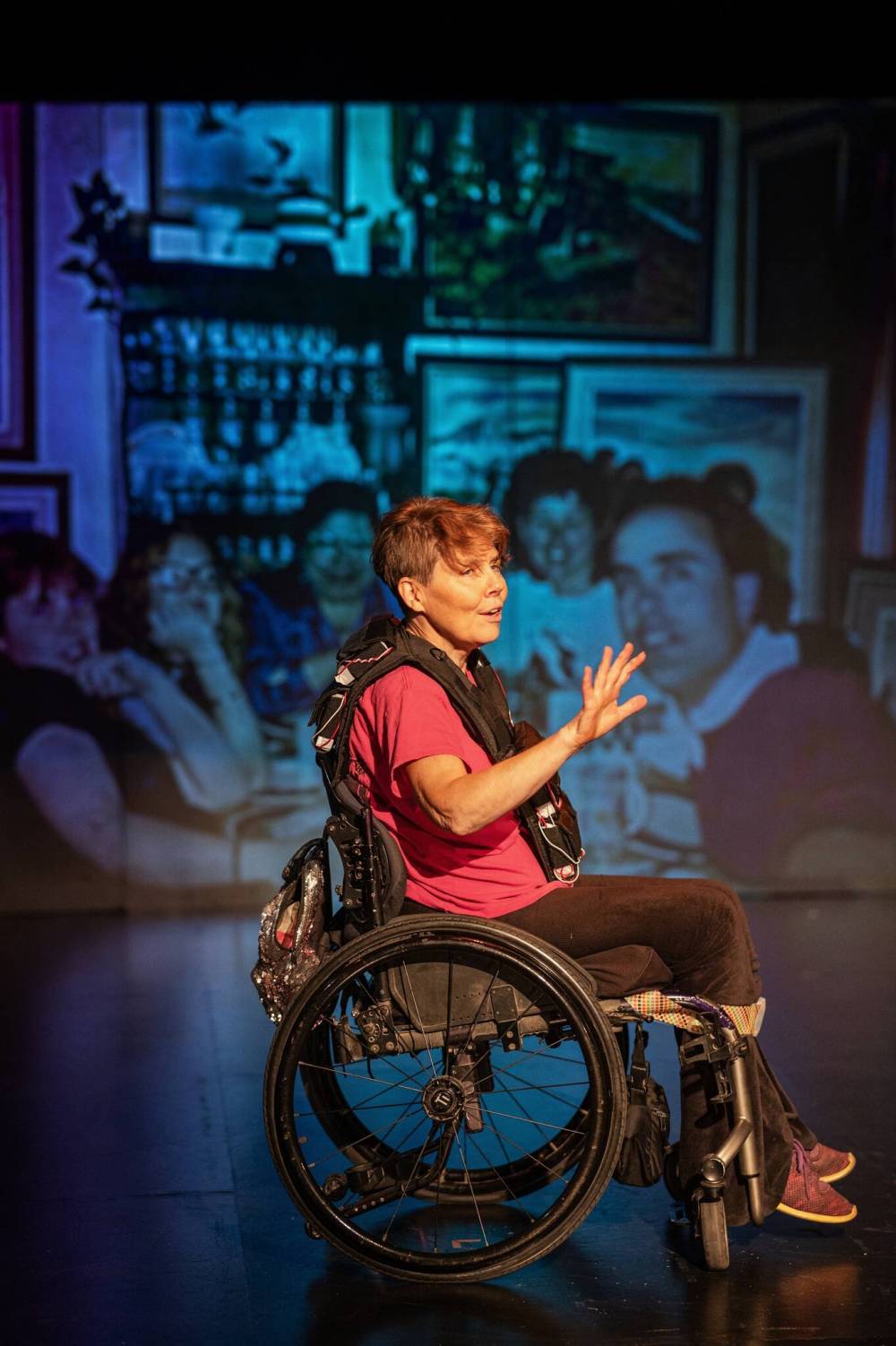
Pablo Riquelme photo
Debbie Patterson is one of three local performers adapting O.G.I during its Theatre Projects run.

Act II of this experimental work invites audience members to an onstage, long-table discussion akin to a dinner party (and yes, there are snacks). It speaks to TPM’s intrepid audiences that 14 people, including Patterson and artistic director Suzie Martin, pulled up a chair to take part in a discussion based on a prompt moderated by Parasram and Davis.
Thus the audience becomes subsumed into the fabric of the play as first-person participants in its own drama(s), extending the conversation further, in lieu of a typical, Q&A interactive discussion.
Without wholly committed actors/playwrights, this highly reflective play, which comes with a content warning, could fall flat or be overly didactic. Its unapologetic, politically charged title, somewhat blunted by its acronym, also might turn off those with more sensitive proclivities.
However this is theatre, and Patterson’s fierce conviction creates a riveting, two-hour (including intermission) ride into the stratum of what it means to be “othered,” stirring the pot of complacency while forcing audience members to examine their own potential prejudice.
holly.harris@shaw.ca
Holly Harris writes about music for the Free Press Arts & Life department.
Our newsroom depends on a growing audience of readers to power our journalism. If you are not a paid reader, please consider becoming a subscriber.
Our newsroom depends on its audience of readers to power our journalism. Thank you for your support.
Theatre Review
O.G.I. (The Only Good Indian)
Theatre Projects Manitoba
Prairie Theatre Exchange’s Colin Jackson Studio
To Sunday, Sept. 28
★★★★ out of five
Holly Harris writes about music for the Free Press Arts & Life department.
Our newsroom depends on a growing audience of readers to power our journalism. If you are not a paid reader, please consider becoming a subscriber.
Our newsroom depends on its audience of readers to power our journalism. Thank you for your support.
Related Articles
Dozens join city’s first Reconciliation Walk
Advertisement Advertise With Us
Advertisement Advertise With Us