Ukraine uses remote-controlled vehicles for dangerous missions to protect soldiers

Advertisement

Advertise with us

DONETSK REGION, Ukraine (AP) — On a battlefield swarming with deadly Russian drones, Ukrainian soldiers are increasingly turning to nimble, remote-controlled armored vehicles that can perform an array of tasks and spare troops from potentially life-threatening missions.

Read this article for free:


or

Already have an account? Log in here »

To continue reading, please subscribe:

Subscribe and receive a limited-edition Free Press branded hat or tote.

Digital Subscription

One year of digital access for only $205*

  • Enjoy unlimited reading on winnipegfreepress.com
  • Read the E-Edition, our digital replica newspaper
  • Access News Break, our award-winning app
  • Play interactive puzzles

*First annual payment billed as $205.00 + GST for one year. This annual subscription will automatically renew at $233.00 + GST every 52 weeks (10% off the regular annual price of $259.35). Offer available to new and qualified returning subscribers only. Cancel any time.

To continue reading, please subscribe:

Add Free Press access to your Brandon Sun subscription for only an additional

$1 for the first 4 weeks*

  • Enjoy unlimited reading on winnipegfreepress.com
  • Read the E-Edition, our digital replica newspaper
  • Access News Break, our award-winning app
  • Play interactive puzzles
Start now

*Your next Brandon Sun subscription payment will increase by $1.00 and you will be charged $17.95 plus GST for four weeks. After four weeks, your payment will increase to $24.95 plus GST every four weeks.

Hey there, time traveller!
This article was published 22/09/2025 (362 days ago), so information in it may no longer be current.

DONETSK REGION, Ukraine (AP) — On a battlefield swarming with deadly Russian drones, Ukrainian soldiers are increasingly turning to nimble, remote-controlled armored vehicles that can perform an array of tasks and spare troops from potentially life-threatening missions.

The Ukrainian army is especially eager to deploy what soldiers refer to as “robots on wheels” as it faces a shortage of soldiers in a war that has dragged on for more than 3 1/2 years. The vehicles look like miniature tanks and can ferry supplies, clear mines and evacuate the wounded or dead.

“It cannot fully replace people,” said the commander of a platoon of the 20th Lyubart Brigade who goes by the call sign Miami and spoke on condition of anonymity in line with military rules. “I would put it this way: A person can go in there, but for a human it’s (sometimes) far too dangerous.”

A Ukrainian serviceman known by the call sign
A Ukrainian serviceman known by the call sign "Miami" works on robotic military equipment near the front line in Donetsk region, Ukraine, on Monday, Sept. 8, 2025. (AP Photo/Alex Babenko)

The robotic vehicles are mostly made by Ukrainian companies and range in cost from about $1,000 to as much as $64,000, depending on their size and capabilities.

While they have become vital to Ukrainian troops along the 1,000 kilometer (620 mile) front line, such vehicles are not new to warfare.

The German army used a remote-controlled miniature tank – tethered by a wire — called the Goliath in World War II. In recent decades, the U.S., Israel, Britain and China have developed modern versions used for combat engineering and other battlefield roles, according to Ben Barry, a fellow at the International Institute for Strategic Studies. But Ukraine’s extensive deployment of these vehicles is noteworthy and could lead to advances, Barry said.

The Russian army also uses remote-controlled vehicles.

From drones to autonomous vehicles

Miami joined the army on the first day of Russia’s full-scale invasion in February 2022. He served as an infantryman and later a drone operator before his latest assignment. His path reflects how the war itself has evolved.

“I couldn’t even imagine that I would become a (drone) pilot,” he said. “But war is progress, and we cannot stand aside.”

The robotic vehicles his team deploys are armored and mounted on either wheels or tracks. Painted in military colors, they crawl slowly over rubble or dirt roads, easily navigating terrain that would be difficult – or too dangerous — for soldiers.

“They arrive in one condition, and we improve them,” Miami said. “We adapt the controls to work better (in the face of Russia’s) electronic warfare so the connection doesn’t cut off.”

Miami’s 10-man team is just starting to incorporate the machines into their missions, mostly using them to deliver food and ammunition to soldiers near the front.

Just like remote-controlled, or first-person view, drones, the use of these vehicles will only grow, said a soldier in Miami’s unit who goes by the call sign Akim and spoke on condition of anonymity.

“When FPV drones first appeared, they weren’t popular, but those who pioneered them, (now) show (the best) results,” said Akim.

An autonomous vehicle ‘doesn’t get tired’

Before sending a remote-controlled vehicle forward, Akim flies a drone along the planned route to check for obstacles or mines.

Operating from a cramped basement near Kostiantynivka, less than 10 kilometers from the front, Akim can hear the muffled thuds of aerial bombs, the sharp cracks of artillery and the buzzing of drones.
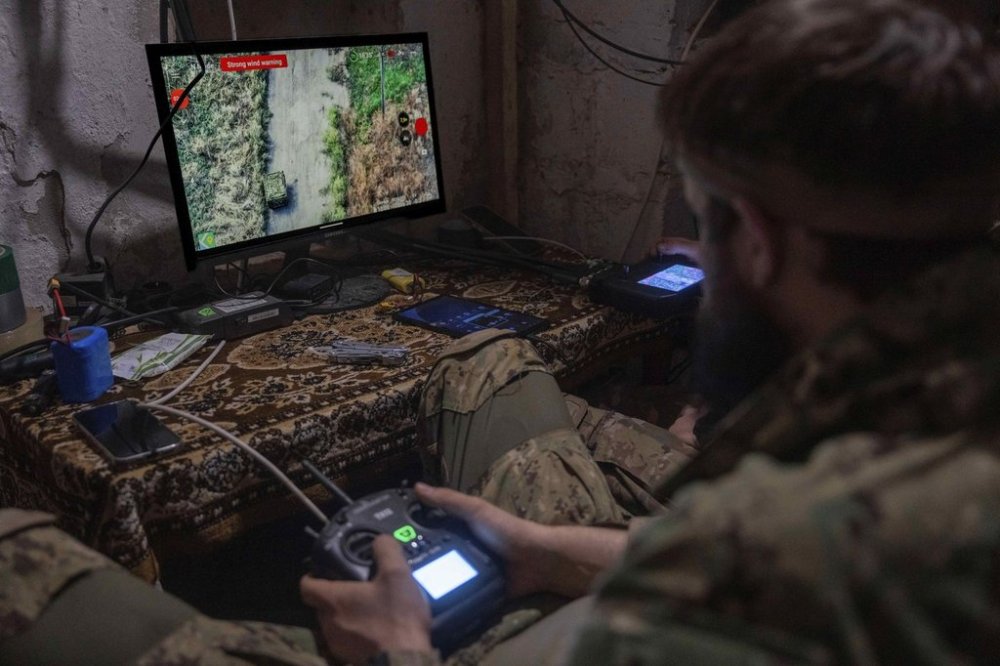
Ukrainian servicemen navigate land and aerial drones near Kostiantynivka, Ukraine, on Wednesday, Sept. 10, 2025. (AP Photo/Alex Babenko)

Kostiantynivka, once home to 67,000 people, is a largely deserted city on a shrinking patch of Ukrainian-held territory just west of Bakhmut. It is nearly encircled on three sides by Russian forces. Apartment blocks are scarred by strikes, smoke still rises from recent bombings, and the roads leading toward nearby Pokrovsk are littered with burned-out cars.

The aerial drone allows Akim to scout the city and routes without risking his life.

“Every time a drone or a robot does something, it means one of our fighters doesn’t have to,” Akim said. On top of that, “the machine doesn’t get tired. It can carry as much as needed.”

Akim works in tandem with another soldier operating the robotic vehicle with a joystick. The vehicle has no camera; instead, Akim’s drone feed provides its “eyes.”

On one recent mission, the team loaded it with 200 kilograms (440 pounds) of supplies — ammunition, fuel, water and food — and sent it several kilometers to drone operators closer to the front. The machine moved forward at about six kilometers per hour, delivered its cargo into a well-hidden position in the forest, and returned to base.

Bumps along the road

Because robotic vehicles move more slowly than cars or trucks, and usually across open ground, they are an easy target — and this is one factor slowing their adoption.

“That’s why we haven’t evacuated many wounded (on these vehicles),” said Miami. “Some refuse to leave because it’s dangerous.”

There are also cost considerations, with the vehicles his platoon uses averaging roughly 400,000 hryvnias ($9,700). “That’s not too expensive, but when three or four get destroyed in a week, the total adds up,” Miami said.

To make them less vulnerable, Miami and his soldiers have tried welding grill-like cages onto the machines or attaching metallic rollers in front to detect mines. The war provides real-time feedback that is incorporated into newer models being built.

___

Vasilisa Stepanenko and Yehor Konovalov contributed to this report.
Report Error Submit a Tip

More Stories

Former Bombers linebacker Gauthier enjoying career as electrician

Taylor Allen 6 minute read Preview

Former Bombers linebacker Gauthier enjoying career as electrician

Taylor Allen 6 minute read Yesterday at 12:44 PM CDT

Most professional football players don’t ride off into the sunset on their own terms.

Shayne Gauthier was well aware of that, but it didn’t make it sting any less when the Winnipeg Blue Bombers informed the veteran linebacker that they weren’t bringing him back for 2026.

“I was really hoping to play one more (season) because it would have been my 10th season, so, I’d say it didn’t really end the way I wanted,” Gauthier recently told the Free Press.

“It left a little sour taste in my mouth, but that’s part of pro sports. If everybody got the ending that they wanted, then it wouldn’t really work.”

Read
Yesterday at 12:44 PM CDT

Hellebuyck standoff caused by… Nathan MacKinnon?

Mike McIntyre 6 minute read Preview

Hellebuyck standoff caused by… Nathan MacKinnon?

Mike McIntyre 6 minute read Yesterday at 6:34 PM CDT

Looking for someone to blame in the Connor Hellebuyck fiasco and cast as public enemy No. 1? How about long-time Winnipeg Jets nemesis Nathan MacKinnon?

Allow us to explain as we fire up the time machine and head back to February in Italy.

Oh, what could have been if MacKinnon had been able to score on what appeared to be an open net late in the third period of the men’s gold medal game with Hellebuyck down and seemingly out of position.

Instead, the star forward fired wide, keeping the score deadlocked at 1-1 as the clock ticked down on regulation.

Read
Yesterday at 6:34 PM CDT

Not falling back means time loop remains unclosed

Jen Zoratti 4 minute read 2:01 AM CDT

I demand restitution. Where’s my hour?

In the traditional fall-back, spring-forward time change set up — you know, ol’ trusty that’s been effect for lo these 63 years — we lost an hour in the spring that we got back in the fall.

That was the social contract: you commit to feeling like you’re on cold medication for a week in March because you know a glorious extra hour of sleep will be returned to you in November. (Unless, of course, you have little kids, but look: we all make our choices.)

Well, that transaction, flawed as it was, isn’t happening this year. That hour you sacrificed to the sun gods in the spring? Gone. Not coming back. We’ve sprung forward and we shan’t be falling back — not in November, and (possibly) not ever. The scale shall remain unbalanced and the loop shall remain unclosed as Manitoba has adopted permanent daylight time.

Jets vets weigh in on franchise goalie Hellebuyck not reporting to training camp

Mike McIntyre 7 minute read Preview

Jets vets weigh in on franchise goalie Hellebuyck not reporting to training camp

Mike McIntyre 7 minute read Thursday, Sep. 17, 2026

Hockey is the ultimate team sport, where it’s supposed to be about the crest on your chest rather than the name on your back.

So how is Connor Hellebuyck’s trade request and subsequent training camp strike playing out inside the Winnipeg Jets locker room — particularly among other core players he’s gone to battle with over the years?

“Obviously the news is heartbreaking,” Jets forward Kyle Connor said Thursday.

“It feels like we had such a special group here and for whatever reason — I can’t speak to the reason until we hear from the man, I’m not going to speculate on what it is but I know that a lot of guys in that room that are heartbroken.”

Read
Thursday, Sep. 17, 2026

Cabernet Sauvignon star of wine festival

Ben Sigurdson 5 minute read Preview

Cabernet Sauvignon star of wine festival

Ben Sigurdson 5 minute read 3:00 AM CDT

The Winnipeg Wine Festival will celebrate the king of red wine grapes next weekend — the theme of this year’s festival, which takes place Sept. 25 and 26 at the RBC Convention Centre, is Cabernet Sauvignon.

Cab Sauv, as it’s also known, is the world’s most widely planted wine grape of any colour, first coming to prominence in the 1800s in France’s Bordeaux region, where the grape is still popular. Rather than single-variety wines, Bordeaux reds tend to be blends, with those coming from the left bank of the Gironde estuary being Cabernet-dominant, while right-bank wines are Merlot-dominant, with Cabernet Sauvignon playing a supporting role. Cabernet and Merlot work well together and many other countries have followed suit in blending the two.

A team at University of California Davis put Cabernet Sauvignon through a DNA test in 1996 and discovered its parent grapes are Cabernet Franc and Sauvignon Blanc — it’s likely that at some point the two varieties, planted next to each other in some vineyard, crossed and mutated and became the grape we know today. (Someone growing grapes in the 19th century must have had an inkling of what was up, as the grape has been called Cabernet Sauvignon since long before the DNA test.)

Flavour-wise, most Cabernet Sauvignon wines are big and bold, with a core of deep dark berry flavours, some graphite and spice notes and relatively bright acidity. It’s a grape that is well-suited to barrel aging, with most examples seeing at least some time in wood.

Read
3:00 AM CDT

Desperate Poilievre wants Canadians to believe the sky is falling when it’s just cloudy outside

Tom Brodbeck 5 minute read Preview

Desperate Poilievre wants Canadians to believe the sky is falling when it’s just cloudy outside

Tom Brodbeck 5 minute read Yesterday at 12:47 PM CDT

Pierre Poilievre has a problem.

Canadians just don’t seem to be paying much attention to him anymore.

So, naturally, the Conservative Opposition leader has decided to turn up the volume.

At a recent party caucus retreat in Penticton, B.C., Poilievre delivered the familiar message: Canada is in trouble, Canadians are hurting and the Liberal government is making everything worse.

Read
Yesterday at 12:47 PM CDT