OpenAI shows off Stargate AI data center in Texas and plans 5 more elsewhere with Oracle, Softbank
Advertisement
Read this article for free:
or
Already have an account? Log in here »
To continue reading, please subscribe:

Digital Subscription
One year of digital access for only $205*
- Enjoy unlimited reading on winnipegfreepress.com
- Read the E-Edition, our digital replica newspaper
- Access News Break, our award-winning app
- Play interactive puzzles
*First annual payment billed as $205.00 + GST for one year. This annual subscription will automatically renew at $233.00 + GST every 52 weeks (10% off the regular annual price of $259.35). Offer available to new and qualified returning subscribers only. Cancel any time.
To continue reading, please subscribe:
Add Free Press access to your Brandon Sun subscription for only an additional
$1 for the first 4 weeks*
- Enjoy unlimited reading on winnipegfreepress.com
- Read the E-Edition, our digital replica newspaper
- Access News Break, our award-winning app
- Play interactive puzzles
*Your next Brandon Sun subscription payment will increase by $1.00 and you will be charged $17.95 plus GST for four weeks. After four weeks, your payment will increase to $24.95 plus GST every four weeks.
Read unlimited articles for free today:
or
Already have an account? Log in here »
Hey there, time traveller!
This article was published 23/09/2025 (319 days ago), so information in it may no longer be current.
ABILENE, Texas (AP) — The afternoon sun was so hot that OpenAI CEO Sam Altman traded his usual crewneck sweater for a T-shirt on the last legs of a Tuesday visit to the massive Stargate artificial intelligence data center complex that will power the future of ChatGPT.
OpenAI announced Tuesday that its flagship AI data center in Texas will be joined by five others around the U.S. as the ChatGPT maker aims to make good on the $500 billion infrastructure investment promoted by President Donald Trump earlier this year.
Stargate, a joint venture between OpenAI, Oracle and Softbank, said it is building two more data center complexes in Texas, one in New Mexico, one in Ohio and another in a Midwest location it hasn’t yet disclosed.
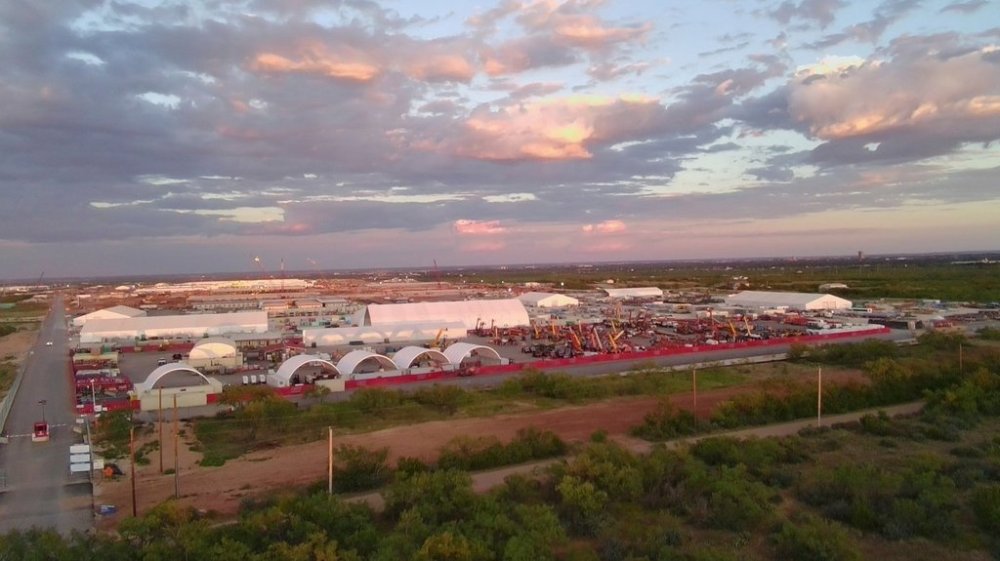
But it’s the project in Abilene, Texas, that promised to be the biggest of them all, transforming what the city’s mayor called an old railroad town.
Oracle executives visiting the eight-building complex said it is already on track to be the world’s largest AI supercluster once fully built, a reference to its network of hundreds of thousands of AI computer chips that will be running in its H-shaped buildings.
Altman said, “When you hit that button on ChatGPT, you really don’t — I don’t, at least” — think about what happens inside the data halls used to build and operate the chatbot.
He and Oracle’s new co-CEO Clay Magouyrk also sought to emphasize the steps they’ve taken to reduce the energy-hungry complex’s environmental effects on a drought-prone region of West Texas, where temperatures hit 97 degrees Fahrenheit (36 degrees Celsius) on Tuesday.
“We’re burning gas to run this data center,” said Altman, but added that “in the long trajectory of Stargate” the hope is to rely on many other power sources.
The complex will require about 900 megawatts of electricity to power the eight buildings.
One is already operating, and a second that Altman and Magouyrk visited Tuesday is nearly complete. Each server rack in those buildings holds 72 of Nvidia’s GB200 chips, which are specially designed for the most intensive AI workloads. Each building is expected to have about 60,000 of them.
More than 6,000 workers now commute to the massive construction project each day, in what Mayor Weldon Hurt described as a significant boost to the local economy. The campus and nearby expansion will provide nearly 1,700 jobs onsite when fully operational, Oracle said, with “thousands more indirect jobs” predicted to be created.
Hand-made signs lining the roads to the facility advertise “move-in-ready” homes for workers.
“AI WORKERS? HUGE DISCOUNTS” says one promising homes with one to six bedrooms.
But Hurt also acknowledged that residents have mixed feelings about the project due to its water and energy needs.
The city’s chronically stressed reservoirs were at roughly half-capacity this week. Residents must follow a two-day-a-week outdoor watering schedule, trading off based on whether their address numbers are odd or even.
One million gallons of water from the city’s municipal water systems provides an “initial fill” for a closed-loop system that cools the data center’s computers and keeps the water from evaporating. After that initial fill, Oracle expects each of the eight buildings to need another 12,000 gallons per year, which it describes as a “remarkably low figure for a facility of this scale.”
“These data centers are designed to not use water,” Magouyrk said. “All of the data centers that we’re building (in) this part of Stargate are designed to not use water. The reason we do that is because it turns out that’s harmful for the environment and this is a better solution.”
The closed-loop system shows that the developer is “taking its impact on local public water supplies seriously,” but the overall environmental effect is more nuanced because such systems require more electricity, which also means higher indirect water usage through power generation, said Shaolei Ren, a professor at the University of California, Riverside, who has studied AI’s environmental toll.
Indeed, the data center complex includes a new gas-fired power plant, using natural gas turbines similar to those that power warships. The companies say the plant is meant to provide backup power for the data halls and is a better option than traditional diesel generators. Most of the power comes from the local grid, sourced from a mix of natural gas with the sprawling wind and solar farms that dot the windy and sunny region.
Ren said that “even with emission-reduction measures, the health impacts of essentially turning the data center site into a power plant deserve further study for nearby communities.”
Arlene Mendler, a Stargate neighbor, said she wished she had more say in the project that eliminated a vast tract of mesquite shrubland, home to coyotes and roadrunners.
“It has completely changed the way we were living,” said Mendler, who lives across the street. “We moved up here 33 years ago for the peace, quiet, tranquility. After we got home from work, we could ride horses down the road. It was that type of a place.”
Now, she doesn’t know what to do about the constant cacophony of construction sounds or the bright lights that have altered her nighttime views. The project was essentially a done deal once she found out about it.
“They took 1,200 acres and just scraped it to bare dirt,” said her husband, Fred Mendler.
The first time most residents heard of Stargate — at least by that name — was when Trump announced the project shortly after returning to the White House in January. Originally planned as a facility to mine cryptocurrency, developers had pivoted and expanded their designs to tailor the project to the AI boom sparked by ChatGPT.
The partnership said at that time it was investing $100 billion — and eventually up to $500 billion — to build large-scale data centers and the energy generation needed to further AI development. More recently, OpenAI signed a $300 billion deal to buy computing capacity from Oracle. It’s a huge bet for the San Francisco-based AI startup, which was founded as a nonprofit.
OpenAI and Oracle invited media and politicians, including U.S. Sen. Ted Cruz, a Texas Republican, to tour the site for the first time Tuesday.
Cruz called Texas “ground zero for AI” because if “you’re building a data center, what do you want? No. 1, you want abundant, low-cost energy.”
Of the other five Stargate data center projects announced Tuesday, Oracle is working with OpenAI to build one just northeast of Abilene, in Shackelford County, Texas, and another in New Mexico’s Doña Ana County. It also said it is working to build one in the Midwest.
Softbank said it has broken ground on two more in Lordstown, Ohio, and in Milam County, Texas.
The projects offer OpenAI a way to break out from its longtime partnership with Microsoft, which until recently was the startup’s exclusive computing partner. Altman told The Associated Press his company has been “severely limited for the value we can offer to people.”
“ChatGPT is slow. It’s not as smart as we’d like to be. Many users can’t use it as much as they would like,” Altman said. “We have many other ideas and products we want to build.”
——-
The Associated Press and OpenAI have a licensing and technology agreement that allows OpenAI access to part of AP’s text archives.