A trio of space weather satellites blast off together to study the sun’s violent side

Advertisement

Advertise with us

CAPE CANAVERAL, Fla. (AP) — A cluster of space weather satellites blasted off Wednesday morning to cast fresh eyes on solar storms that can produce stunning auroras but also scramble communications and threaten astronauts in flight.

Read this article for free:


or

Already have an account? Log in here »

To continue reading, please subscribe:

Subscribe and receive a limited-edition Free Press branded hat or tote.

Digital Subscription

One year of digital access for only $205*

  • Enjoy unlimited reading on winnipegfreepress.com
  • Read the E-Edition, our digital replica newspaper
  • Access News Break, our award-winning app
  • Play interactive puzzles

*First annual payment billed as $205.00 + GST for one year. This annual subscription will automatically renew at $233.00 + GST every 52 weeks (10% off the regular annual price of $259.35). Offer available to new and qualified returning subscribers only. Cancel any time.

To continue reading, please subscribe:

Add Free Press access to your Brandon Sun subscription for only an additional

$1 for the first 4 weeks*

  • Enjoy unlimited reading on winnipegfreepress.com
  • Read the E-Edition, our digital replica newspaper
  • Access News Break, our award-winning app
  • Play interactive puzzles
Start now

*Your next Brandon Sun subscription payment will increase by $1.00 and you will be charged $17.95 plus GST for four weeks. After four weeks, your payment will increase to $24.95 plus GST every four weeks.

Hey there, time traveller!
This article was published 24/09/2025 (378 days ago), so information in it may no longer be current.

CAPE CANAVERAL, Fla. (AP) — A cluster of space weather satellites blasted off Wednesday morning to cast fresh eyes on solar storms that can produce stunning auroras but also scramble communications and threaten astronauts in flight.

The three satellites soared from Kennedy Space Center shortly after sunrise on the same SpaceX rocket. They aimed for a sun-orbiting lookout 1 million miles (1.6 million kilometers) from Earth, each on its own separate mission.

Altogether, the satellites from NASA and the National Oceanic and Atmospheric Administration, plus related costs, are worth about $1.6 billion. NASA’s Joe Westlake calls it “the ultimate cosmic carpool” by sharing a rocket to save money.
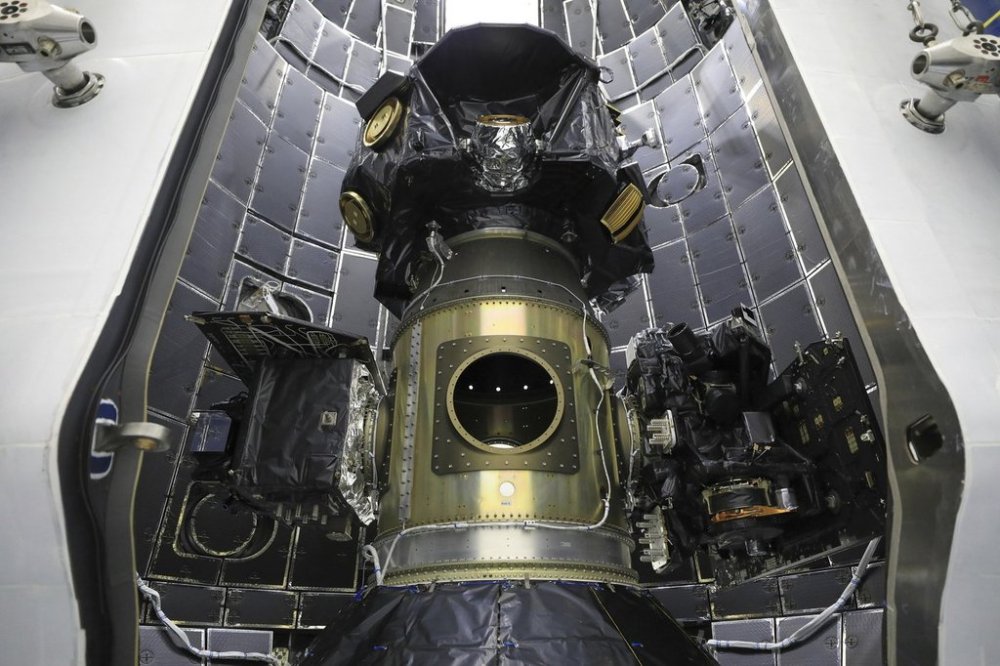
This photo provided by NASA in September 2025 shows NASA’s Carruthers Geocorona Observatory, IMAP (Interstellar Mapping and Acceleration Probe), and the National Oceanic and Atmospheric Administration’s (NOAA) Space Weather Follow On-Lagrange 1 (SWFO-L1) satellite at the Kennedy Space Center in Florida. (NASA via AP)

Heading the lineup is NASA’s Interstellar Mapping and Acceleration Probe, the first to be deployed. It will scrutinize the outer limits of the heliosphere, the protective, solar wind-driven bubble of gas around our solar system.

As a bonus, IMAP will be capable of providing advance notice of solar storms — a valuable 30-minute heads-up — for astronauts exploring the moon under NASA’s Artemis program. Officials expect the observatory to be fully operational by the time four astronauts fly around the moon and back next year.

NASA’s smaller Carruthers Geocorona Observatory also is flying, focusing on Earth’s outermost, glowing atmosphere that extends well beyond the moon. It’s named after the late scientist George Carruthers, who invented the ultraviolet telescope left on the moon by the Apollo 16 astronauts in 1972.

NOAA’s newest space weather observatory will be pushed into full-time, around-the-clock forecasting service. It will keep tab on the sun’s activity and measure the solar wind to help keep Earth safe from threatening flares.

Officials expect NASA’s satellites to be in position and operational by the beginning of next year, and NOAA’s spacecraft by spring.

NASA is kicking in more than $879 million for its two missions, while NOAA’s share is $693 million.

While NASA already has a fleet of sun-observing spacecraft, science mission chief Nicky Fox said these newer missions offer more advanced instruments that will provide more sensitive measurements.

“Just being able to put all those together to give us a much, much better view of the sun,” she said.
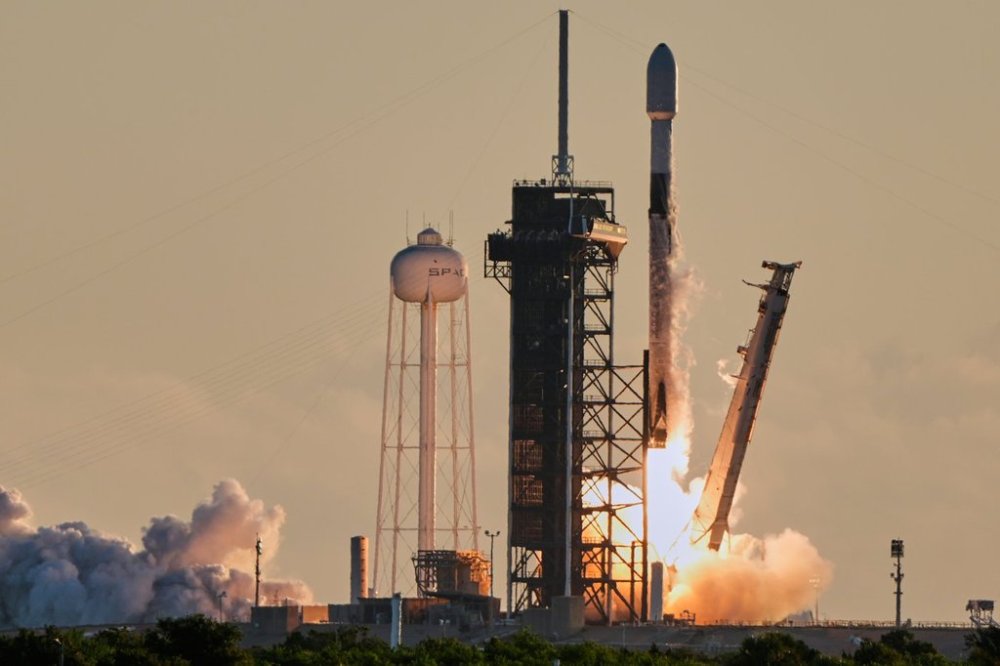
A SpaceX Falcon 9 rocket with a Interstellar Mapping and Acceleration Probe (IMAP) as it's primary payload, lifts off from pad 39A at the Kennedy Space Center in Cape Canaveral, Fla., Wednesday, Sept. 24, 2025. (AP Photo/John Raoux)

The goal is to better understand the sun in order to better protect Earth, according to officials. As spectacular as they are, the northern and southern lights will not be the missions’ focus.

During a preview of NASA’s upcoming Artemis mission around the moon, science officials said Tuesday that these new space weather missions will enhance forecasting and provide vital alerts if major solar activity strikes. If that happens, the four astronauts will take temporary shelter in a storage area under the capsule’s floor to avoid the heightened radiation levels.

___

The Associated Press Health and Science Department receives support from the Howard Hughes Medical Institute’s Department of Science Education and the Robert Wood Johnson Foundation. The AP is solely responsible for all content.


Report Error Submit a Tip

More Stories

Sidney Crosby sings praises of Jets' Bjorck, summer training partner Barron

Ken Wiebe 6 minute read Preview

Sidney Crosby sings praises of Jets' Bjorck, summer training partner Barron

Ken Wiebe 6 minute read Monday, Oct. 5, 2026

PITTSBURGH — It wasn’t that long ago when the shoe was on the other foot for Sidney Crosby.

Read
Monday, Oct. 5, 2026

Klein promises fixes to Winnipeg Transit network overhaul failures

Joyanne Pursaga 5 minute read Preview

Klein promises fixes to Winnipeg Transit network overhaul failures

Joyanne Pursaga 5 minute read 5:50 PM CDT

A mayoral candidate is promising to restore at least 150 previously removed bus stops, extend Winnipeg Transit service to later hours and guarantee front-door bus dropoffs at acute-care hospitals.

In his Wednesday “Bring the Bus Back” announcement, Kevin Klein said Winnipeg Transit’s bus network overhaul, which has been in place for the past 16 months, has left some passengers stranded, with fewer stops and shorter hours at night.

“We need an effective, efficient… transit system that is safe, in order to grow, in order to expand,” said Klein.

The new primary transit network was part of the Winnipeg Transit Master Plan city council approved in 2021. Klein was the city councillor for Charleswood-Tuxedo-Westwood at the time and voted against the plan.

Read
5:50 PM CDT

Khan’s abrupt departure presents desperate Tories with a valuable opportunity

Tom Brodbeck 5 minute read Preview

Khan’s abrupt departure presents desperate Tories with a valuable opportunity

Tom Brodbeck 5 minute read Yesterday at 1:06 PM CDT

If the Manitoba Progressive Conservatives are serious about getting out of the political wilderness, they should start by electing a progressive conservative leader.

Read
Yesterday at 1:06 PM CDT

Ladies and gentlemen of voting age, please turn your attention to the centre ring…

Dan Lett 5 minute read Preview

Ladies and gentlemen of voting age, please turn your attention to the centre ring…

Dan Lett 5 minute read 3:40 PM CDT

If there’s one thing that we in the news business wish for any election, it’s that the campaign is competitive and voters have multiple, viable options when it comes time to cast their ballots.

That is certainly what I wished for in this year’s Winnipeg mayoral election: a ballot with two or more competent candidates — including incumbent Scott Gillingham — that offered contrasting visions for the future of the city.

Unfortunately, this time we didn’t get competent or viable. Instead, we got a clown show stuffed with candidates for mayor who have demonstrated a stunning capacity for self-inflicted wounds.

It all started when mayoral candidates Kevin Klein and Mike Vogiatzakis both alleged they had been asked by each other’s campaign to step down to give the remaining candidate a better shot at defeating Gillingham.

Read
3:40 PM CDT

Duo accused in random Osborne Village attacks no strangers to police

Dean Pritchard and Chris Kitching 5 minute read Preview

Duo accused in random Osborne Village attacks no strangers to police

Dean Pritchard and Chris Kitching 5 minute read Updated: Yesterday at 6:48 PM CDT

A man arrested following a violent, random attack on two men in Osborne Village late Sunday night was released from jail a week earlier after a dozen charges, including crimes of violence, were stayed against him, court records show.

A man in his 40s was sent to hospital in critical condition and another man in his 20s in stable condition following separate attacks shortly before midnight in the vicinity of River Avenue and Osborne Street.

Police have charged Reginald Owen, 26, and Meaghan Owen, 32, both from Little Grand Rapids, with assault with a weapon and aggravated assault. They both remain in custody.

Court records show Reginald Owen was sentenced Sept. 24 to 30 days time served after pleading guilty to simple possession of magic mushrooms. Owen remained in custody until the following day when he was set to apply for bail on charges including assault, sexual assault, choking to overcome resistance, pointing a firearm, and carrying a concealed weapon.

Read
Updated: Yesterday at 6:48 PM CDT

MPI lowers speed limit on tech upgrade with ‘IT roadmap’ following Project Nova debacle

Carol Sanders 5 minute read Preview

MPI lowers speed limit on tech upgrade with ‘IT roadmap’ following Project Nova debacle

Carol Sanders 5 minute read Monday, Oct. 5, 2026

Manitoba Public Insurance is now using an “IT road map” and phasing in new technology and systems after pulling the plug last year on its failed $164-million overhaul known as Project Nova, its annual report says.

Read
Monday, Oct. 5, 2026