Legal challenges claim B.C. natural gas pipeline hasn’t been ‘substantially started’

Advertisement

Advertise with us

VANCOUVER - Two legal challenges filed in British Columbia claim a liquefied natural gas pipeline hasn't been "substantially started," contrary to a decision made by the provincial government back in June. 

Read this article for free:


or

Already have an account? Log in here »

To continue reading, please subscribe:

Subscribe and receive a limited-edition Free Press branded hat or tote.

Digital Subscription

One year of digital access for only $205*

  • Enjoy unlimited reading on winnipegfreepress.com
  • Read the E-Edition, our digital replica newspaper
  • Access News Break, our award-winning app
  • Play interactive puzzles

*First annual payment billed as $205.00 + GST for one year. This annual subscription will automatically renew at $233.00 + GST every 52 weeks (10% off the regular annual price of $259.35). Offer available to new and qualified returning subscribers only. Cancel any time.

To continue reading, please subscribe:

Add Free Press access to your Brandon Sun subscription for only an additional

$1 for the first 4 weeks*

  • Enjoy unlimited reading on winnipegfreepress.com
  • Read the E-Edition, our digital replica newspaper
  • Access News Break, our award-winning app
  • Play interactive puzzles
Start now

*Your next Brandon Sun subscription payment will increase by $1.00 and you will be charged $17.95 plus GST for four weeks. After four weeks, your payment will increase to $24.95 plus GST every four weeks.

Hey there, time traveller!
This article was published 29/09/2025 (346 days ago), so information in it may no longer be current.

VANCOUVER – Two legal challenges filed in British Columbia claim a liquefied natural gas pipeline hasn’t been “substantially started,” contrary to a decision made by the provincial government back in June. 

Petitions filed in B.C. Supreme Court last week allege the Prince Rupert Gas Transmission natural gas pipeline project has been given the green-light by the B.C. Environment Ministry to go ahead without requiring a new environmental assessment certificate, which was first granted in 2014. 

One of the petitions was filed by hereditary Chief Charles Wright with the Gitxsan Nation, who claims the decision to allow the pipeline project to proceed through its “untouched” territory was made without proper consultation. 
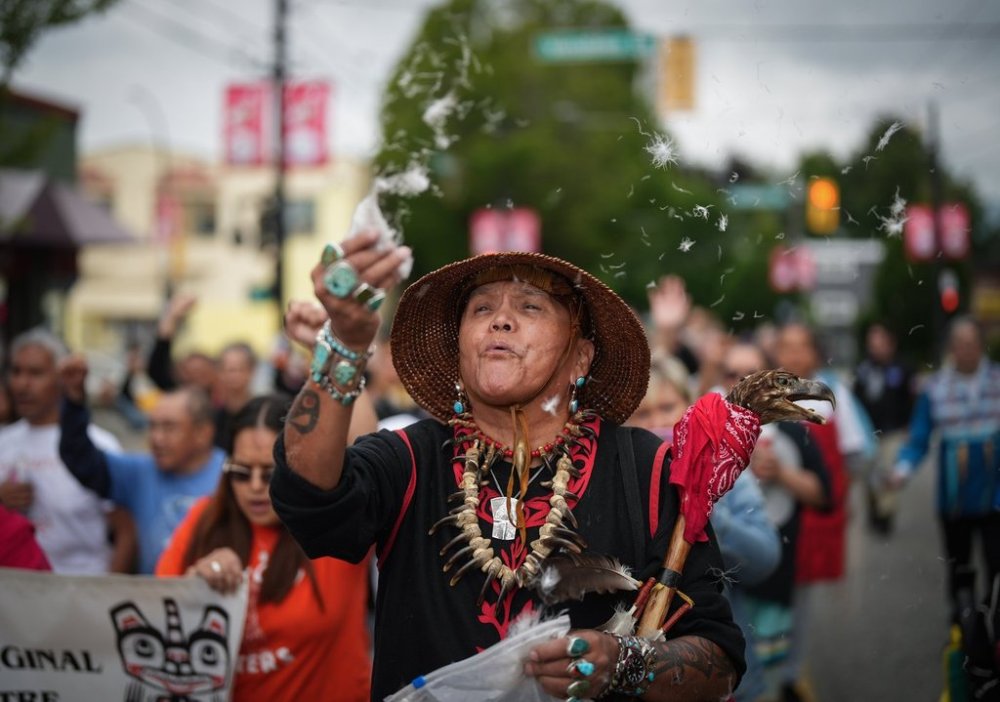
Randy Tait, of the Nisga'a-Gitxsan Nation, blows down feathers into the air during a friendship walk to a National Indigenous Peoples Day gathering, in Vancouver, B.C., Wednesday, June 21, 2023. THE CANADIAN PRESS/Darryl Dyck

The ministry announced in June that pipeline project has been “substantially started,” meaning the environmental assessment certificate approving its construction issued in 2014 remains valid. 

The 900 kilometre pipeline is to supply the Ksi Lisims liquefied natural gas facility off the B.C. coast was given an environmental certificate from the B.C. government two weeks ago and federal approval quickly followed under a one-project, one-review system. 

Wright’s petition says the decision on the pipeline was unreasonable because it failed to consult about the project’s impacts on Aboriginal rights and title. 

It says the pipeline route is through his clan’s territory, including “important cultural areas,” and there is concern the land will be “irrevocably altered,” rather than protected. 

Wright said in a statement that the legal action isn’t about stopping the pipeline altogether, but that the project is relying on an “outdated” assessment and the province’s decision has “set the stage for inevitable conflict in the region.” 

Environmental lawyers at Ecojustice said in a statement last week that the project is also facing a legal challenge by a coalition of community groups opposed to the pipeline. 

The petitioners in that case, Kispiox Valley Community Centre Association, Skeena Watershed Conservation Coalition and local resident Kathy Larson, claim the pipeline, which will carry fracked natural gas, hasn’t been substantially started, and the original environmental assessment certificate was set to expire last November. 

Ecojustice said the project was inactive for nearly 10 years, and “the pipeline company only partially cleared trees from about five per cent of the pipeline route and built some limited supporting infrastructure.”

“The substantial start decision means that the … project could proceed without taking into account the many changes to the project and the region that have occurred since the project was assessed over 10 years ago,” it said. 

British Columbia's provincial flag flies on a flag pole in Ottawa on July 3, 2020. THE CANADIAN PRESS/Adrian Wyld

Ecojustice lawyer Matt Hulse said the province should “follow its own rules” by requiring a new assessment because “if construction on a project has not been significantly started by the deadline set by the government, it needs a new environmental assessment in order to proceed.”

The province’s Environment Assessment Office said in its reasons for decision in June that the company behind the project, Prince Rupert Gas Transmission Ltd., had spent $584 million between 2013 and 2024 to “advance the project.” 

The office’s reasons said the majority of public feedback about the project contended it had not been substantially started, and concerns raised by the Gitxsan included greenhouse gas emissions, whether all permits were in place and about whether the facility poised to receive gas from the pipeline would be approved. 

“Though there was feedback received expressing opposition to the project, this is not the issue before me,” Chief Executive Assessment Officer Alex MacLennan wrote. “Similarly, the determination at hand is not whether the project is in the public interest; that decision was made when the certificate was granted.” 

Ministry of Environment and Parks spokesman David Karn said the province is “not able to comment on matters before the courts.” 

This report by The Canadian Press was first published Sept. 29, 2025. 

Report Error Submit a Tip

More Stories

Manitoba gains doctors for third straight year, but loses at pandemic-level rate: report

Scott Billeck 5 minute read Preview

Manitoba gains doctors for third straight year, but loses at pandemic-level rate: report

Scott Billeck 5 minute read Updated: Yesterday at 7:44 PM CDT

Manitoba is adding doctors at a record clip — but it’s also losing them at a rate not seen since the depths of the COVID-19 pandemic, a physicians advocacy organization cautioned Wednesday.

Read
Updated: Yesterday at 7:44 PM CDT

Cancelling court erodes access to justice — just ask Matt Wiebe

Dan Lett 5 minute read Preview

Cancelling court erodes access to justice — just ask Matt Wiebe

Dan Lett 5 minute read 12:22 PM CDT

Back in May 2023, when the NDP were in opposition and Matt Wiebe was just an earnest justice critic, he had harsh words for the Progressive Conservative government when provincial circuit court sessions were being cancelled.

At the time, then-Chief Provincial Court Judge Margaret Wiebe issued a statement saying dozens of circuit court sittings in eight rural communities would be cancelled “to provide timely access to justice and ensure court resources are allocated in a manner that reflects the specific needs of all communities throughout the province of Manitoba.”

The provincial court was trying to become more efficient in processing lower-priority cases — ones that didn’t appear to be headed to court. The move was not necessarily due to a shortage of judges or staff.

Even so, the NDP opposition critic was incensed.

Read
12:22 PM CDT

Letters, Sept. 10

6 minute read Preview

Letters, Sept. 10

6 minute read 2:01 AM CDT

So, Coun. Browaty, do tell, when should we start to panic? What is your magic number? Is there one?

Read
2:01 AM CDT

‘Huge resource gaps’: judge shortage leads to circuit court cuts

Dean Pritchard 4 minute read Preview

‘Huge resource gaps’: judge shortage leads to circuit court cuts

Dean Pritchard 4 minute read Updated: Yesterday at 6:33 PM CDT

A shortage of judges is forcing Manitoba’s provincial court to slash sittings across the province.

The court announced in a notice to the profession Wednesday that it will be reducing the number of annual court sittings at nine rural circuit locations and St. Boniface provincial court in Winnipeg by 68 sittings, effective April 1, 2027.

The reductions are necessary to balance “access to justice needs with the complement of judicial resources currently insufficient to maintain the current court schedule,” said the notice, signed by provincial court Chief Judge Ryan Rolston.

Affected circuit courts include Altona, Arborg, Beausejour, Easterville, Cranberry Portage, Lundar, Grand Rapids, Moose Lake, and Pine Falls.

Read
Updated: Yesterday at 6:33 PM CDT

Ferraro, Skinner getting lay of the land before training camp starts

Mike McIntyre 8 minute read Preview

Ferraro, Skinner getting lay of the land before training camp starts

Mike McIntyre 8 minute read Yesterday at 5:45 PM CDT

They’ve both been around the NHL block a bit, but make no mistake, Stuart Skinner and Mario Ferraro are experiencing some “new kid at school” type jitters this week.

The pair were prized July 1 free agent signings by the Winnipeg Jets and are now quickly trying to get the lay of the land — from teammates and systems and structure to restaurants, schools and the best routes to the rink — in what is a frantic time on both a professional and personal level.

“It’s a big change, right?” Ferraro said Wednesday following a pre-training camp skate at the Hockey For All Centre.

“Like moving cities, getting settled somewhere else, with my family, my wife, my daughter, our two dogs. But I think it’s gone really well and smooth. We found a great place here, and we’re really happy with where we’re living.”

Read
Yesterday at 5:45 PM CDT

Cultivating compassion in young people

Jordan Laidlaw 5 minute read 2:00 AM CDT

We live in the unenviable era of rising American imperialism and the emergence of a precarious new world order.

As U.S. President Donald Trump escalates his annexation threats over Canada, Greenland and Venezuela; deteriorates decades-long relations with NATO; and offers concessions to totalitarian North Korea; we must remain steadfast and vigilantly united against these ominous — and markedly unusual — sociopolitical developments.

We have so much to learn from our past. As historical patterns suggest, these threats are not idle nor mere political rhetoric. Rather, these threats should be treated with utmost seriousness. As Winston Churchill so famously uttered, “Those that fail to learn from history are doomed to repeat it.”

As a Canadian public educator, I hold the vehement conviction that we need to instruct our youth on the societal dangers of imperialism, while simultaneously exploring the “contentious” concepts of sharing and acceptance.