AI helps Ont. researcher discover breakthrough antibiotic treatment for bowel disease

Advertisement

Advertise with us

HAMILTON - Jon Stokes’s research lab has discovered what could be a breakthrough treatment for Crohn’s and inflammatory bowel disease in about 100 seconds. 

Read this article for free:


or

Already have an account? Log in here »

To continue reading, please subscribe:

Subscribe and receive a limited-edition Free Press branded hat or tote.

Digital Subscription

One year of digital access for only $205*

  • Enjoy unlimited reading on winnipegfreepress.com
  • Read the E-Edition, our digital replica newspaper
  • Access News Break, our award-winning app
  • Play interactive puzzles

*First annual payment billed as $205.00 + GST for one year. This annual subscription will automatically renew at $233.00 + GST every 52 weeks (10% off the regular annual price of $259.35). Offer available to new and qualified returning subscribers only. Cancel any time.

To continue reading, please subscribe:

Add Free Press access to your Brandon Sun subscription for only an additional

$1 for the first 4 weeks*

  • Enjoy unlimited reading on winnipegfreepress.com
  • Read the E-Edition, our digital replica newspaper
  • Access News Break, our award-winning app
  • Play interactive puzzles
Start now

*Your next Brandon Sun subscription payment will increase by $1.00 and you will be charged $17.95 plus GST for four weeks. After four weeks, your payment will increase to $24.95 plus GST every four weeks.

Hey there, time traveller!
This article was published 05/10/2025 (357 days ago), so information in it may no longer be current.

HAMILTON – Jon Stokes’s research lab has discovered what could be a breakthrough treatment for Crohn’s and inflammatory bowel disease in about 100 seconds. 

Rather, his AI sequencing tool discovered it in 100 seconds. Then, as Stokes said, his team spent about six months testing the results to confirm they were true. 

Still that’s six months of testing, rather than years. And only $60,000, rather than millions. 
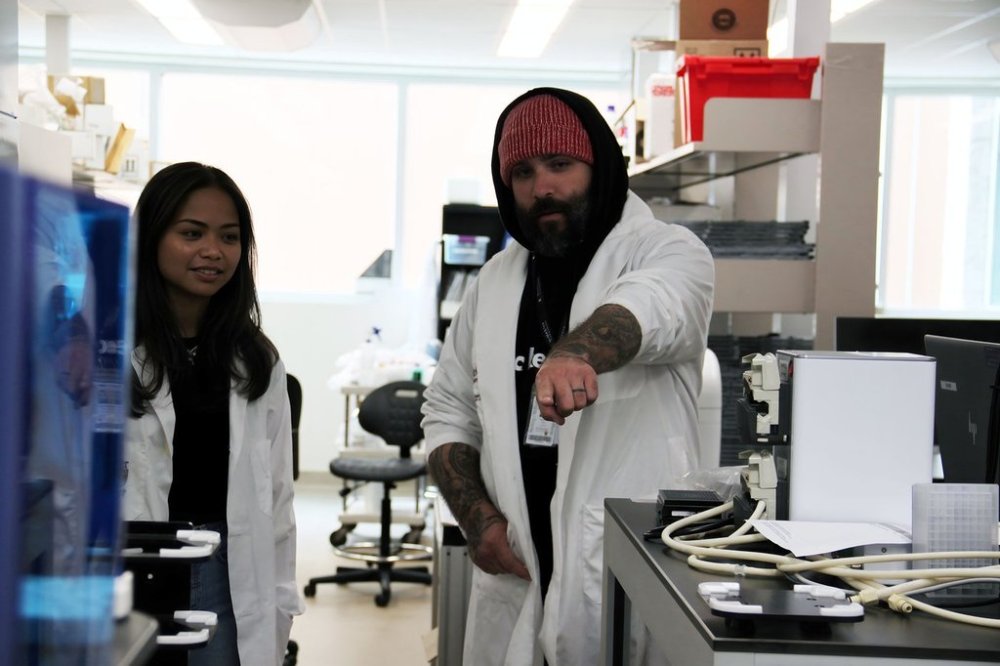
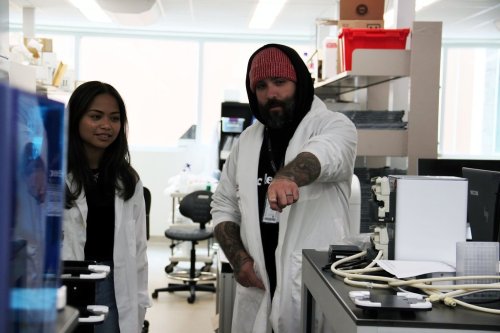
McMaster University researcher Jon Stokes, right, and graduate student Denise Catacutan are seen at the Centre for Microbial Chemical Biology, a core lab at McMaster's Michael G. DeGroote Institute for Infectious Disease Research, in this undated handout photo, in Hamilton, Ont. THE CANADIAN PRESS/Handout - Blake Dillon, McMaster University (Mandatory Credit)

As far as new drug discoveries go, Stokes said this use case of AI could be a game changer for Canadian patients. 

ANTIBIOTIC ISSUES

The problem with traditional antibiotics, said Stokes, is that many of them are designed to be broad spectrum – meaning they destroy good bacteria along with bad when aiming to clear up infection. This can be especially bad news for people with Crohn’s or bowel disease. Antibiotics can destroy healthy gut bacteria needed to stave of further infections. 

What Stokes needed was to find a narrow-spectrum antibiotic. 

The result was enterololin, a drug that is the first of its kind, designed to only target harmful bacteria, including E. Coli.  

This is where Stokes’s lab, and their partners at the Massachusetts Institute of Technology, used AI in two distinct ways. 

First, they used AI to determine which chemical structures are likely to be antibacterial. Then, they used AI to predict how those structures would actually work when targeting a cell, or what’s called the ‘mechanism of action.’ 

“E.Coli has roughly 4,000 genes. Out of those, probably about 300 are what we call essential,” Stokes said. “The number of things my molecule could be doing once it gets inside of a cell is mind boggling…that’s what takes years and millions of dollars.” 

Stokes said the AI modelling acted like a GPS, telling the researchers which combinations of structures were most likely to produce good results. 

“We weren’t flying blind anymore,” Stokes said. 

AI LIMITATIONS

For the most part, AI use cases like this are a positive step forward, said Wyatt Tessari L’Allié, founder of AI Governance and Safety Canada.

The key is that AI is not at a stage where it can make these sorts of predictions without human verification. 

“(AI) can do a decent first draft, or something that looks reasonable, but you still very much need the human to be thinking through exactly, why am I using the AI tool? And what kind of answers should I be getting?” said Tessari L’Allié. “(AI) looks like it’s smart. And it’s easy to think that it is smart all the time, and it’s often not.” 

Stokes said the AI model in his lab spit out its predictions in less than two minutes. They then spent six months verifying them, which Tessari L’Allié said is exactly what’s needed when it comes to AI-assisted research. 

The federal government has looked at AI regulation with the AI and Data Regulation Act, or Bill C-27, but the bill ultimately failed when Parliament was prorogued earlier this year. Tessari L’Allié and the team at AIGS submitted recommendations for the bill. He said part of the challenge of legislating AI is that it’s a moving target. 

“Regulation is going to take multiple months, or years. So you have to ask where is AI going to be two, three, five years from now?”

AN OPTION FOR PATIENTS

Canada has one of the highest rates of inflammatory bowel disease globally, with one study out of the University of Calgary suggesting that patient numbers across the country could rise sharply over the next two decades.

Currently, a new patient is diagnosed every 48 minutes in Canada, according to Crohn’s and Colitis Canada. That’s just over 320,000 patients now, but estimated to rise to 470,000 patients in the next decade. 

There is no cure for Crohn’s and associated bowel diseases. Common symptoms include pain, fatigue, persistent diarrhea and unexplained weight loss. 

Stokes said he hopes his research and methods could help patients manage diseases better. More importantly, he said he hopes that AI can speed up this kind of medical research. 

“AI is a set of tools to help us, as domain experts, make better experimental decisions at each key point along the development of a drug,” Stokes said. “They’re guiding us better, helping us make more informed decisions that are likely to result in a success.”

This report by The Canadian Press was first published Oct. 5, 2025.

Report Error Submit a Tip

More Stories

Blue Bombers whiff on their opportunities to put game away

Taylor Allen 7 minute read Preview

Blue Bombers whiff on their opportunities to put game away

Taylor Allen 7 minute read Friday, Sep. 25, 2026

In theory, Bryce Perkins has a simple job.

When it’s third and short, the Winnipeg Blue Bombers trot out the short-yardage quarterback, and all he has to do is plunge forward for a yard or two to make everyone on his sideline happy.

But on Friday night against the visiting Toronto Argonauts, he went above and beyond his job description.

The Bombers, down 24-21 with six minutes left, faced a third-and-one from their own end when Perkins found a hole and burst through it for a 76-yard touchdown to put the home team in front 28-24 late.

Read
Friday, Sep. 25, 2026

Positive anticipation is growing about major housing developments underway in Winnipeg’s downtown

Gabrielle Piché 10 minute read Preview

Positive anticipation is growing about major housing developments underway in Winnipeg’s downtown

Gabrielle Piché 10 minute read Friday, Sep. 25, 2026

If traffic is light and the wind is down, Somia Sadiq is able to hear the roar of Winnipeg Jets fans twice: first through her window, then on TV.

From her apartment view high above downtown, she can look out at Graham Avenue’s painted pedestrian landscape, see construction cranes and hear the heavy equipment at work as massive housing projects take shape at The Forks, at what used to be Portage Place shopping centre and at the former Hudson’s Bay building.

Sadiq has lived at 300 Main for 2 1/2 years, a few steps from the city’s famous, windy and reopened-to-pedestrians Portage Avenue intersection. At 42 storeys, it’s the tallest building in Winnipeg.

She is among 18,000 downtown residents who will soon be joined by thousands of others attracted to the city’s core by the new wave of major construction projects.

Read
Friday, Sep. 25, 2026

Special teams woes hurt Bombers in loss to Argos

Ken Wiebe 7 minute read Preview

Special teams woes hurt Bombers in loss to Argos

Ken Wiebe 7 minute read Yesterday at 8:06 PM CDT

THEY’VE been the most consistent of the three phases in the Winnipeg Blue Bombers arsenal this season.

A port in the proverbial storm, throughout this topsy-turvy campaign of ups-and-downs, the special-teams units have been supplying strength to a group that is still searching for consistency with only four games left in the regular season.

That’s what made this momentary lapse so costly in a 30-28 loss to the Toronto Argonauts on Friday at Princess Auto Stadium.

“We didn’t keep up our end of the bargain. And that hurts our football team, hurts our chances of winning games,” said Blue Bombers special teams ace Tanner Cadwallader. “And if we want to win close games. we’ve got to be a whole lot better than that. And we will. We’re going to come in (on Saturday for the film session) and go through it with a fine-tooth comb and just work a little bit harder.”

Read
Yesterday at 8:06 PM CDT

Jets’ brass warming up to El Nino?

Mike McIntyre 7 minute read Preview

Jets’ brass warming up to El Nino?

Mike McIntyre 7 minute read Friday, Sep. 25, 2026

Decisions, decisions.

The Winnipeg Jets held their final dress rehearsal Friday night before the curtain rises next week on the new NHL season.

Unlike their first three exhibitions, this one in Denver featured competitive lineups that looked an awful lot like what we’ll see when the games start counting, with plenty of star power and veteran presence on both sides.

So what are we to make of the Jets’ 5-2 loss to the mighty Colorado Avalanche, who captured the Presidents’ Trophy last year and are once again a legitimate Stanley Cup contender?

Read
Friday, Sep. 25, 2026

AI helps Ont. researcher discover breakthrough antibiotic treatment for bowel disease

Emily Baron Cadloff, The Canadian Press 5 minute read Preview

AI helps Ont. researcher discover breakthrough antibiotic treatment for bowel disease

Emily Baron Cadloff, The Canadian Press 5 minute read Sunday, Oct. 5, 2025

HAMILTON - Jon Stokes’s research lab has discovered what could be a breakthrough treatment for Crohn’s and inflammatory bowel disease in about 100 seconds. 

Rather, his AI sequencing tool discovered it in 100 seconds. Then, as Stokes said, his team spent about six months testing the results to confirm they were true. 

Still that’s six months of testing, rather than years. And only $60,000, rather than millions. 

As far as new drug discoveries go, Stokes said this use case of AI could be a game changer for Canadian patients. 

Read
Sunday, Oct. 5, 2025

WSO season kicks off with two fateful fifths

Holly Harris 4 minute read Preview

WSO season kicks off with two fateful fifths

Holly Harris 4 minute read 3:57 PM CDT

Saturday night’s Masterworks program, titled Beethoven 5 and Tchaikovsky 5 and led by Daniel Raiskin, also officially introduced the WSO’s new composer-in-residence, Kelly-Marie Murphy, to the weekend crowd of 1,720. She was met with enthusiastic applause and cheers upon taking the stage.

Read
3:57 PM CDT