

B.C.’s public service workers escalate strike to correctional facilities
Advertisement
Read this article for free:
or
Already have an account? Log in here »
To continue reading, please subscribe:

Digital Subscription
One year of digital access for only $205*
- Enjoy unlimited reading on winnipegfreepress.com
- Read the E-Edition, our digital replica newspaper
- Access News Break, our award-winning app
- Play interactive puzzles
*First annual payment billed as $205.00 + GST for one year. This annual subscription will automatically renew at $233.00 + GST every 52 weeks (10% off the regular annual price of $259.35). Offer available to new and qualified returning subscribers only. Cancel any time.
To continue reading, please subscribe:
Add Free Press access to your Brandon Sun subscription for only an additional
$1 for the first 4 weeks*
- Enjoy unlimited reading on winnipegfreepress.com
- Read the E-Edition, our digital replica newspaper
- Access News Break, our award-winning app
- Play interactive puzzles
*Your next Brandon Sun subscription payment will increase by $1.00 and you will be charged $17.95 plus GST for four weeks. After four weeks, your payment will increase to $24.95 plus GST every four weeks.
Read unlimited articles for free today:
or
Already have an account? Log in here »
Hey there, time traveller!
This article was published 10/10/2025 (316 days ago), so information in it may no longer be current.
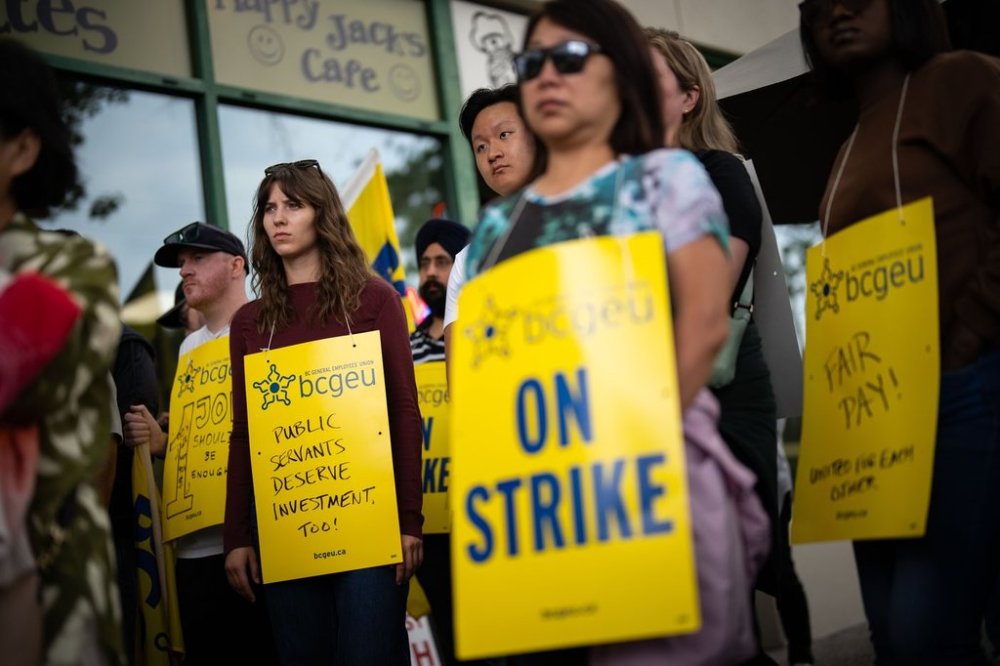
BURNABY – British Columbia jails have been added to the growing list of sites behind picket lines as public service workers escalate job action.
The BC General Employees’ Union said in a statement Friday that all its remaining unionized staff at adult correctional facilities across the province are now on strike.
The union said the escalation brings the total number of work sites behind pickets to more than 470, with about 25,000 workers taking strike action across 20 ministries, Crown corporations and agencies.
Union president Paul Finch said the escalation is due to the government’s “lack of urgency” in coming to the table with a better contract offer.
B.C. Public Safety Minister Nina Krieger said Friday in response that the BCGEU pickets are causing “no disruption to the core services of the correction centres.”
Speaking at an unrelated press conference, Krieger said corrections officers are classified as essential services, and the province’s correction centres “are staffed as needed during this time.”
Her ministry said in a statement that in-community monitoring services, such as electronic supervision of individuals, also remain in place.
“We are aware of the BCGEU’s recent advisory and can assure the public that essential staffing levels are in place to support the safe and secure operation of all 10 provincial correctional centres,” a ministry statement said.
The statement said “discretionary programming and other supports and services” at the facilities could be limited while they are operating at essential-service levels.
The strike is in its sixth week, but job action ramped up quickly in the last week, with a march in Vancouver last Friday and a rally at the legislature on Monday as politicians returned for the fall session.
The government has said its last proposal to the union was fair in balancing workers’ needs and B.C.’s constrained fiscal position.
The Professional Employees Association, which represents B.C. government workers such as engineers, foresters and geoscientists, has also escalated its job action this week to include more than 1,000 staff from various ministries.
The PEA said that its last contract offer from the government was for a general wage increase of 3.5 per cent over two years. The union said its request was for 8.25 per cent over two years.
Those participating in job action include environmental protection officers, groundwater hydrologists, litigation lawyers and mines inspectors.
The union noted examples of essential workers who would never be on strike include hydrologists with B.C.’s River Forecast Centre and child and youth psychologists with the Ministry of Children and Family Development.
This report by The Canadian Press was first published Oct. 10, 2025.