

Relentless international window expansions detrimental
Ever-growing player stress injuries point to only one remedy — less football
Advertisement
Read this article for free:
or
Already have an account? Log in here »
To continue reading, please subscribe:

Digital Subscription
One year of digital access for only $205*
- Enjoy unlimited reading on winnipegfreepress.com
- Read the E-Edition, our digital replica newspaper
- Access News Break, our award-winning app
- Play interactive puzzles
*First annual payment billed as $205.00 + GST for one year. This annual subscription will automatically renew at $233.00 + GST every 52 weeks (10% off the regular annual price of $259.35). Offer available to new and qualified returning subscribers only. Cancel any time.
To continue reading, please subscribe:
Add Free Press access to your Brandon Sun subscription for only an additional
$1 for the first 4 weeks*
- Enjoy unlimited reading on winnipegfreepress.com
- Read the E-Edition, our digital replica newspaper
- Access News Break, our award-winning app
- Play interactive puzzles
*Your next Brandon Sun subscription payment will increase by $1.00 and you will be charged $17.95 plus GST for four weeks. After four weeks, your payment will increase to $24.95 plus GST every four weeks.
Read unlimited articles for free today:
or
Already have an account? Log in here »
Hey there, time traveller!
This article was published 10/10/2025 (353 days ago), so information in it may no longer be current.
Anyone seen Cole Palmer lately? How about Exequiel Palacios? At least Ousmane Dembélé, surely?
If not, it’s likely because the Chelsea, Bayer Leverkusen and Paris Saint-Germain players, who represent England, Argentina and France, respectively, are currently out injured.
Now, they’ve not suffered broken bones, major ligament damage or concussions. Their injuries were not sustained in tackles, knee-on-knees or any other sort of on-field clashes. No, they picked up their knocks over time — time they spent playing too much football without adequate rest and recovery.
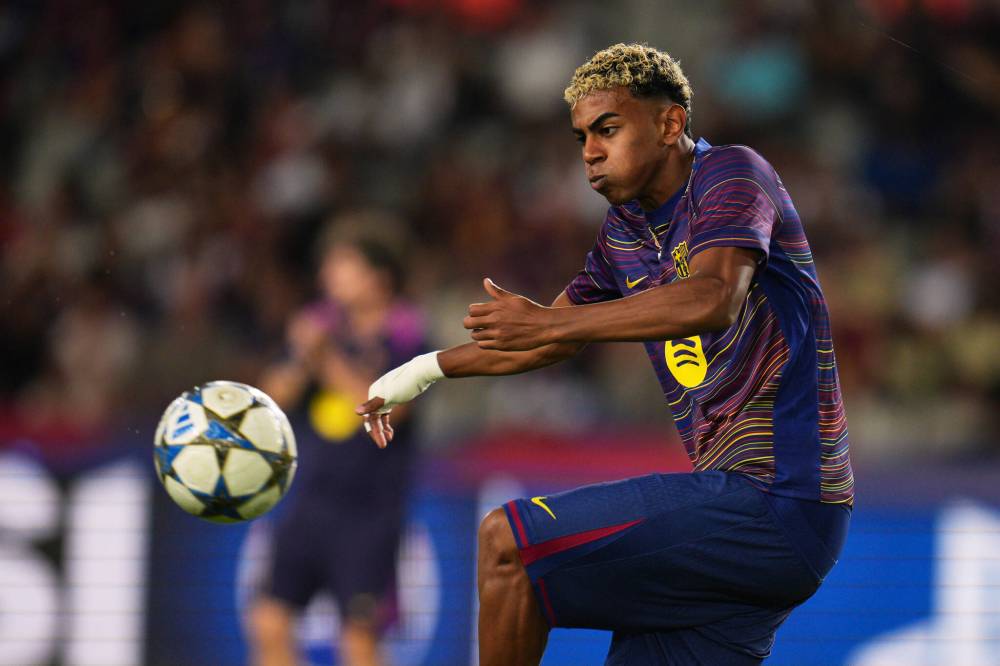
Emilio Morenatti / The Associated Press files
The 18-year-old Barcelona and Spain megastar, Lamine Yamal, has barely had a break in two years and has been taking painkillers to keep him going.
They have stress injuries, and they’re not alone.
Inevitably, it’s their clubs that will notice their absences in the immediate term, but fitness worries can also be viewed through an international lens, especially as the World Cup is barely eight months away.
In addition to Palmer, Palacios and Dembélé, the stress injury recovery room also includes Alisson (Liverpool and Brazil), Marcus Thuram (Inter Milan and France), Mattia Zaccagni (Lazio and Italy), Trent Alexander-Arnold (Real Madrid and England), Stanislav Lobotka (Napoli and Slovakia) and Raphinha (Barcelona and Brazil), among many, many others.
Among the most high-profile is Lamine Yamal — the 18-year-old Barcelona and Spain megastar who has barely had a break in two years. To help him keep going, he’s been taking painkillers.
Club and country teammate Dani Olmo was actually sent home during the ongoing international break. Spain manager Luis de la Fuente said the 27-year-old “came feeling a bit fatigued” and “wasn’t comfortable.”
That’s not normal. None of this is normal.
Late last month, FIFPro released its latest “Player Workload and Monitoring” report. Among its key findings (and it used specific examples of players, clubs and national teams) was that “relentless expansion of overlapping competitions is driving unprecedented demands, putting player health and wellbeing at growing risk.”
It’s a risk born out most prominently by stress injuries. Consult the injury lists of any European league (this is a global problem, but fixture congestion is most acute for Europe-based players) and you’ll see a troublingly common descriptor: “adductor.”
The adductor muscles work to bring a person’s leg closer to their body and, as plainly stated by the NHS, “may get strained when overworked.” A 2010 article in the journal Sports Health made the straightforward link between adductor strains and “incomplete rehabilitation or inadequate time for complete tissue repair.”
An Oxford University Hospitals report described adductor stress as especially common in athletes required to run, kick and change directions — footballers, in other words.
The evidence is clear. So is the remedy.
There needs to be less football.
Ironically, the party most guilty of causing these injuries is the one that’s supposed to be nurturing the sport and those who play it.
Over the last 30 years, FIFA’s international windows have expanded by about 50 per cent and its World Cup has doubled in size. Last summer’s Club World Cup also saw it claim an additional month of the calendar. To be clear, FIFA has zero mandate to organize club tournaments, period.
It should also be underlined, again and again, that the Club World Cup as it now exists is first and foremost a moneyspinning enterprise involving FIFA and the sovereign wealth fund of Saudi Arabia. FIFA president and authoritarian lackey Gianni Infantino negotiated personally on its behalf in Riyadh, to which he flew on Air Force One while skipping his own FIFA Congress.
Similarly, the upcoming 48-team World Cup in Canada, Mexico and the United States was not grown from its previous 32 contestants to somehow grow the sport or broaden the franchise.
FIFA — a supposedly not-for-profit organization, don’t forget — cares only for ticket receipts, sponsorships and broadcast revenues. More matches means more of those things. If it also means an inferior product, so be it. And the players? Merely means to an end; a disposable workforce.

Even so, at some point you’d think those ticket-buyers, sponsors and broadcasters would notice the absent or diminished players. What then?
That’s the stress test FIFA wants to avoid.
The only question is how many Palmers, Dembélés, Alissons and Yamals have to go down before it faces one.
jerradpeters@gmail.com
jerradpeters.bsky.com
Our newsroom depends on a growing audience of readers to power our journalism. If you are not a paid reader, please consider becoming a subscriber.
Our newsroom depends on its audience of readers to power our journalism. Thank you for your support.
Our newsroom depends on a growing audience of readers to power our journalism. If you are not a paid reader, please consider becoming a subscriber.
Our newsroom depends on its audience of readers to power our journalism. Thank you for your support.
Related Articles
Stunning victory for Faroe Islands keeps World Cup hopes alive; Netherlands, Scotland, Croatia win











Advertisement Advertise With Us
Advertisement Advertise With Us