Archaeological site in Alaska that casts light on early Yup’ik life ravaged by ex-Typhoon Halong

Advertisement

Advertise with us

JUNEAU, Alaska (AP) — A fragment of a mask that was preserved for hundreds of years in permafrost sat in the muck of a low tide in the western Alaska community of Quinhagak. Wooden spoons, toys, a fishing lure and other artifacts were strewn, in some cases for miles, along the beach.

Read this article for free:


or

Already have an account? Log in here »

To continue reading, please subscribe:

Subscribe and receive a limited-edition Free Press branded hat or tote.

Digital Subscription

One year of digital access for only $205*

  • Enjoy unlimited reading on winnipegfreepress.com
  • Read the E-Edition, our digital replica newspaper
  • Access News Break, our award-winning app
  • Play interactive puzzles

*First annual payment billed as $205.00 + GST for one year. This annual subscription will automatically renew at $233.00 + GST every 52 weeks (10% off the regular annual price of $259.35). Offer available to new and qualified returning subscribers only. Cancel any time.

To continue reading, please subscribe:

Add Free Press access to your Brandon Sun subscription for only an additional

$1 for the first 4 weeks*

  • Enjoy unlimited reading on winnipegfreepress.com
  • Read the E-Edition, our digital replica newspaper
  • Access News Break, our award-winning app
  • Play interactive puzzles
Start now

*Your next Brandon Sun subscription payment will increase by $1.00 and you will be charged $17.95 plus GST for four weeks. After four weeks, your payment will increase to $24.95 plus GST every four weeks.

Hey there, time traveller!
This article was published 29/10/2025 (352 days ago), so information in it may no longer be current.

JUNEAU, Alaska (AP) — A fragment of a mask that was preserved for hundreds of years in permafrost sat in the muck of a low tide in the western Alaska community of Quinhagak. Wooden spoons, toys, a fishing lure and other artifacts were strewn, in some cases for miles, along the beach.

The Yup’ik community near the edge of the Bering Sea was spared the widespread devastation wrought by the remnants of Typhoon Halong on its neighbors further west earlier this month. But it suffered a different kind of blow: The lashing winds and storm surge devoured dozens of feet of shoreline, disrupting a culturally significant archaeological site and washing away possibly thousands of unearthed artifacts.

About 1,000 pieces, including wooden masks and tools, were recovered in Quinhagak after the storm ravaged parts of southwest Alaska on Oct. 11 and 12. But many more pieces — perhaps up to 100,000 — were left scattered, said Rick Knecht, an archaeologist who has worked on the Nunalleq, or old village, project for 17 years. That’s roughly the number of pieces previously recovered from the archaeological site.
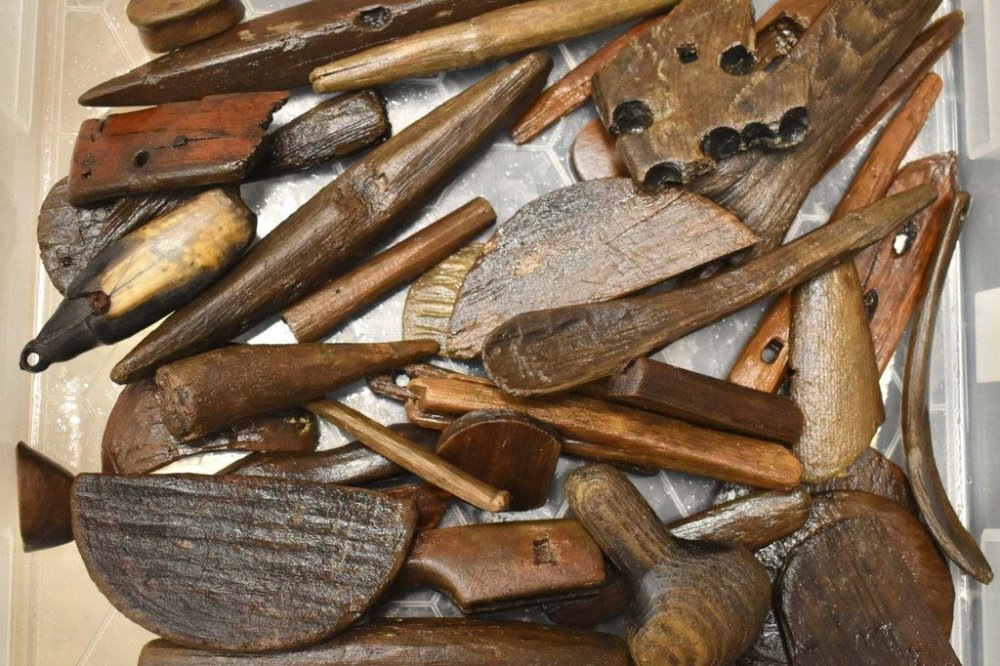
This photo provided by Richard Arden Knecht shows various tools, utensils and other artifacts that were recovered after the Typhoon Halong scattered them from a significant Yup'ik archaeological site, known as the Nunalleq site, in Quinhagak, Alaska, Oct. 2025. (Richard Arden Knecht via AP)

Meanwhile, freezing temperatures and ice have settled into the region, stalling immediate efforts to find and recover more displaced artifacts on searches done by four-wheeler and foot.

Knecht called what happened a major loss. The site has yielded the world’s largest collection of pre-contact Yup’ik artifacts. Much of what’s known about Yup’ik life before outsiders arrived stems from the project, said Knecht, an emeritus senior lecturer in archaeology at the University of Aberdeen in Scotland.

“When there are holes or disturbances in the site, it’s like trying to read a book with holes in the pages. You’re going to miss a few things,” he said. “And the bigger those holes are, the weaker the story gets. There’s a few holes in the book right now.”

While the name of the original village isn’t known, it was attacked by another village and burned around 1650, he said. Knecht has worked with elders and others in Quinhagak to combine their traditional knowledge with the technology and techniques used by the archaeology teams to study the past together.

Quinhagak has about 800 residents, and subsistence food gathering is critically important to them.

The storm dispersed artifacts from a site long preserved by permafrost, Knecht said. A longstanding concern has been the threat that climate change — melting permafrost, coastal erosion, the potential for more frequent or stronger storms — has posed to the site, he said.

It poses risks to the community itself. Erosion threatens major infrastructure in Quinhagak, including a sewage lagoon, homes and fish camps. Thawing permafrost is also unsettling and undermining buildings, according to a 2024 report from the Alaska Native Tribal Health Consortium.

The excavation project itself began after artifacts began appearing on the beach around 2007. Part of the site that washed out had been excavated previously.

“There was a big chunk where we’d only gone about halfway down and left it for later because we prioritized parts of the site that were most at risk from marine erosion,” Knecht said.

When he left in July, there was a roughly 30-foot buffer to the sea. The storm took out the buffer and another 30 feet of the site, he said. It also left what Knecht described as piano-sized clumps of tundra on the tidal flats.

Knecht didn’t recognize the site at first after Halong.

“I just drove right by it because all the landmarks I’m used to on the beach and at the site were gone or changed,” he said.

Work to preserve the rescued artifacts has included soaking the marine salts from the wood and placing the pieces in special chemicals that will help them hold together when they dry out, he said. If one were to just take one of the wooden artifacts off the beach and let them dry, they’d “crack to pieces, sometimes in a matter of hours.”

There is a lab at the museum in Quinhagak where the artifacts are kept.

Archaeologists hope to return to the site next spring for a “rescue excavation” of layers exposed by the storm, he said. In some ways, it feels like when teams saw the site in 2009: “We’ve got this raw site with artifacts popping off in every way,” he said. “So we’re starting from scratch again.”


Report Error Submit a Tip

More Stories

Chief says minister offered money to remove highway checkstop

Kelly-Anne Riess 5 minute read Preview

Chief says minister offered money to remove highway checkstop

Kelly-Anne Riess 5 minute read Wednesday, Oct. 14, 2026

The chief of the Bloodvein River First Nation says a Manitoba cabinet minister offered up to $250,000 for economic development as he was trying to persuade her to remove a highway checkstop that has outraged hunters.

Read
Wednesday, Oct. 14, 2026

Capital punishment as macabre theatre

Editorial 4 minute read Preview

Capital punishment as macabre theatre

Editorial 4 minute read 2:00 AM CDT

There was already enough to write about the question of capital punishment when the State of Tennessee attempted to execute Christa Pike.

Pike would have been the first woman executed in Tennessee in more than 200 years, but her execution on Sept. 30 did not go as planned — she survived, despite two lethal injections of pentobarbital, and was taken to hospital in critical condition.

Pike was released from hospital and sent back to the same prison where she has been incarcerated for the last 30 years, ever since she was convicted — as an 18-year-old — of the murder of 19-year-old Colleen Slemmer in 1995.

Pike faces a long recovery, and an uncertain one. Tennessee assistant attorney general Will Ayers has not said if the state will attempt to execute Pike again, but Gov. Bill Lee has halted all executions this year and ordered an independent review of what went wrong.

Read
2:00 AM CDT

Slain chef’s family infuriated by stayed charges

Morgan Modjeski 3 minute read Preview

Slain chef’s family infuriated by stayed charges

Morgan Modjeski 3 minute read Wednesday, Oct. 14, 2026

The family of a Ste. Anne chef who died after an altercation at a party says they are angry a manslaughter charge has been stayed against a 46-year-old man.

Read
Wednesday, Oct. 14, 2026

Letters, Oct. 16

6 minute read 2:00 AM CDT

Concern over closure

As advocates for seniors in Manitoba, CARP Manitoba (Canadian Association of Retired Persons) is deeply concerned about the closure of the Lions Club Charleswood Adult Day Club.

This closure will have a significant impact on seniors in the community who rely on the Adult Day Club for social connection, companionship, meaningful activities and stimulation. It will also place additional pressure on other Adult Day Clubs throughout the city, many of which are already experiencing increased demand and are now being required to establish waiting lists.

Families of affected seniors are understandably concerned that, without access to this important community-based support, their loved ones may eventually require admission to personal care homes. Adult Day Clubs play an important role in helping seniors remain independent, connected to their communities and living in their own homes for as long as possible.

Today’s horoscope

Georgia Nicols 4 minute read Preview

Today’s horoscope

Georgia Nicols 4 minute read 2:00 AM CDT

MOON ALERT: Avoid shopping (except for food and gas and important decisions until after 8:30 a.m. After that, the moon moves from Sagittarius into Capricorn.

ARIES (March 21-April 19)

You couldn’t pick a better day for sports training or improving a skill in the arts, music, welding, sculpting, pottery making or doing anything that requires repetition to improve. That’s because you have the patience and the perseverance to keep trying.

TAURUS (April 20-May 20)

Read
2:00 AM CDT

Archaeological site in Alaska that casts light on early Yup’ik life ravaged by ex-Typhoon Halong

Becky Bohrer, The Associated Press 5 minute read Preview

Archaeological site in Alaska that casts light on early Yup’ik life ravaged by ex-Typhoon Halong

Becky Bohrer, The Associated Press 5 minute read Thursday, Oct. 30, 2025

JUNEAU, Alaska (AP) — A fragment of a mask that was preserved for hundreds of years in permafrost sat in the muck of a low tide in the western Alaska community of Quinhagak. Wooden spoons, toys, a fishing lure and other artifacts were strewn, in some cases for miles, along the beach.

The Yup'ik community near the edge of the Bering Sea was spared the widespread devastation wrought by the remnants of Typhoon Halong on its neighbors further west earlier this month. But it suffered a different kind of blow: The lashing winds and storm surge devoured dozens of feet of shoreline, disrupting a culturally significant archaeological site and washing away possibly thousands of unearthed artifacts.

About 1,000 pieces, including wooden masks and tools, were recovered in Quinhagak after the storm ravaged parts of southwest Alaska on Oct. 11 and 12. But many more pieces — perhaps up to 100,000 — were left scattered, said Rick Knecht, an archaeologist who has worked on the Nunalleq, or old village, project for 17 years. That's roughly the number of pieces previously recovered from the archaeological site.

Meanwhile, freezing temperatures and ice have settled into the region, stalling immediate efforts to find and recover more displaced artifacts on searches done by four-wheeler and foot.

Read
Thursday, Oct. 30, 2025