Deep-sea mining risks disrupting the marine food web, study warns
Advertisement
Read this article for free:
or
Already have an account? Log in here »
To continue reading, please subscribe:

Digital Subscription
One year of digital access for only $205*
- Enjoy unlimited reading on winnipegfreepress.com
- Read the E-Edition, our digital replica newspaper
- Access News Break, our award-winning app
- Play interactive puzzles
*First annual payment billed as $205.00 + GST for one year. This annual subscription will automatically renew at $233.00 + GST every 52 weeks (10% off the regular annual price of $259.35). Offer available to new and qualified returning subscribers only. Cancel any time.
To continue reading, please subscribe:
Add Free Press access to your Brandon Sun subscription for only an additional
$1 for the first 4 weeks*
- Enjoy unlimited reading on winnipegfreepress.com
- Read the E-Edition, our digital replica newspaper
- Access News Break, our award-winning app
- Play interactive puzzles
*Your next Brandon Sun subscription payment will increase by $1.00 and you will be charged $17.95 plus GST for four weeks. After four weeks, your payment will increase to $24.95 plus GST every four weeks.
Read unlimited articles for free today:
or
Already have an account? Log in here »
Hey there, time traveller!
This article was published 06/11/2025 (308 days ago), so information in it may no longer be current.
Drilling for minerals deep in the ocean could have immense consequences for the tiny animals at the core of the vast marine food web — and ultimately affect fisheries and the food we find on our plates, according to a new study.
Deep-sea mining means drilling the seafloor for “polymetallic nodules” loaded with critical minerals including copper, iron, zinc and more. While not yet commercialized, nations are pursuing deep-sea operations amid rising demand for these minerals in electric vehicles and other parts of the energy transition, as well as for technology and military use.
The researchers examined water and waste gathered from a deep-sea mining trial in 2022.
What the study discovered
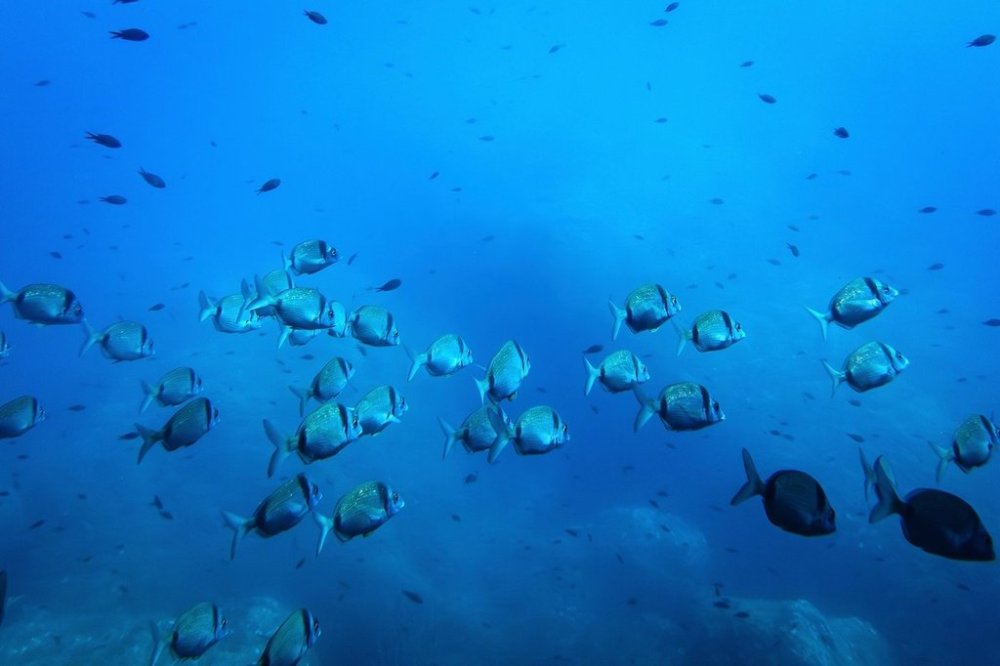
University of Hawaii researchers studied an area of the Pacific Ocean called the “twilight zone,” about 650-5,000 feet (200-1,500 meters) below sea level. Their peer-reviewed findings, published Thursday in the Nature Communications scientific journal, say mining waste could affect anything from tiny shrimp smaller than .08 inches (2 millimeters) long to fish 2 inches (5 centimeters) long.
That’s because, after mining companies bring the mineral-rich nodules up to the surface, they have to release excess sea water, ocean floor dirt and sediment back into the ocean. That creates a murky plume of particles about the same size as the naturally occurring food particles normally eaten by the zooplankton that swim at that depth.
That’s a little more than half of the zooplankton in the ocean. If those organisms eat the waste particles — what senior study author Brian Popp called “junk food” — then that affects 60% of micronekton that eat the zooplankton.
And that undernourishment is a problem because these tiny organisms are the food source up the chain — ultimately affecting commercially important fish such as mahi mahi or tuna.
“Surface fish can dive down deep into the water, they feed on organisms down at depth,” said Michael Dowd, study lead author and oceanography graduate student. “If these organisms down at depth are no longer present because their food web has collapsed, then that can impact higher food webs and more commercial interests.”
Impact on the water and alternative sources
While other research has highlighted the negative environmental impacts from deep-sea mining of nodules, the focus is often the seafloor. This study looks at mid-water.
The researchers said more work needs to be done to assess the appropriate quality and depth at which dirty water and sediment from sea mining could be returned to the ocean. But they said returning the excess directly to the ocean floor or at other depths could be just as environmentally disruptive as in the “twilight zone,” only in different ways.
Popp said digging up the deep sea might not be necessary, and instead noted alternative sources of metals, including recycling batteries and electronics, or sifting through mining waste and tailings.
“If only a single company is mining in one single spot, it’s not going to affect a huge fishery. It’s not going to affect a huge amount of water. But if many companies are mining for many years and outputting a lot of material, this is going to spread across the region,” Dowd said. “And the more mining occurs, the more a problem it could be.”
Where deep-sea mining stands
It might not be viable to simply halt ocean mining. The International Seabed Authority that governs mineral activity beyond national jurisdiction has already granted several contracts for exploration.
In the U.S., President Donald Trump has expressed interest in deep-sea mining operations amid tense trade negotiations with China that have limited U.S. access to China’s wide swath of critical minerals. In April, Trump signed an executive order directing the National Oceanic and Atmospheric Administration to expedite the permitting process for companies to mine the ocean floor, and in May, the administration said it would consider selling leases to extract minerals off the South Pacific island of American Samoa. Last month, NOAA sent a draft rule to the White House to streamline operations.
Environmental groups have advocated against deep-sea mining, citing not only the direct harm to wildlife and parts of the sea, but also the disturbance of planet-warming carbon dioxide that is currently sequestered in the ocean and on its floor.
“It was well laid out in the study that the impacts wouldn’t necessarily be just the depth that the plume is released,” said Sheryl Murdock, a deep-sea postdoctoral researcher at Arizona State University who was not involved in the study. “The question being: Is it worth a few minerals to potentially destroy the way that the oceans function?”
Diva Amon, a marine biologist and postdoctoral researcher at the University of California, Santa Barbara, praised the research for examining potential consequences.
“All of this could lead to species illness, species movement, species death. And depending on the scale of this, that could have graver repercussions, like species extinctions,” said Amon, who wasn’t involved in the study but has previously worked with some of the researchers.
“There’s a lot more research that needs to be done to be able to make an informed decision about how to manage this industry, if it does start, in a way that will prevent, essentially, serious harm to the ocean and ocean ecosystem.”
___

Alexa St. John is an Associated Press climate reporter. Follow her on X: @alexa_stjohn. Reach her at ast.john@ap.org.
___
Read more of AP’s climate coverage.
___
The Associated Press’ climate and environmental coverage receives financial support from multiple private foundations. AP is solely responsible for all content. Find AP’s standards for working with philanthropies, a list of supporters and funded coverage areas at AP.org.