James Watson helped crack DNA’s code, sparking medical advances and ethical debates
Advertisement
Read this article for free:
or
Already have an account? Log in here »
To continue reading, please subscribe:

Digital Subscription
One year of digital access for only $205*
- Enjoy unlimited reading on winnipegfreepress.com
- Read the E-Edition, our digital replica newspaper
- Access News Break, our award-winning app
- Play interactive puzzles
*First annual payment billed as $205.00 + GST for one year. This annual subscription will automatically renew at $233.00 + GST every 52 weeks (10% off the regular annual price of $259.35). Offer available to new and qualified returning subscribers only. Cancel any time.
To continue reading, please subscribe:
Add Free Press access to your Brandon Sun subscription for only an additional
$1 for the first 4 weeks*
- Enjoy unlimited reading on winnipegfreepress.com
- Read the E-Edition, our digital replica newspaper
- Access News Break, our award-winning app
- Play interactive puzzles
*Your next Brandon Sun subscription payment will increase by $1.00 and you will be charged $17.95 plus GST for four weeks. After four weeks, your payment will increase to $24.95 plus GST every four weeks.
Read unlimited articles for free today:
or
Already have an account? Log in here »
Hey there, time traveller!
This article was published 07/11/2025 (335 days ago), so information in it may no longer be current.
On a foggy Saturday morning in 1953, a tall, skinny 24-year-old man fiddled with shapes he had cut out of cardboard. They represented fragments of a DNA molecule, and young James Watson was trying to figure how they fit together in a way that let DNA do its job as the stuff of genes.
Suddenly, he realized that they joined together to form the “rungs” of a long, twisted ladder, a shape better known nowadays as a double helix.
His first reaction: “It’s so beautiful.”
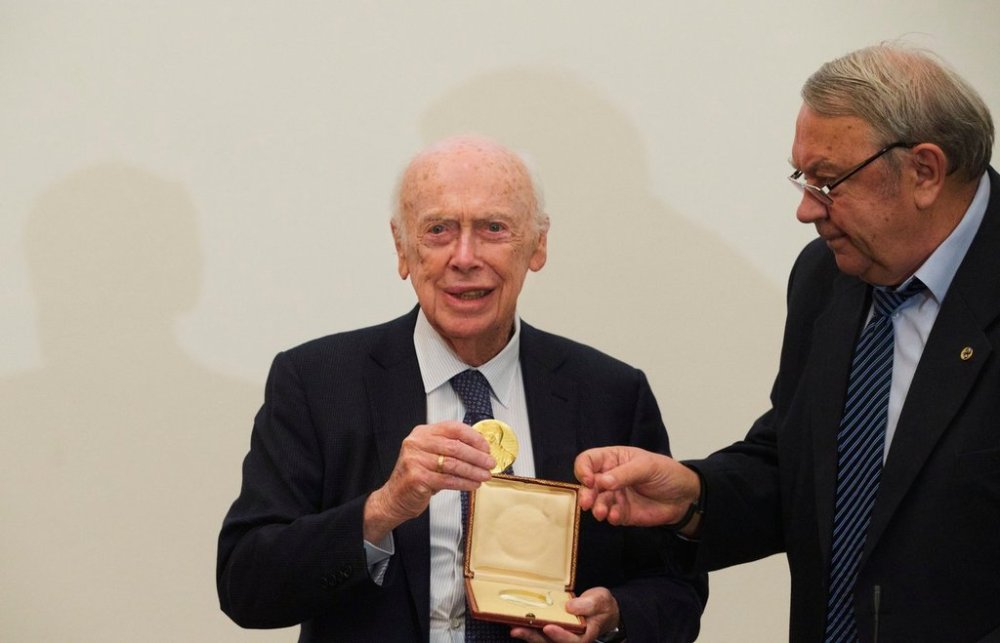
But it was more than that. Discovering the structure of deoxyribonucleic acid, or DNA, was a breakthrough that would help open the way to a revolution in medicine, biology and other fields as diverse as crime-fighting, genealogy and ethics.
Watson died Thursday, according to his former research lab. The Chicago-born scientist was 97 years old. His career was marked by significant achievements, including his role in mapping the human genome. However, his legacy is complicated by controversial remarks on race, which led to his condemnation and loss of honorary titles.
Figuring out the double helix “goes down as one of the three most important discoveries in the history of biology,” alongside Charles Darwin’s theory of evolution through natural selection and Gregor Mendel’s fundamental laws of genetics, said Bruce Stillman, president of the Cold Spring Harbor lab, on Friday.
Watson shared the Nobel Prize with collaborator Francis Crick and scientist Maurice Wilkins. They were aided by X-ray research by colleague Rosalind Franklin and her graduate student Raymond Gosling. Watson was later criticized for a disparaging portrayal of Franklin in his book “The Double Helix,” and today she is considered a prominent example of a female scientist whose contributions were overlooked.
Both of his Nobel co-winners, Crick and Wilkins, died in 2004. Franklin died in 1958.
Their discovery instantly suggested how hereditary information is stored and how a cell duplicates its DNA before dividing so that each resulting cell inherits a copy. The duplication begins with the two strands of DNA pulling apart like a zipper.
“Francis Crick and I made the discovery of the century, that was pretty clear,” Watson once said. He also wrote: “There was no way we could have foreseen the explosive impact of the double helix on science and society.”
Among non-scientists, the double helix has become an instantly recognized symbol of science. And for researchers, it helped open the door to more recent developments such as tinkering with the genetic makeup of living things, treating disease by inserting genes into patients, identifying human remains and criminal suspects from DNA samples and tracing family trees.
That in turn has raised a host of ethical questions, such as whether we should be altering a person’s genome in a way that is transmitted to one’s offspring.
Watson’s initial motivation for supporting the gene project was personal: His son Rufus had been hospitalized with a possible diagnosis of schizophrenia, and Watson figured that knowing the complete makeup of DNA would be crucial for understanding that disease, maybe in time to help his son.
Watson never made another lab finding as big as the double helix. But in the decades that followed, he wrote influential textbooks and a best-selling memoir, picked out bright young scientists and helped them. And he used his prestige and contacts to influence science policy.
Following the discovery, Watson spent two years at the California Institute of Technology, then joined the faculty at Harvard in 1955. Before leaving Harvard in 1976, he essentially created the university’s molecular biology program, scientist Mark Ptashne recalled in a 1999 interview. Watson became director of the Cold Spring Harbor lab in 1968, its president in 1994 and its chancellor 10 years later.
From 1988 to 1992, he directed the federal effort to identify the detailed makeup of human DNA. He created the project’s huge investment in ethics research by simply announcing it at a news conference. He later said it was “probably the wisest thing I’ve done over the past decade.”
Yet he gained unwelcome attention in 2007 when the Sunday Times Magazine of London quoted him as saying he was “inherently gloomy about the prospect of Africa” because “all our social policies are based on the fact that their intelligence is the same as ours — where all the testing says not really.” He said that while he hopes everyone is equal, “people who have to deal with Black employees find this is not true.”
He apologized, but after an international furor he was suspended from his job as chancellor of the Cold Spring Harbor Laboratory in New York. He retired a week later. He had served in various leadership jobs there for nearly 40 years.
“I only wish that Jim’s views on society and humanity could have matched his brilliant scientific insights.” Dr. Francis Collins, then-director of the National Institutes of Health, said in 2019.
In a television documentary that year, Watson was asked if his views had changed. “No, not at all,” he said.
In response, the Cold Spring Harbor lab revoked several honorary titles it had given Watson, saying his statements were “reprehensible” and “unsupported by science.”

His 2007 remarks on race were not the first time Watson struck a nerve with his comments. In a speech in 2000, he suggested that sex drive is related to skin color. And earlier he told a newspaper that if a gene governing sexuality were found and could be detected in the womb, a woman who didn’t want to have a gay child should be allowed to have an abortion.
___
Ritter is a retired AP science writer. AP science writers Christina Larson in Washington and Adithi Ramakrishnan in New York contributed to this report.
___
The Associated Press Health and Science Department receives support from the Howard Hughes Medical Institute’s Department of Science Education and the Robert Wood Johnson Foundation. The AP is solely responsible for all content.