B.C. wolves use line to pull up crab traps in first possible tool use by species

Advertisement

Advertise with us

Researchers have captured video footage of wild wolves in British Columbia pulling crab traps out of the sea by their lines to eat the bait inside, in the first evidence of possible tool use by the animals.

Read this article for free:

or

Already have an account? Log in here »

To continue reading, please subscribe:

Subscribe and receive a limited-edition Free Press branded hat or tote.

Digital Subscription

One year of digital access for only $205*

  • Enjoy unlimited reading on winnipegfreepress.com
  • Read the E-Edition, our digital replica newspaper
  • Access News Break, our award-winning app
  • Play interactive puzzles

*First annual payment billed as $205.00 + GST for one year. This annual subscription will automatically renew at $233.00 + GST every 52 weeks (10% off the regular annual price of $259.35). Offer available to new and qualified returning subscribers only. Cancel any time.

To continue reading, please subscribe:

Add Free Press access to your Brandon Sun subscription for only an additional

$1 for the first 4 weeks*

  • Enjoy unlimited reading on winnipegfreepress.com
  • Read the E-Edition, our digital replica newspaper
  • Access News Break, our award-winning app
  • Play interactive puzzles
Start now

*Your next Brandon Sun subscription payment will increase by $1.00 and you will be charged $17.95 plus GST for four weeks. After four weeks, your payment will increase to $24.95 plus GST every four weeks.

Hey there, time traveller!
This article was published 17/11/2025 (247 days ago), so information in it may no longer be current.

Researchers have captured video footage of wild wolves in British Columbia pulling crab traps out of the sea by their lines to eat the bait inside, in the first evidence of possible tool use by the animals.

A report released Monday in the scientific journal Ecology and Evolution by researchers Kyle Artelle and Paul Paquet says they placed cameras on the beach aimed at Heiltsuk First Nation crab traps to work out what was repeatedly damaging them.

The traps, set up near Bella Bella, on B.C.’s central coast, were being used to control the invasive European green crab, and some were in deeper water submerged at all times, leading researchers to believe the damage that started in 2023 was caused by marine mammals.

“We were going, ‘Well, what the heck is doing this, right?'” said Artelle, a researcher with State University of New York’s College of Environmental Science and Forestry, who was involved with the Heiltsuk Nation’s efforts to respond to the green crabs.

“It can’t be a bear, a wolf. They’re not going to dive down to get to the trap. So, what is getting the traps?”

Their assumptions were wrong.

Within a day of the cameras being set up in May last year, researchers  captured footage of a sea wolf emerging from the water with a buoy hanging from its mouth.

The footage then showed the wolf dropping the buoy on the beach, picking up the exposed line, and pulling it until the crab trap emerged from the water.

The wolf then picked up the trap with its mouth, moved it to shallower waters and ate the bait inside.

“We had to pick our jaws off the floor,” Artelle said.

“We know that they’re really, really smart, but it hadn’t crossed our mind that, oh, maybe a wolf is swimming out to the deeper traps and bringing the buoy to shore, pulling the line up just like a person would.”

The cameras then picked up a second sea wolf also pulling up a crab trap in a similar way earlier this year, leading researchers to believe other wolves in the local pack may have learned from each other.

Sea wolves are a grey wolf subspecies known for their marine-based diet.
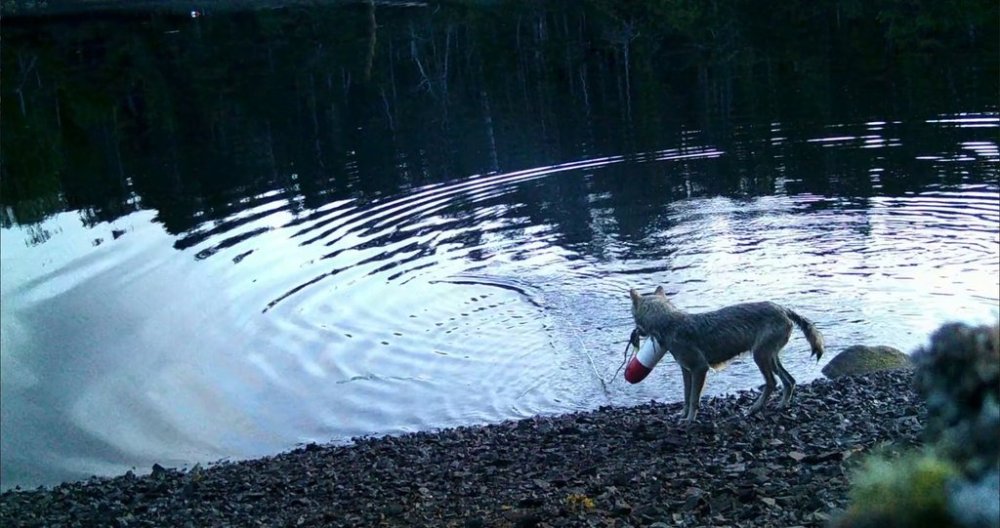
A sea wolf is captured on video, in this handout still image, near Bella Bella, B.C., extracting a submerged crab trap using a buoy and an attached line, in what researchers are calling the first evidence of possible tool-use by the wild animal species. THE CANADIAN PRESS/Handout - Kyle Artelle (Mandatory Credit)

As for how the behaviour started, Artelle said researchers can only speculate.

“We ultimately don’t know, but the two most likely explanations in our minds, one would be that the wolves started doing this with traps that were exposed at a low tide because that’s really easy,” Artelle said.

“There might’ve been this incremental learning that started with the trap fully onshore to traps partly submerged, to then associating the line with the trap and then the buoy with the line … It would make a lot of sense, and that’s often how we learn.”

Researchers say a few cameras at the B.C. site are now dedicated 24-7 to the crab traps to track the behaviour of sea wolves in the area, while work is “in progress” to prevent too much damage to the traps that may inhibit the invasive crab study.

“Some really special things are happening here, and we want to understand more about that. What else is happening on the ground? What else do these wolves have to teach us? And so that’s a focus for the next decades as we explore more about wolves here,” Artelle said.

“This is really just the tip of the iceberg.”

This report by The Canadian Press was first published Nov. 17, 2025.

Report Error Submit a Tip

More Stories

Volunteer support surges as search for boys presumed drowned enters fifth day

Nicole Buffie 3 minute read Preview

Volunteer support surges as search for boys presumed drowned enters fifth day

Nicole Buffie 3 minute read 2:49 PM CDT

Dozens of volunteers have joined the search for two boys presumed drowned on Nutimik Lake.

With the search entering the fifth day, several volunteer teams were on the water Wednesday morning using sonar systems to sweep the bottom of the lake.

Manuel Maendel, the founder of the Hutterian Emergency Aquatic Response Team, and a team of four searchers have used a sonar and a remote-operated underwater vehicle since Sunday.

“I can see quite a few fishing boats around, people trying to see if there’s anything they can spot with their scopes. There’s quite a few people on shore and we’ve even seen airplanes flying,” Maendel said from his boat.

Read
2:49 PM CDT

WestJet adding two new direct flights from Winnipeg to warm-weather destinations

Aaron Epp 3 minute read Preview

WestJet adding two new direct flights from Winnipeg to warm-weather destinations

Aaron Epp 3 minute read Monday, Jul. 20, 2026

WestJet announced on Monday it will launch non-stop routes between Winnipeg and Punta Cana, Dominican Republic, and between Winnipeg and Belize City, Belize.

Read
Monday, Jul. 20, 2026

B.C. wolves use line to pull up crab traps in first possible tool use by species

Chuck Chiang, The Canadian Press 4 minute read Preview

B.C. wolves use line to pull up crab traps in first possible tool use by species

Chuck Chiang, The Canadian Press 4 minute read Monday, Nov. 17, 2025

Researchers have captured video footage of wild wolves in British Columbia pulling crab traps out of the sea by their lines to eat the bait inside, in the first evidence of possible tool use by the animals.

A report released Monday in the scientific journal Ecology and Evolution by researchers Kyle Artelle and Paul Paquet says they placed cameras on the beach aimed at Heiltsuk First Nation crab traps to work out what was repeatedly damaging them.

The traps, set up near Bella Bella, on B.C.'s central coast, were being used to control the invasive European green crab, and some were in deeper water submerged at all times, leading researchers to believe the damage that started in 2023 was caused by marine mammals.

"We were going, 'Well, what the heck is doing this, right?'" said Artelle, a researcher with State University of New York's College of Environmental Science and Forestry, who was involved with the Heiltsuk Nation's efforts to respond to the green crabs.

Read
Monday, Nov. 17, 2025

Search continues for brothers feared drowned at Nutimik Lake

Zoe Pierce 5 minute read Preview

Search continues for brothers feared drowned at Nutimik Lake

Zoe Pierce 5 minute read Monday, Jul. 20, 2026

Search-and-rescue crews continued efforts Monday to locate two boys who are presumed drowned after falling into fast-moving rapids at Nutimik Lake on the weekend, as community members and Manitoba Parks begin conversations about preventing future tragedies.

The boys, identified as brothers Aaron Au Ramirez, 13, and Maximo Au Ramirez, 10, were visiting Whiteshell Provincial Park with their father and some friends when they entered the water near the Sturgeon Falls Trail Saturday afternoon.

Lac du Bonnet RCMP received a report of a possible drowning at about 12:40 p.m. Police, along with local emergency responders, searched the shoreline and waterways but were unable to find the boys, RCMP said in a news release.

The Manitoba RCMP Underwater Recovery Team and the Hutterian Emergency Aquatic Response Team were later deployed to assist with the search.

Read
Monday, Jul. 20, 2026

BRANDON — A 22-year-old man is facing several charges, including impaired driving, after he was arrested last week for going 100 kilometres per hour near a park.

On July 16 around 4:30 p.m., Ste. Rose du Lac RCMP officers saw a truck that appeared to be travelling 100 km/h in a 40 km/h zone near a park in Ebb and Flow First Nation.

The truck was seen near the intersection of Lake Road Northeast and Northwest Road, RCMP said Tuesday.

Police realized the truck matched a description of a vehicle that had fled from officers multiple times earlier in the week, the release said.

Best to steer clear if ex is still life of the party

Maureen Scurfield 4 minute read 2:01 AM CDT

DEAR MISS LONELYHEARTS: I spotted an old girlfriend at the beach recently, and what a jolt. She was tanned and gorgeous. She had a pink towel wrapped around her lower half and it reminded me of when she would walk towards me with a sexy look on her face after a shower. She always knew what she was doing and how it affected me.

We didn’t end up chatting at the beach, but to my surprise she called me later that day, asking to take me out to dinner. What should I do? We were a great pair, except for her excessive partying and drinking. I didn’t ask her if she’s being a good girl now. Please advise.

— Curiosity Aroused, West Kildonan

Dear Curious: The more mature version of this ex might be interesting for you — if she has actually graduated from her bad old days of partying. You’ll probably know after a dinner out with her, especially if you have a couple of cocktails.