Frustrations grow in Russia over cellphone internet outages that disrupt daily life
Advertisement
Read this article for free:
or
Already have an account? Log in here »
To continue reading, please subscribe:

Digital Subscription
One year of digital access for only $205*
- Enjoy unlimited reading on winnipegfreepress.com
- Read the E-Edition, our digital replica newspaper
- Access News Break, our award-winning app
- Play interactive puzzles
*First annual payment billed as $205.00 + GST for one year. This annual subscription will automatically renew at $233.00 + GST every 52 weeks (10% off the regular annual price of $259.35). Offer available to new and qualified returning subscribers only. Cancel any time.
To continue reading, please subscribe:
Add Free Press access to your Brandon Sun subscription for only an additional
$1 for the first 4 weeks*
- Enjoy unlimited reading on winnipegfreepress.com
- Read the E-Edition, our digital replica newspaper
- Access News Break, our award-winning app
- Play interactive puzzles
*Your next Brandon Sun subscription payment will increase by $1.00 and you will be charged $17.95 plus GST for four weeks. After four weeks, your payment will increase to $24.95 plus GST every four weeks.
Read unlimited articles for free today:
or
Already have an account? Log in here »
Hey there, time traveller!
This article was published 21/11/2025 (306 days ago), so information in it may no longer be current.
TALLINN, Estonia (AP) — When Russians look back at 2025, they might remember it as the year when the government took even tighter control of the internet.
Credit cards that won’t buy a ticket on public transport. ATMs that don’t connect to a network. Messaging apps that are down. Cellphones that don’t receive texts or data after a trip abroad. Mothers of diabetic children even complain with alarm that they can’t monitor their kids’ blood glucose levels during outages.
The cellphone internet shutdowns, ostensibly to thwart Ukrainian drone attacks, have hit dozens of Russian regions for months. Popular messaging apps also are restricted, with the government promoting a state-controlled app seen by critics as a possible surveillance tool.
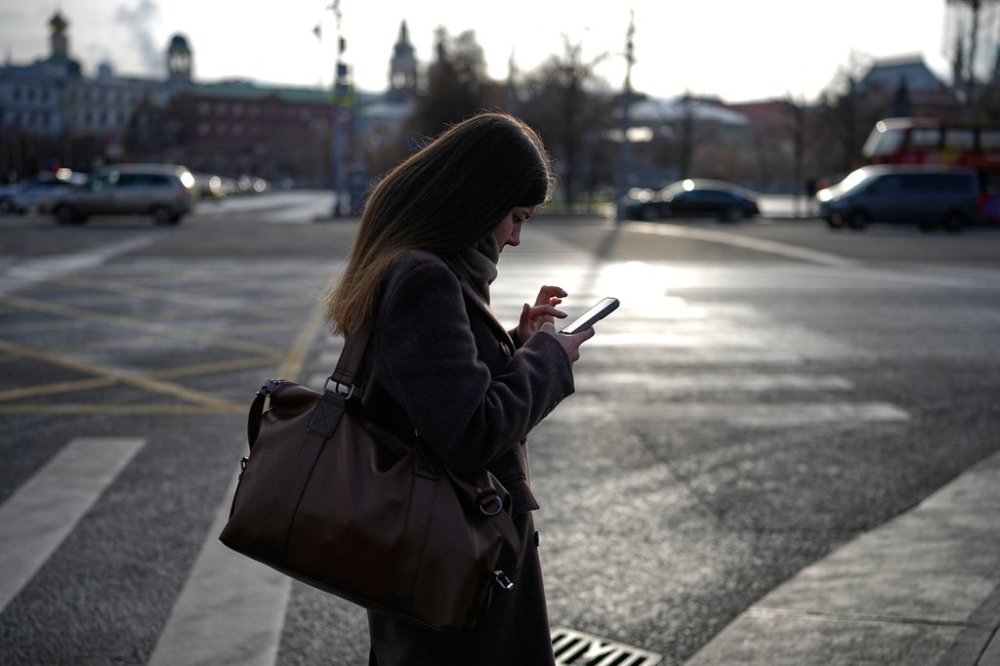
Although broadband and Wi-Fi internet access remain unaffected, Russians contacted by The Associated Press described digital disruptions to their daily lives. All spoke on condition of not being fully identified for their own safety.
Blackouts and ‘white lists’ are part of Russian strategy
Widespread cellphone internet shutdowns began in May and persisted through summer and into the fall. In November, 57 Russian regions on average reported daily disruptions to cellphone links, according to Na Svyazi, an activist group monitoring shutdowns.
Authorities say these outages are designed to prevent Ukrainian drones from tapping mobile networks for navigation.
Kremlin spokesman Dmitry Peskov said they are “absolutely justified and necessary,” but analyst Kateryna Stepanenko of the Washington-based Institute for the Study of War said they haven’t been effective in curbing the intensity of Ukraine’s drone attacks, “given the amount of strikes we’ve seen in recent months on Russian oil refineries.”
In many regions, only a handful of government-approved Russian websites and online services — designated as being on “white lists” — are available during connectivity blackouts.
What’s available on the “white lists” varies by provider and includes official websites, email and social media platforms, two online markets, and the Russian search engine Yandex and its services. One provider offers access to a banking app, but others don’t. Authorities have promised to expand the lists.
Marina, who lives in the Pacific coast city of Vladivostok, described her anxiety when she discovered only one app for a government-controlled bank was working during a mobile internet outage and she wondered what this meant for the future.
“For me, this is the scariest thing,” she said. “The loss of information, the loss of freedom, essentially, is the most depressing thing for me.”
In the Volga River city of Ulyanovsk, about 700 kilometers (435 miles) east of Moscow, one resident described how his credit card didn’t work when he tapped it on the payment terminal on a tram during an outage. He wasn’t carrying enough cash.
Families with diabetic children say they can’t monitor their children’s glucose levels via special apps when they are at school and cellphone internet is down. Mothers in social media posts explain that children often can miss the moment when their blood sugar levels change, requiring an intervention, and special apps allowed parents to see that remotely and warn them. Connection outages disrupt that.
Authorities have tried touting the joys of reconnecting with a technology-free lifestyle.
Internet regulatory agency Roskomnadzor posted a cartoon on social media showing two views of a young man: one in a dark apartment staring at his phone and another strolling happily in a park, carrying a cup of coffee and a book.
Going offline “doesn’t mean losing touch. Sometimes it means getting in touch with yourself,” the cartoon advised.
But the post mostly drew angry and sarcastic comments.
Restrictions set on SIM cards
One recent anti-drone restriction sets 24-hour “cooling periods” during which data and texts are blocked from SIM cards that were carried abroad or have been inactive for 72 hours. The owner can unblock it via a link received by text message.
Unblocking becomes impossible, however, if a SIM card is used in internet-connected appliances or equipment without interfaces for receiving text messages, like portable Wi-Fi routers, cars or meter boxes.
Lawmaker Andrei Svintsov noted that Russia has many electricity meters with SIM cards that transmit readings once a month.
“Does this mean they’ll all die? All the heating boilers will shut down, and all the Chinese cars will stop working? This is a massive problem, and I don’t know if the government is even aware of it,” he said.
Messaging apps are targeted
Other restrictions targeted two popular messaging apps: WhatsApp, with about 96 million monthly users in October, and Telegram, with 91 million, according to media monitoring group Mediascope.
Authorities began restricting calls on these apps in August, supposedly to stop phone scams, and are throttling them in some parts of Russia. Yelena, in the southern city of Krasnodar, recalled a time in October when Telegram wasn’t available at all, affecting the work of her and her colleagues.
Neither app is on the government “white list.”
On the list is Russian messaging service MAX. Authorities actively promote it and since September the service is required to be preinstalled on all smartphones in Russia. Critics see it as a surveillance tool as MAX openly declares it will share user data with authorities upon request. Experts also say it doesn’t use end-to-end encryption.
State institutions, officials and businesses are being encouraged to move communications and blogs to MAX. Marina, the Vladivostok resident, said her employers are insisting on people using MAX, to little enthusiasm. She said she doesn’t plan to install it, and neither do others contacted by the AP.
MAX developers boast of about 50 million users registering on the platform that it says provides messaging and other services.
Mediascope said MAX had about 48 million monthly users in October, but only 18.9 million average daily users, which is far less than the average daily totals of 81 million for WhatsApp and 68 million for Telegram.
Russians shrug at restrictions
Denis Volkov, director of the Levada Center, Russia’s top independent pollster, said many Russians regard the restrictions the same way they feel about the weather: Ultimately, you can do nothing about it.
The authorities’ strategy appears to be to make it difficult for average users to access “alternative content” so that they eventually stop seeking it, Volkov said. Those “who are not that interested will pick simpler channels and ways” to navigate the internet, he said.
That sentiment was echoed by the Ulyanovsk resident who said he uses a virtual private network to access some of the blocked websites and platforms, but VPNs also are routinely blocked, so he must install a new one every few months.

His tight circle of friends trade recommendations on VPNs, but he believes most people won’t make that much effort.
Mikhail Klimarev, executive director of the Internet Protection Society activist group, says the internet is tied to too many economic activities to shut it totally.
“Groceries are being shipped to stores — this is being done via internet, the ordering, the processing, and so on,” he said. “A truck is on the road, it is connected to an information system, maps, navigation, all of it.”
But he forecasts more stifling of websites, VPNs and platforms including totally blocking messenger apps Telegram and WhatsApp and possibly other, unexpected measures.
“Honestly, I’m watching it all with raised eyebrows. They seem to have come up with everything already, and they’re still coming up with something more,” he said.