

Gambling with our lives
How AI and prediction markets are edging us closer to a dystopian world

Advertisement
Read this article for free:
or
Already have an account? Log in here »
To continue reading, please subscribe:

Digital Subscription
One year of digital access for only $205*
- Enjoy unlimited reading on winnipegfreepress.com
- Read the E-Edition, our digital replica newspaper
- Access News Break, our award-winning app
- Play interactive puzzles
*First annual payment billed as $205.00 + GST for one year. This annual subscription will automatically renew at $233.00 + GST every 52 weeks (10% off the regular annual price of $259.35). Offer available to new and qualified returning subscribers only. Cancel any time.
To continue reading, please subscribe:
Add Free Press access to your Brandon Sun subscription for only an additional
$1 for the first 4 weeks*
- Enjoy unlimited reading on winnipegfreepress.com
- Read the E-Edition, our digital replica newspaper
- Access News Break, our award-winning app
- Play interactive puzzles
*Your next Brandon Sun subscription payment will increase by $1.00 and you will be charged $17.95 plus GST for four weeks. After four weeks, your payment will increase to $24.95 plus GST every four weeks.
Read unlimited articles for free today:
or
Already have an account? Log in here »
Hey there, time traveller!
This article was published 12/12/2025 (211 days ago), so information in it may no longer be current.
There’s a new billionaire in the world, as if the world didn’t have enough already.
Her name is Luana Lopes Lara, and at 29 years old she recently became the youngest woman ever to become a self-made billionaire, beating out 31-year-old AI founder Lucy Guo, who took the title from Taylor Swift earlier this year.
Unlike Swift, who rakes in cash each time she strums a riff, Lara’s wealth is mostly speculation on what she started, and mostly exists on paper. She is the co-founder of Kalshi, a company that recently sucked in enough private investment to double its valuation in just two months, hitting US$11 billion.
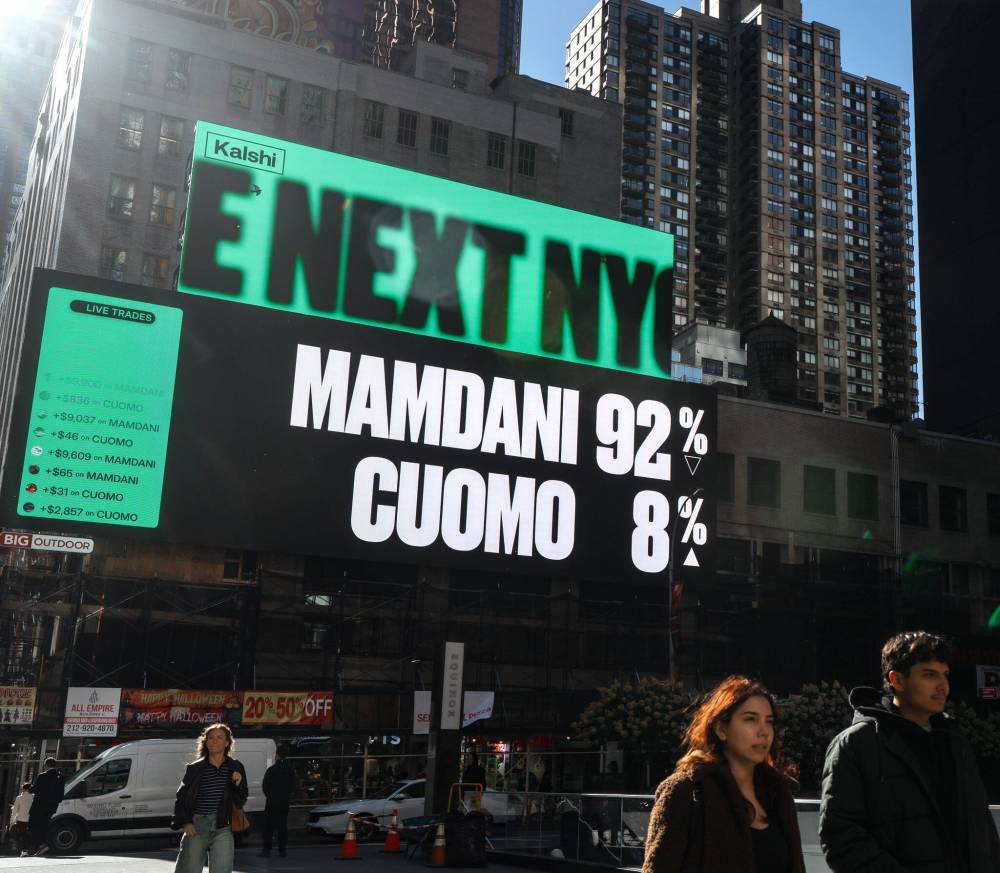
Olga Fedorova / The Associated Press Files
Electronic billboards for online “prediction market” company Kalshi, project a victory for Zohran Mamdani in the New York City mayoral election before the votes are counted and polls closed in New York in November.
Kalshi is one of several offerings in a relatively new category of business. It is an online “prediction market,” or, in other words, a website where people can place bets on everything from whether it will rain in New York City today, to how many people will be deported from the United States in Trump’s first year back in office.
This is, according to Kalshi, not gambling. If you call this “gambling” online, many Kalshi fans will descend upon you, ready to explain why that is not the case.
As a recent article in The Atlantic explained, Kalshi skirts U.S. state gambling laws because it is, “in the eyes of American law, not a gambling company at all; it’s an exchange that facilitates the trading of legitimate financial products.” OK, great.
Whatever you want to call them, prediction markets are poised to storm into the public consciousness. In the four years since Kalshi launched, it has become a challenger for top spot in the sector; it recently landed media partnerships with broadcast giants CNN and CNBC.
These partnerships raise uncomfortable questions, especially as the U.S. heads into a mid-term elections year. For instance: it would be easy for someone with deep enough pockets to rig many of the results.
But how might it affect perceptions of electoral races, and thus, arguably, the outcome of a race itself, if every story is appended by a “prediction market” figure predicting a firm win or loss?
Nor are elections where such potential for shenanigans ends.
Speaking at a recent conference, Kalshi’s other co-founder, Tarek Mansour, explained that “the long-term vision is to financialize everything and create a tradable asset out of any difference in opinion.”
They really do mean any difference.
On the biggest prediction market, Polymarket, there is an open bet — sorry, prediction trading opportunity — for whether Russia will seize certain parts of Ukraine by a certain time, or whether Gaza will be ethnically cleansed by the end of the year.
A note on that latter question and others tries to give it a morally upstanding veneer: “The promise of prediction markets is to harness the wisdom of the crowd to create accurate, unbiased forecasts for the most important events to society,” it reads. “That ability is particularly invaluable in gut-wrenching times like today. After discussing with those directly affected by the attacks, who had dozens of questions, we realized that prediction markets could give them the answers they needed in ways TV news and could not.”
The thing is, there isn’t much evidence that the crowd has any special predictive wisdom, especially not when every information source around them is increasingly manipulated by various actors, state and private.
Beyond that, there is something that, to me at least, is deeply disturbing about betting on whether a people’s home will be stolen, or whether they will be ethnically cleansed. Many, clearly, don’t seem to share this disgust, and that in itself is unsettling.
If people don’t get, on a gut level, why it’s morally repellent to bet on ethnic cleansing, or why there should be limits on the extent to which a society should “financialize everything,” then we are staring at a difference in world view that seems larger than mere passing opinion.
The thing is, only one side has the money. Only one side is winning. And the leaders of that side, flush with cash and evidently unbound by concerns about government regulation, seem hell-bent on throwing us into a place where nothing is sacred, and everything is up for sale.
For decades, we have revelled in dystopian fiction. It’s not fiction anymore; the dystopia is here already, and we are being far too passive. The dystopia came while we were busy, or divided, and it also ensured we were too busy and divided to contain it.
It came in the form of AI programs that hallucinate fake information, and yet now flood our entire information environment: a recent survey of articles published online found that already, 52 per cent were written by AI — in other words, by a program that cannot do original research, articles which future generations of AI will be trained on, spreading those hallucinations further.
It came in the form of AI chat bots that have, under a veneer of empathy, now encouraged people to end their lives by suicide in multiple known cases. Some families of the deceased have since sued; as part of its defence in the death of 17-year-old Adam Raine, OpenAI claimed Raine violated its terms of service by discussing his suicide with ChatGPT.
By the way, ChatGPT is poised to roll out ads in its responses soon. Elon Musk’s xAI will soon begin generating video advertisements and inserting them “seamlessly” into videos, so that even videos in which the creator did not intend to insert ads will include them, and so there will be no way to prepare, or escape, or look away, or even know, necessarily, what you are seeing.
The dystopia came in the form of endless tools to harass, to abuse, to distort reality. In Calgary, earlier this month, a 17-year-old youth was charged for using image-generating AI to turn photos of underage female peers into pornography, which he then shared online.
He isn’t the first, and won’t be the last; the technology is now able to create images that are totally undetectable as fake to the average viewer. Countless victims’ lives will be utterly ruined. Some perpetrators will be caught, but some never will — and worst of all is that we have no effective tools to prevent it.
And the dystopia came in waves of misinformation, perpetrated by shadowy actors or just simple grifters, spread by platforms that prioritize “engagement” — making money from your eyeballs — above all else.

All of this is enabled by two primary factors: the slowness — or unwillingness — of regulatory bodies to adapt, and the rampant amorality of many of those driving it.
People infused by a belief that nothing ought to be sacred, and that human dignity carries no inherent value; people determined to move forward with any idea to seize control of information, or squeeze money out of people.
The dystopia is already here, and so far, we’ve done almost nothing to stop it. The window to slow that acceleration, to adjust and take control of seismic changes to our environment, is very small.
If we don’t act, the chance to stop the worst of what is coming will be lost.
melissa.martin@freepress.mb.ca
Melissa Martin
Reporter-at-large
Melissa Martin reports and opines for the Winnipeg Free Press.
Every piece of reporting Melissa produces is reviewed by an editing team before it is posted online or published in print — part of the Free Press‘s tradition, since 1872, of producing reliable independent journalism. Read more about Free Press’s history and mandate, and learn how our newsroom operates.
Our newsroom depends on a growing audience of readers to power our journalism. If you are not a paid reader, please consider becoming a subscriber.
Our newsroom depends on its audience of readers to power our journalism. Thank you for your support.
Melissa Martin
Reporter-at-large
Melissa Martin reports and opines for the Winnipeg Free Press.
Every piece of reporting Melissa produces is reviewed by an editing team before it is posted online or published in print — part of the Free Press‘s tradition, since 1872, of producing reliable independent journalism. Read more about Free Press’s history and mandate, and learn how our newsroom operates.
Our newsroom depends on a growing audience of readers to power our journalism. If you are not a paid reader, please consider becoming a subscriber.
Our newsroom depends on its audience of readers to power our journalism. Thank you for your support.
Advertisement Advertise With Us
Advertisement Advertise With Us