Trump’s return brought stiff headwinds for clean energy. So why are advocates optimistic in 2026?
Advertisement
Read this article for free:
or
Already have an account? Log in here »
To continue reading, please subscribe:

Digital Subscription
One year of digital access for only $205*
- Enjoy unlimited reading on winnipegfreepress.com
- Read the E-Edition, our digital replica newspaper
- Access News Break, our award-winning app
- Play interactive puzzles
*First annual payment billed as $205.00 + GST for one year. This annual subscription will automatically renew at $233.00 + GST every 52 weeks (10% off the regular annual price of $259.35). Offer available to new and qualified returning subscribers only. Cancel any time.
To continue reading, please subscribe:
Add Free Press access to your Brandon Sun subscription for only an additional
$1 for the first 4 weeks*
- Enjoy unlimited reading on winnipegfreepress.com
- Read the E-Edition, our digital replica newspaper
- Access News Break, our award-winning app
- Play interactive puzzles
*Your next Brandon Sun subscription payment will increase by $1.00 and you will be charged $17.95 plus GST for four weeks. After four weeks, your payment will increase to $24.95 plus GST every four weeks.
Read unlimited articles for free today:
or
Already have an account? Log in here »
Hey there, time traveller!
This article was published 21/12/2025 (296 days ago), so information in it may no longer be current.
There were some highs amid a lot of lows in a roller coaster year for clean energy as President Donald Trump worked to boost polluting fuels while blocking wind and solar, according to dozens of energy developers, experts and politicians.
Surveyed by The Associated Press, many described 2025 as turbulent and challenging for clean energy, though there was progress as projects connected to the electric grid. They said clean energy must continue to grow to meet skyrocketing demand for electricity to power data centers and to lower Americans’ utility bills.
Solar builder and operator Jorge Vargas said it has been “a very tough year for clean energy” as Trump often made headlines criticizing renewable energy and Republicans muscled a tax and spending cut bill through Congress in July that dramatically rolled back tax breaks for clean energy.
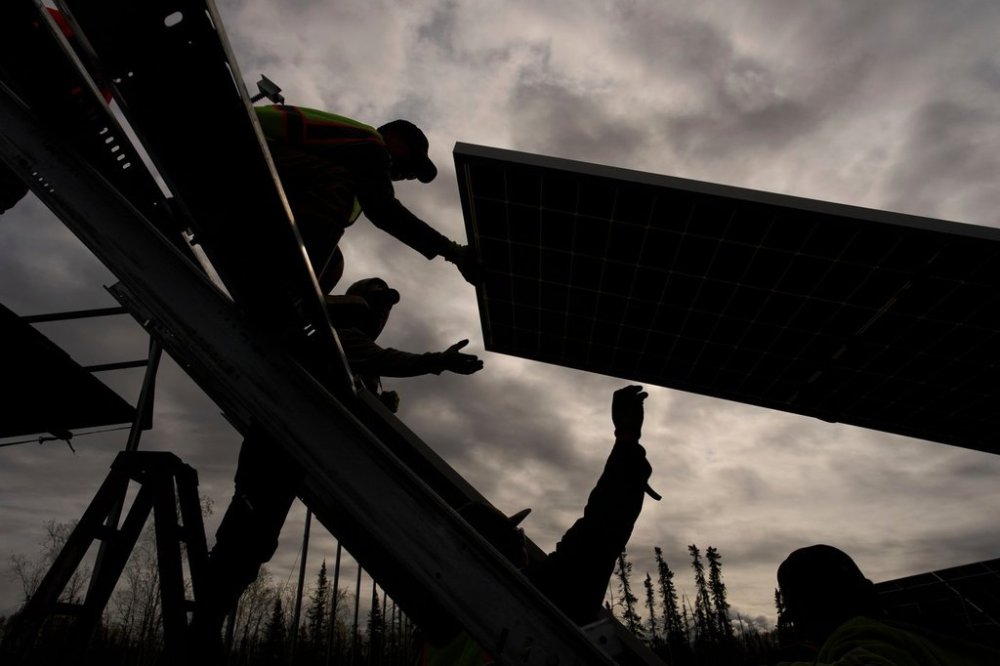
“There was a cooldown effect this year,” said Vargas, cofounder and CEO of Aspen Power. “Having said that, we are a resilient industry.”
Plug Power president Jose Luis Crespo said the developments — both policy recalibration and technological progress — will shape clean energy’s trajectory for years to come.
Energy policy whiplash in 2025
Much of clean energy’s fate in 2025 was driven by booster Joe Biden’s exit from the White House.
The year began with ample federal subsidies for clean energy technologies, a growing number of U.S.-based companies making parts and materials for projects and a lot of demand from states and corporations, said Tom Harper, partner at global consultant Baringa.
It ends with subsidies stripped back, a weakened supply chain, higher costs from tariffs and some customers questioning their commitment to clean energy, Harper said. He described the year as “paradigm shifting.”
Trump called wind and solar power “the scam of the century” and vowed not to approve new projects. The federal government canceled grants for hundreds of projects.
The Republicans’ tax bill reversed or steeply curtailed clean energy programs established through the Democrats’ flagship climate and health care bill in 2022. Wayne Winegarden, at the Pacific Research Institute think tank, said the time has come for alternative energy to demonstrate viability without subsidies. ( Fossil fuels also receive subsidies.)
Many energy executives said this was the most consequential policy shift. The bill reshaped the economics of clean energy projects, drove a rush to start construction before incentives expire and forced developers to reassess their strategies for acquiring parts and materials, Lennart Hinrichs said. He leads the expansion of TWAICE in the Americas, providing analytics software for battery energy storage systems.
Companies can’t make billion-dollar investments with so much policy uncertainty, said American Clean Power Association CEO Jason Grumet.
Consequently, greenhouse gas emissions will fall at a much lower rate than previously projected in the U.S., said Brian Murray, director of the Nicholas Institute for Energy, Environment and Sustainability at Duke University.
Still, solar and battery storage are booming
Solar and storage accounted for 85% of the new power added to the grid in the first nine months of the Trump administration, according to Wood Mackenzie research.
That’s because the economics remain strong, demand is high and the technologies can be deployed quickly, said Mike Hall, CEO of Anza Renewables.
Solar energy company Sol Systems said it had a record year as it brought its largest utility-scale project online and grew its business. The energy storage systems company CMBlu Energy said storage clearly stands out as a winner this year too, moving from optional to essential.
“Trump’s effort to manipulate government regulation to harm clean energy just isn’t enough to offset the natural advantages that clean energy has,” Democratic U.S. Sen. Sheldon Whitehouse said. “The direction is still all good.”
The Solar Energy Industries Association said that no matter the policies in Washington, solar and storage will grow as the backbone of the nation’s energy future.
Nuclear and geothermal had a good year, too
Democrats and Republicans have supported investing to keep nuclear reactors online, restart previously closed reactors and deploy new, advanced reactor designs. Nuclear power is a carbon-free source of electricity, though not typically labeled as green energy like other renewables.
“Who had ‘restart Three Mile Island’ on their 2025 Bingo card?” questioned Baringa partner David Shepheard. The Pennsylvania plant was the site of the nation’s worst commercial nuclear power accident, in 1979. The Energy Department is loaning $1 billion to help finance a restart.
Everyone loves nuclear, said Darrin Kayser, executive vice president at Edelman. It helps that the technology for small, modular reactors is starting to come to fruition, Kayser added.
Benton Arnett, a senior director at the Nuclear Energy Institute, said that as the need for clean, reliable power intensifies, “we will look back on the actions being taken now as laying the foundation.”
The Trump administration also supports geothermal energy, and the tax bill largely preserved geothermal tax credits. The Geothermal Rising association said technologies continue to mature and produce, making 2025 a breakthrough year.
Offshore wind had a terrible year
Momentum for offshore wind in the United States came to a grinding halt just as the industry was starting to gain traction, said Joey Lange, a senior managing director at Trio, a global sustainability and energy advisory company.
The Trump administration stopped construction on major offshore wind farms, revoked wind energy permits and paused permitting, canceled plans to use large areas of federal waters for new offshore wind development and stopped federal funding for offshore wind projects.
That has decimated the projects, developers and tech innovators, and no one in wind is raising or spending capital, said Eric Fischgrund, founder and CEO at FischTank PR. Still, Fischgrund said he remains optimistic because the world is transitioning to cleaner energy.
More clean energy needed in 2026
An energy strategy with a diverse mix of sources is the only way forward as demand grows from data centers and other sources, and as people demand affordable, reliable electricity, said former Democratic Sen. Mary Landrieu. Landrieu, now with Natural Allies for a Clean Energy Future, said promoting or punishing specific energy technologies on ideological grounds is unsustainable.
Experts expect solar and battery storage to continue growing in 2026 to add a lot of power to the grid quickly and cheaply. The market will continue to ensure that most new electricity is renewable, said Amanda Levin, policy analysis director at the Natural Resources Defense Council.
Hillary Bright, executive director of Turn Forward, thinks offshore wind will still play an important role too. It is both ready and needed to help address the demand for electricity in the new year, which will become increasingly clear “to all audiences,” she said. Turn Forward advocates for offshore wind.
That skyrocketing demand “is shaking up the political calculus that drove the administration’s early policy decisions around renewables,” she said.

BlueWave CEO Sean Finnerty thinks that states, feeling the pressure to deliver affordable, reliable electricity, will increasingly drive clean energy momentum in 2026 by streamlining permitting and the process of connecting to the grid, and by reducing costs for things like permits and fees.
Ed Gunn, Lunar Energy’s vice president for revenue, said the industry has weathered tough years before.
“The fundamentals are unchanged,” Gunn said, “there is massive value in clean energy.”
___
The Associated Press’ climate and environmental coverage receives financial support from multiple private foundations. AP is solely responsible for all content. Find AP’s standards for working with philanthropies, a list of supporters and funded coverage areas at AP.org.