

Judge allows Kilmar Abrego Garcia to remain free while she considers immigration issues
Advertisement
Read this article for free:
or
Already have an account? Log in here »
To continue reading, please subscribe:

Digital Subscription
One year of digital access for only $205*
- Enjoy unlimited reading on winnipegfreepress.com
- Read the E-Edition, our digital replica newspaper
- Access News Break, our award-winning app
- Play interactive puzzles
*First annual payment billed as $205.00 + GST for one year. This annual subscription will automatically renew at $233.00 + GST every 52 weeks (10% off the regular annual price of $259.35). Offer available to new and qualified returning subscribers only. Cancel any time.
To continue reading, please subscribe:
Add Free Press access to your Brandon Sun subscription for only an additional
$1 for the first 4 weeks*
- Enjoy unlimited reading on winnipegfreepress.com
- Read the E-Edition, our digital replica newspaper
- Access News Break, our award-winning app
- Play interactive puzzles
*Your next Brandon Sun subscription payment will increase by $1.00 and you will be charged $17.95 plus GST for four weeks. After four weeks, your payment will increase to $24.95 plus GST every four weeks.
Read unlimited articles for free today:
or
Already have an account? Log in here »
Hey there, time traveller!
This article was published 21/12/2025 (235 days ago), so information in it may no longer be current.
GREENBELT, Md. (AP) — A federal judge on Monday questioned whether government officials could be trusted to follow orders barring them from taking Kilmar Abrego Garcia into immigration custody or deporting him.
U.S. District Judge Paula Xinis noted that Abrego Garcia was already deported without legal authority once and said she was “growing beyond impatient” with government misrepresentations in her court. “Why should I give the respondents the benefit of the doubt?” she asked, referring to the government attorneys.
Abrego Garcia’s mistaken deportation and imprisonment in El Salvador in March has galvanized both sides of the immigration debate. The Trump administration initially fought efforts to bring him back to the U.S. but eventually complied after the U.S. Supreme Court weighed in. He returned to the U.S. in June, only to face an arrest warrant on human smuggling charges in Tennessee.

Xinis ordered Abrego Garcia released from immigration custody on Dec. 11 after determining that the government had no viable plan for deporting him. She followed that with a temporary restraining order the next day barring Immigration and Customs Enforcement from immediately taking him back into custody. The Monday hearing was to determine if the temporary restraining order should be dissolved.
The hearing was a glimpse into the complexity of immigration proceedings as Xinis tried to get information on the status of Abrego Garcia’s case. “I am trying to get to the bottom of whether there are going to be any removal proceedings,” she said as she questioned the government’s lawyer. “You haven’t told me what you’re going to do next.”
Xinis said she would leave the restraining order in place for now while she considers the issue.
“This is an extremely irregular and extraordinary situation,” Xinis told attorneys.
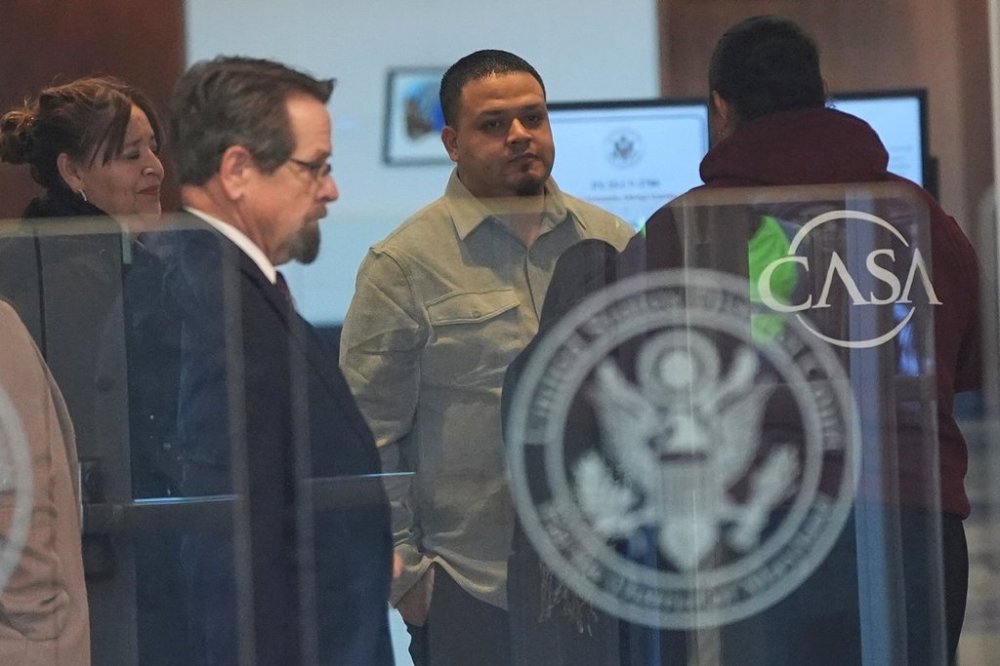
Abrego Garcia, his wife and his legal team were welcomed to the federal court building in Maryland by a boisterous reception that included a choir, bullhorn and drum as scores of supporters cheered. Inside the courtroom, Abrego Garcia sat with at least half a dozen defense team members while a lone government attorney sat across from them.
Before his release, Abrego Garcia had been in immigration detention since August. In that time, the government has said it planned to deport him to Uganda, Eswatini, Ghana and, most recently, Liberia. However, officials have made no effort to deport him to the one country he has agreed to go to — Costa Rica. Xinis has even accused the government of misleading her by falsely claiming that Costa Rica was unwilling to take him.
The government’s “persistent refusal to acknowledge Costa Rica as a viable removal option, their threats to send Abrego Garcia to African countries that never agreed to take him, and their misrepresentation to the Court that Liberia is now the only country available to Abrego Garcia, all reflect that whatever purpose was behind his detention, it was not for the ‘basic purpose’ of timely third-country removal,” she wrote.
In court Monday, Abrego Garcia’s attorneys reiterated that he is prepared to go to Costa Rica “today.”
Simon Sandoval-Moshenberg, one of Abrego Garcia’s attorneys, said after the hearing that the judge was clearly unhappy with the government’s inability to outline its intentions for Abrego Garcia. He said it was clear the government simply wants to punish his client rather than resolving the case.
“You know who’s keeping Mr. Garcia in the United States right now? The federal government,” he said.
Abrego Garcia would prefer to stay in Maryland with his family, but absent that, he would willingly self-deport to Costa Rica, which offered him refugee status months ago, Sandoval-Moshenberg said.
Abrego Garcia has an American wife and child and has lived in Maryland for years, but he immigrated to the U.S. illegally from El Salvador as a teenager. In 2019, an immigration judge granted him protection from being deported back to his home country, finding he faced danger there from a gang that had targeted his family. Although he is back in the U.S. now, Department of Homeland Security officials have said he cannot stay and have vowed to deport him to a third country.
In addition to the Maryland case, Abrego Garcia is fighting the human smuggling charges in Tennessee. His attorneys in that case on Friday asked the judge for sanctions after Border Patrol’s Gregory Bovino made disparaging comments about their client on national news. The judge previously ordered Justice Department and Homeland Security officials to cease making comments that could prejudice Abrego Garcia’s right to a fair trial.
___
Loller reported from Nashville, Tenn.