

Attention-grabbing screens demean us, bit by bit

Advertisement
Read this article for free:
or
Already have an account? Log in here »
To continue reading, please subscribe:

Digital Subscription
One year of digital access for only $205*
- Enjoy unlimited reading on winnipegfreepress.com
- Read the E-Edition, our digital replica newspaper
- Access News Break, our award-winning app
- Play interactive puzzles
*First annual payment billed as $205.00 + GST for one year. This annual subscription will automatically renew at $233.00 + GST every 52 weeks (10% off the regular annual price of $259.35). Offer available to new and qualified returning subscribers only. Cancel any time.
To continue reading, please subscribe:
Add Free Press access to your Brandon Sun subscription for only an additional
$1 for the first 4 weeks*
- Enjoy unlimited reading on winnipegfreepress.com
- Read the E-Edition, our digital replica newspaper
- Access News Break, our award-winning app
- Play interactive puzzles
*Your next Brandon Sun subscription payment will increase by $1.00 and you will be charged $17.95 plus GST for four weeks. After four weeks, your payment will increase to $24.95 plus GST every four weeks.
Read unlimited articles for free today:
or
Already have an account? Log in here »
Hey there, time traveller!
This article was published 03/01/2026 (247 days ago), so information in it may no longer be current.
The first time I read Oryx and Crake, Canadian author Margaret Atwood’s haunting dystopic novel, I couldn’t put it down. I devoured it in just days, engrossed by the fictional world Atwood wove from the most discomfiting new threads of our own.
Over the years, I returned to the book many times, always finding new depth in its pages. Each time, I finished it at the same brisk pace. I was a fast reader as a child, and for most of my life, that didn’t change.
Until now. In November, as part of an effort to calm my restless mind, I put Oryx and Crake on my nightstand, and made a pledge to myself to read a little bit every night. This time, it’s been over two months, and I’ve made it through only 92 pages.
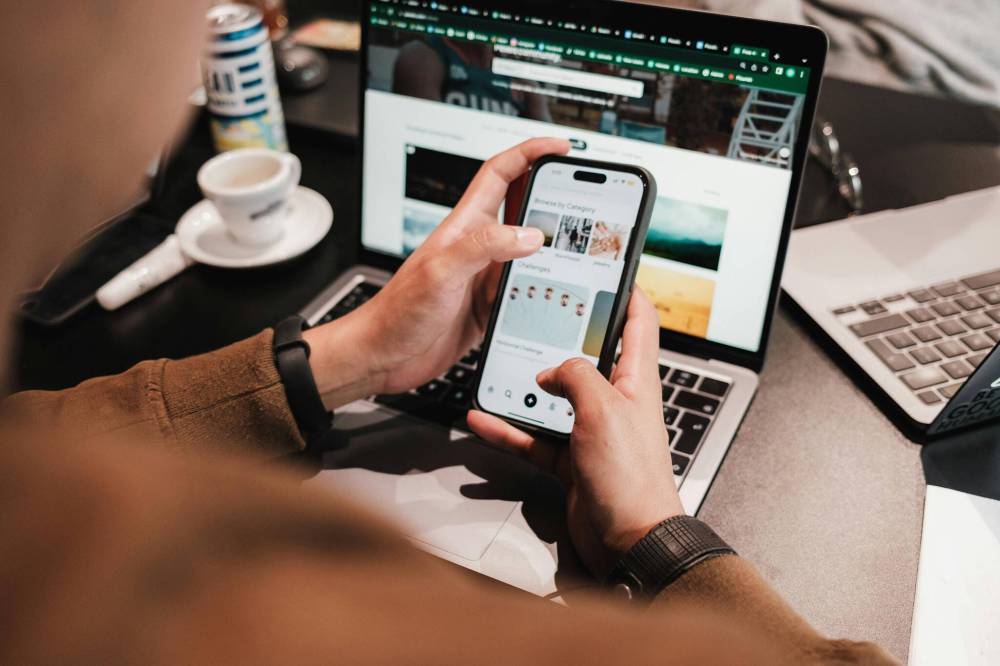
AIRAM DATO-ON / PEXELS.COM
A planned January digital detox starts with deleting time-wasting apps, including social media, and occasionally going phone-free.
It would be easy to say I’ve been too busy, but that would be a lie. I’ve had time to read. The problem is now, unlike when the book came out in 2003, I struggle to read more than a page without checking my phone quickly; and checking it once means falling into the chasm of raw content the internet has become.
You know how it goes. Your phone buzzes; a text from a friend. You reply. You flick over to Instagram. There’s a post about relationships. (“How to Let Go of People Who Don’t Deserve You.”) There’s a video of the tiny blue bird that dances while it sings the phrase “bacon pancakes.”
Flick over to Facebook. There’s an argument about Donald Trump’s immigration policy. A post from a group for Edmonton singles you have no idea why it showed up in your feed. You read it anyway. (Bryce, 36, is tired of people wasting time, and looking for something real.)
More videos of cute birds, and cute dogs, and cooking tips from self-described “lazy moms.” More arguments, more photos, more advertisements for things you suddenly sort of want, though until that moment had never once thought you’d need. It goes on forever, a rabbit hole with no bottom, coaxing you to stay until you forget why you came.
It’s not by accident that the internet is this way. This is how it was designed: to grab your attention, hold it and cash in on stealing your time. The point of much of the internet, now is not to build a site you enjoy. It’s to build a site you can’t stop looking at — and at this, it’s become terrifyingly effective.
This is screen addiction, and it could be the most widespread and least-discussed source of compulsive harm. The majority of teens and adults are at least a little affected, though some of us — like myself, with the inattentive-type ADHD — are more susceptible to severe phone overuse than others.
There’s a great deal of research about the impact of phone use on our brains. Much of it is alarming, particularly about the way it reshapes our cognition. Multiple studies have shown heavy phone use makes us less focused and more anxious, worse at solving problems, worse at learning new tasks.
It wrecks our attention spans. It keeps us distracted. Worse, it trains us to need that distraction, to be unable to just sit and be without the constant dopamine rush of new information. It’s been perhaps four or five years since I first noticed I could no longer watch a movie without simultaneously being on my phone; or read more than a few pages of a book.
That should have disturbed me more than it did, at the time. But I accepted it, and then it grew worse.
My screen time, during the week of Christmas, averaged a whopping 15 hours a day. Much of this is idle use — clicking to check my text messages, opening and immediately closing Facebook, Googling “best way to roast Brussels sprouts” while standing in front of the oven — but it reflects a compulsive need to keep my phone always ready, in hand.
Well, the turn of a new year has always been time for new resolutions. This one is mine, and I invite you to join me: it’s time to crawl out of the rabbit hole, and start undoing the damage the gushing fountain of content has done. It’s time to force our brains to relearn how to exist without constant stimulation.
In 2026, it’s time for those of us addicted to get off our phones.
This is, of course, easier said than done. Screen addiction is a difficult one to quit cold-turkey, because most of our lives and work are so deeply integrated with our phones, it can be near-impossible to untangle. I use my phone for nearly everything: buying groceries, booking medical appointments, paying bills, working. It even acts as my television remote.
With that in mind, any digital detox will have to look different for everyone. It depends on how you use your devices, what wastes your time most and what you can manage without. The goal, in all cases, is to slowly retrain the brain, to break its dependence on the constant stimulation of messages and content and information.
For my digital-detox January, this is the starting approach I’ve determined.
Step 1: delete all time-wasting apps, the ones that serve no practical purpose. For me, the most damaging is online chess. It’s a hobby I embraced in recent years, delving into YouTube videos about opening theory; thanks to the sport’s reputation as a pursuit for very smart people, I convinced myself it was a form of personal development.
In truth, my play is compulsive, a mindless distraction. I turn to it when I’m struggling with writer’s block (often), or waiting for an important text. Sometimes, I’ll sink into rapid-fire games of anonymous chess until whole evenings slip away. (In fact, without even realizing what I was doing, I played a brief game in the middle of writing that last sentence.)
Next: delete most social media from the phone, starting with Elon Musk’s X. When that app was still Twitter, it was a vital source of breaking news. Now, it’s overrun with AI-generated garbage, staggering racism and antisemitism, and the short-form videos that have been shown to be among the worst for inducing compulsive scrolling.
No reason to keep it anymore. We can get breaking news better straight from mainstream news sites, including the Free Press. I do need to keep an eye on X for work, but I can do that from my laptop, which doesn’t follow me everywhere I go.
Speaking of how my phone follows me everywhere, the next step is to break that co-dependence. I expect this will be the hardest part of doing a digital detox, because it requires setting and enforcing rules against a deeply ingrained habit. But recovery from any addiction requires holding kindness for oneself, when one stumbles.

So, these are my new rules of screen engagement. First: my phone is physically no longer allowed in the bedroom. Yes, this means I’ll have to get a real alarm clock. But it also means no more risk of losing sleep over endless scrolling, or falling into the rabbit hole first thing in the morning.
Next, I will look to start extending the physical time I go without my phone at the ready. In January, that will mean if I’m leaving home for a short time — say, just to the grocery store — I won’t take my phone. If I do need to take my phone, it’ll stay zipped in my purse or pocket until I absolutely need it, not in my hand.
Writing those words, I can feel the tension in my chest rising. Just the thought of being out without my phone makes me anxious; in the past, when I’ve forgotten my phone at home, I felt scattered and uncomfortable, even a little bit naked. It would be funny, if it weren’t so sad.
That’s all the more reason to start this new year by breaking the habit. For those who have noticed the same problems, and are interested in taking the same plunge: good luck, keep in touch and let’s give our brains the space they need to recover.
melissa.martin@freepress.mb.ca
Melissa Martin
Reporter-at-large
Melissa Martin reports and opines for the Winnipeg Free Press.
Every piece of reporting Melissa produces is reviewed by an editing team before it is posted online or published in print — part of the Free Press‘s tradition, since 1872, of producing reliable independent journalism. Read more about Free Press’s history and mandate, and learn how our newsroom operates.
Our newsroom depends on a growing audience of readers to power our journalism. If you are not a paid reader, please consider becoming a subscriber.
Our newsroom depends on its audience of readers to power our journalism. Thank you for your support.
Melissa Martin
Reporter-at-large
Melissa Martin reports and opines for the Winnipeg Free Press.
Every piece of reporting Melissa produces is reviewed by an editing team before it is posted online or published in print — part of the Free Press‘s tradition, since 1872, of producing reliable independent journalism. Read more about Free Press’s history and mandate, and learn how our newsroom operates.
Our newsroom depends on a growing audience of readers to power our journalism. If you are not a paid reader, please consider becoming a subscriber.
Our newsroom depends on its audience of readers to power our journalism. Thank you for your support.
Advertisement Advertise With Us
Advertisement Advertise With Us