Drought leaves people hungry in Kenya as their livestock die

Advertisement

Advertise with us

KAMPALA, Uganda (AP) — Drought conditions have left over 2 million people facing hunger in parts of Kenya, with cattle-keeping communities in the northeast the hardest hit, according to the United Nations and others.

Read this article for free:


By clicking the button above, an account will be created and you will begin to receive some of our recommended newsletters. You may opt out of any newsletter by visiting your Email and Communication Preferences page or by clicking "unsubscribe" at the bottom of any email.

or

Already have an account? Log in here »

To continue reading, please subscribe:

Digital Subscription

One year of digital access for only $1.44 a week*

  • Enjoy unlimited reading on winnipegfreepress.com
  • Read the E-Edition, our digital replica newspaper
  • Access News Break, our award-winning app
  • Play interactive puzzles

*Billed as $5.77 plus GST every four weeks. After 52 weeks, price increases to the regular rate of $19.95 plus GST every four weeks. Offer available to new and qualified returning subscribers only. Cancel any time.

To continue reading, please subscribe:

Add Free Press access to your Brandon Sun subscription for only an additional

$1 for the first 4 weeks*

  • Enjoy unlimited reading on winnipegfreepress.com
  • Read the E-Edition, our digital replica newspaper
  • Access News Break, our award-winning app
  • Play interactive puzzles
Start now

*Your next Brandon Sun subscription payment will increase by $1.00 and you will be charged $17.95 plus GST for four weeks. After four weeks, your payment will increase to $24.95 plus GST every four weeks.

Hey there, time traveller!
This article was published 09/02/2026 (250 days ago), so information in it may no longer be current.

KAMPALA, Uganda (AP) — Drought conditions have left over 2 million people facing hunger in parts of Kenya, with cattle-keeping communities in the northeast the hardest hit, according to the United Nations and others.

In recent weeks, images of emaciated livestock in the arid area near the Somali border have shocked many in a region that reels from the effects of climate change.

In recent years, rainy seasons have become shorter for some communities, exposing them to drought. Normally, animals are the first to die.
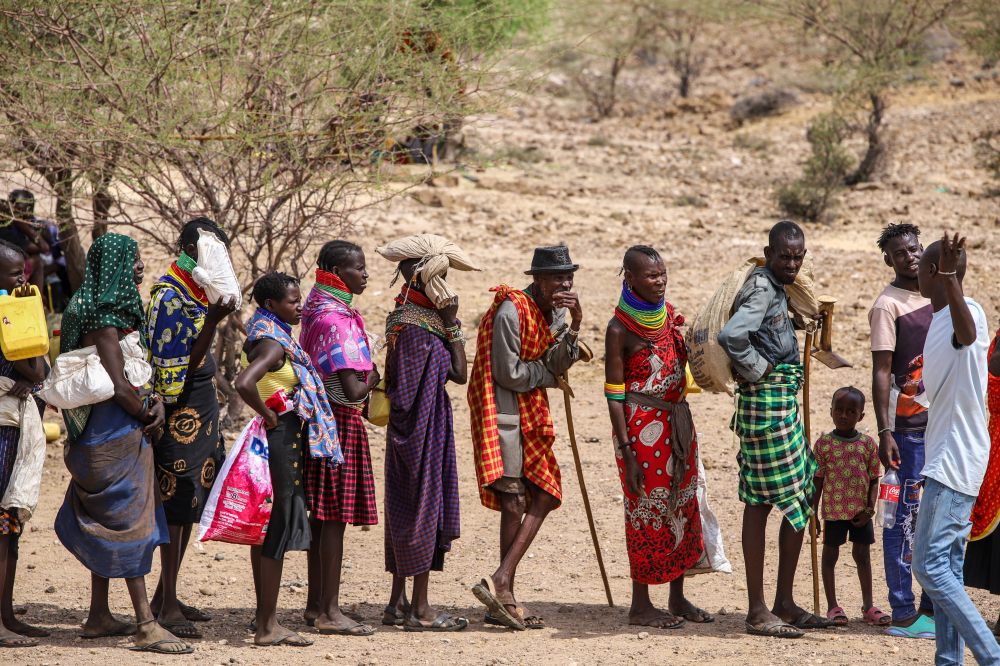
Locals queue to receive relief food as severe drought continues, in Lomekulu Village, Turkana County, Kenya, Sunday, Feb. 8, 2026. (AP Photo/Patrick Ngugi)

The livestock losses echo what happened between 2020 and 2023, when millions of animals died in the region that extends from Kenya into parts of Ethiopia and Somalia. At the time, a famine predicted for Somalia was averted by a surge in international aid.

Four consecutive wet seasons have failed in parts of the Horn of Africa, which juts into the Indian Ocean.

The wet season from October to December was one of the driest ever recorded, according to the U.N. health agency. Because the rains were brief, parts of eastern Kenya were the driest they have been during that season since 1981.

Some 10 counties in Kenya are experiencing drought conditions, according to the National Drought Management Authority.

The northeastern county of Mandera, bordering Somalia, has reached the “alarm” classification, which means critical water shortages have led to the death of livestock and the wasting of children.

The suffering extends into Somalia, Tanzania and even Uganda, where many are threatened by similar weather patterns and water shortages, the World Health Organization said in late January.

In southern Somalia, an assessment by the Islamic Relief aid group found “shocking food shortages as families flee the region’s worsening drought.”

In Somalia, long vulnerable to drought conditions, over 3 million people have left their homes, seeking shelter in camps for the internally displaced.

But support is not enough, with 70% of the internally displaced in the city of Baidoa surviving on one meal a day or less, Islamic Relief said in a statement, adding that children in the camps are “showing visible signs of malnutrition and wasting.”

Experts say much of what’s happening is due to climate change.

The Indian Ocean has become warmer, feeding some of the more destructive tropical storms in recent years. At the same time, drought conditions have become longer, more intense and more severe.

All of that is devastating for Africans whose economic mainstay is rain-fed agriculture, making them vulnerable to extreme weather. Many farmers say increasing temperatures deny livestock pasture and kill their crops.

Africa is particularly vulnerable to extreme weather events because it is less equipped to prepare for natural disasters. Despite contributing only 3% to 4% of global emissions, according to the U.N., the continent is one of the most exposed to the effects of climate change.


Report Error Submit a Tip

More Stories

NDP expects crypto, data centre electricity levy to shave about $50 annually off residential Hydro bills

Chris Kitching 5 minute read Preview

NDP expects crypto, data centre electricity levy to shave about $50 annually off residential Hydro bills

Chris Kitching 5 minute read Updated: Yesterday at 8:36 AM CDT

Revenue from the province’s new electricity levy on cryptocurrency businesses and large AI data centres will go toward offsetting residential bills, rather than the coffers of cash-strapped Manitoba Hydro.

Read
Updated: Yesterday at 8:36 AM CDT

New chapter for Yellowquill University College

Tory McNally 7 minute read Preview

New chapter for Yellowquill University College

Tory McNally 7 minute read 2:01 AM CDT

Sometimes, a milestone is about much more than a degree. It is about opportunity, recognition and the doors that open for the people who come next.

Yellowquill University College reached a historic milestone on Oct. 1, when new Manitoba legislation came into effect formally recognizing the institution within the province’s post-secondary education system and granting it authority to award degrees.

Established in 1984, Yellowquill is now Manitoba’s first fully recognized First Nations-owned and operated post-secondary institution with degree-granting authority.

It is an achievement worth celebrating, not only for Yellowquill and the communities it serves, but also for what it represents about education, career development and the future of Manitoba’s workforce.

Read
2:01 AM CDT

Letters, Oct. 16

6 minute read Preview

Letters, Oct. 16

6 minute read Updated: Yesterday at 8:53 AM CDT

A few days ago, U.S. President Donald Trump attended a rally in Arizona. At about the same time, Pete Hoekstra, the U.S. ambassador to Canada was interviewed on The Really Big Show.

Read
Updated: Yesterday at 8:53 AM CDT

Jets salvage point in Chicago

Mike McIntyre 7 minute read Preview

Jets salvage point in Chicago

Mike McIntyre 7 minute read Updated: Yesterday at 6:16 AM CDT

CHICAGO — Ever have one of those days where you should have just stayed in bed? That pretty much sums up how Thursday went for the Winnipeg Jets here in the Windy City.

It began with the bad news that top defenceman Josh Morrissey’s wrist issue is more serious than feared, and he likely won’t be back in the lineup any time soon. Then, veteran forward Vlad Namestnikov, coming off his best game of the young season, crashed into the boards at the end of morning skate, suffering an upper-body injury that sent him to the sidelines.

Off to the game itself, which began with Dylan DeMelo hitting the post on the first shift, a parade of Winnipeg penalties helping the home team build a healthy early lead and, last and certainly least, an eventual 4-3 overtime loss at United Center.

It actually could have been worse.

Read
Updated: Yesterday at 6:16 AM CDT

Convicted harasser accused of targeting old, new victims, including judge

Dean Pritchard 6 minute read Preview

Convicted harasser accused of targeting old, new victims, including judge

Dean Pritchard 6 minute read Thursday, Oct. 15, 2026

Agnieszka Ciochon-Newton, who was sentenced to six years in prison for mercilessly harassing two people she believed had wronged her, as well as other crimes, wasted no time when her sentence ended to launch fresh attacks on victims new and old, including the judge who convicted her, court documents allege.

The 58-year-old former nurse was arrested last month after Winnipeg police “became aware that (Ciochon-Newton) was engaging in aggressive and harassing behaviours again, starting almost immediately upon the expiry of her parole conditions” on May 13, Det. Sgt Kylie Case wrote in search warrant documents obtained by the Free Press.

Ciochon-Newton is charged with seven counts of criminal harassment, two counts of uttering threats and one count each of fraud, breaking and entering, attempting to obstruct justice, intimidation of a justice official, mischief and defamatory libel. She remains in custody.

Search warrant documents say provincial court Judge Keith Eyrikson learned in late August that Ciochon-Newton had emailed CBC Manitoba days earlier and threatened him.

Read
Thursday, Oct. 15, 2026

Manitoba Hydro to replace dozens of electrical substations over 20 years

Chris Kitching 5 minute read Preview

Manitoba Hydro to replace dozens of electrical substations over 20 years

Chris Kitching 5 minute read Updated: Yesterday at 4:33 PM CDT

Manitoba Hydro is promising fewer power outages in Winnipeg once it replaces or converts 41 electrical substations in a project the utility says will last up to 20 years and cost as much as $1.2 billion.

Read
Updated: Yesterday at 4:33 PM CDT