

City report recommends reducing residential speed limit to 40 km/h
Slowing down a growing trend in North America, urban studies expert says

Advertisement
Read this article for free:
or
Already have an account? Log in here »
To continue reading, please subscribe:

Digital Subscription
One year of digital access for only $205*
- Enjoy unlimited reading on winnipegfreepress.com
- Read the E-Edition, our digital replica newspaper
- Access News Break, our award-winning app
- Play interactive puzzles
*First annual payment billed as $205.00 + GST for one year. This annual subscription will automatically renew at $233.00 + GST every 52 weeks (10% off the regular annual price of $259.35). Offer available to new and qualified returning subscribers only. Cancel any time.
To continue reading, please subscribe:
Add Free Press access to your Brandon Sun subscription for only an additional
$1 for the first 4 weeks*
- Enjoy unlimited reading on winnipegfreepress.com
- Read the E-Edition, our digital replica newspaper
- Access News Break, our award-winning app
- Play interactive puzzles
*Your next Brandon Sun subscription payment will increase by $1.00 and you will be charged $17.95 plus GST for four weeks. After four weeks, your payment will increase to $24.95 plus GST every four weeks.
Read unlimited articles for free today:
or
Already have an account? Log in here »
Hey there, time traveller!
This article was published 25/02/2026 (228 days ago), so information in it may no longer be current.
Winnipeg drivers may have to ease up on the gas pedal when they head down residential streets and minor collector roads.
The City of Winnipeg is looking at making the default speed limit 40 km/h, from the current 50 km/h.
A report to be presented to the public works committee next week suggests the change could improve safety for pedestrians, cyclists and others.
Committee chair Coun. Janice Lukes says she supports the recommendation, but stressed amendments to the provincial Highway Traffic Act are required before it could take effect.
Phil Hossack / Free Press Files A report to be presented to the City of Winnipeg’s public works committee next week suggests reducing the default speed limit from the current 50 km/h down to 40 km/h could improve safety for pedestrians, cyclists and others.
“I’m hopeful that the province approves the default,” Lukes said Wednesday. “The difference in time is seconds to get somewhere when you’re going 40 or 50 km/h, but it makes a big difference. It creates a better quality of life for neighbourhoods.”
Lukes, who represents the Waverly West ward, said she fields calls daily from constituents who are concerned about traffic speed.
Winnipeg’s population density is growing, and more people are exploring transportation alternatives, including walking and cycling, she said.
A pilot project launched in March 2023 reviewed how reducing speed limits in four neighbourhoods would affect driving behaviour, safety and quality of life.
“It creates a better quality of life for neighbourhoods.”
Winnipeg’s default speed limit is currently 50 km/h, except on roads where a posted sign indicates otherwise. Lowering the default level would allow the city to reduce speeds without having to install new road signs at an enormous cost, the report says.
The public service expects implementing the speed reduction would cost about $525,000, including $275,000 to update signs, $150,000 to develop signage plans and $100,000 for a public educational campaign.
The city had considered lowering default speed limits, including in an administrative report from 2012 which also recommended a 40 km/h standard. Council decided against it at that time.
Jino Distasio, an expert in urban studies, said municipalities across North America are taking similar steps to reduce residential speeds.
Coun. Janice Lukes (Mikaela MacKenzie / Free Press files)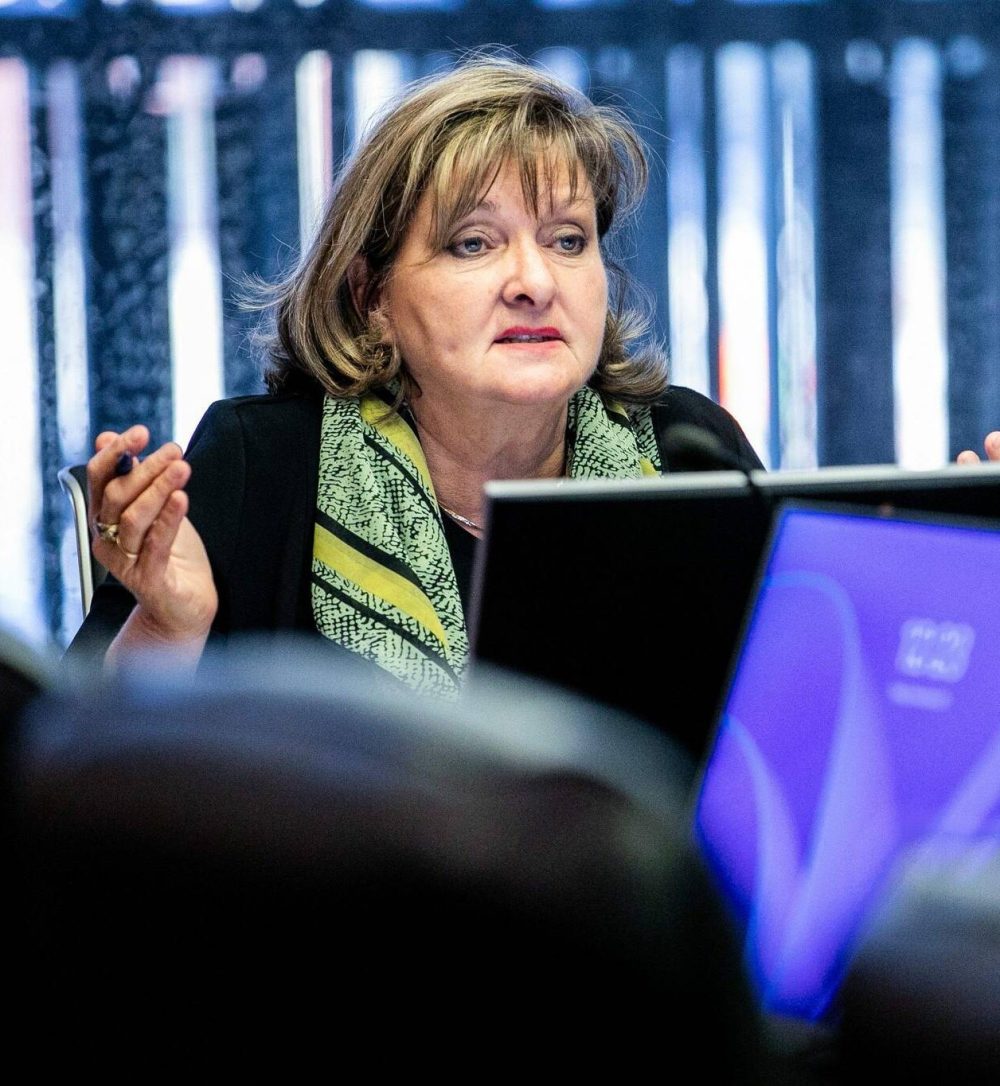
“I think, reasonably speaking, you wouldn’t see much of a change,” he said. “If you average out your time on residential streets… you’re really not travelling at top speeds for very long.”
This was reinforced by data collected in the public service report, which found the average speed on residential streets is 36 km/h, and 44 km/h on collector streets.
“It tells us that the speed limit is set too high. Drivers are moderating their own speed based on the environment and not the speed limit,” the report says.
“This works well for most drivers, but for drivers that have a higher risk tolerance or are driving irresponsibly it gives them too much leeway to create a dangerous situation before speeding can be legally enforced.”
Distasio said even small speed reductions reduce braking distances and the impact when collisions do occur.
A reduction in speed could be particularly effective on collector streets. Those often provide access to businesses, schools and other community destinations, and are areas where collisions are statistically more likely to occur, he said.
“It tells us that the speed limit is set too high.”
The public service analyzed five years of collision data in Winnipeg and found nine per cent of crashes involving fatal or major injuries occurred on collector streets. During that time, seven people were killed and 59 others were injured, the report says.
The report also included data collected in Probe Research surveys, which found growing support for speed reductions.
A poll from 2021 found 44 per cent of respondents were in favour of reducing speed limits. When the same question was asked in a survey just over two years later, support had grown to 57 per cent of respondents, the report says.
The move will still generate opposition from some, Distasio said, noting “people are averse to change.”

Todd Dube, co-founder of the anti-photo radar group Wise Up Winnipeg, counts himself among those who oppose a lower speed limit.
He believes the city’s efforts to do so are not an attempt to improve safety, but rather to generate revenue through traffic enforcement.
“The whole thing is an empty attempt to change the speed limit for the obvious reason, and that’s revenue. There can be no question about that,” he said.
Dube pointed out the previous attempt to reduce speed limits failed because of opposition from council members and some city staff.
Even if city hall green-lights the proposal, he feels it’s unlikely the provincial government will approve a default change, he said.
“The whole thing is an empty attempt to change the speed limit for the obvious reason, and that’s revenue.”
In a statement, Transportation Minister Lisa Naylor said the province is aware of the city report.
She acknowledged any change to default speed limit restrictions would require legislative amendments, but said the city does have the ability to immediately lower limits wherever it sees fit, with the appropriate signage.
“We remain open to discussions with municipal partners and will consider the evidence, public safety impacts and stakeholder input before making any decisions,” Naylor said.
“Our priority is keeping Manitobans safe while ensuring that any changes are practical and well-informed.”
Mayor Scott Gillingham said it’s too early to comment on the recommendation.
“I’m not going to prejudge the debate. This will be a big debate if the province does permit the City of Winnipeg to change the speed limit,” he said. “It would be time for a robust discussion with the public.”
The public works committee will review the report on March 4. If approved, the city will formally request legislative changes.
tyler.searle@freepress.mb.ca
Tyler Searle is a multimedia producer who writes for the Free Press’s city desk. A graduate of Red River College Polytechnic’s creative communications program, he wrote for the Stonewall Teulon Tribune, Selkirk Record and Express Weekly News before joining the paper in 2022. Read more about Tyler.
Every piece of reporting Tyler produces is reviewed by an editing team before it is posted online or published in print — part of the Free Press‘s tradition, since 1872, of producing reliable independent journalism. Read more about Free Press’s history and mandate, and learn how our newsroom operates.
Our newsroom depends on a growing audience of readers to power our journalism. If you are not a paid reader, please consider becoming a subscriber.
Our newsroom depends on its audience of readers to power our journalism. Thank you for your support.
Tyler Searle is a multimedia producer who writes for the Free Press’s city desk. A graduate of Red River College Polytechnic’s creative communications program, he wrote for the Stonewall Teulon Tribune, Selkirk Record and Express Weekly News before joining the paper in 2022. Read more about Tyler.
Every piece of reporting Tyler produces is reviewed by an editing team before it is posted online or published in print — part of the Free Press‘s tradition, since 1872, of producing reliable independent journalism. Read more about Free Press’s history and mandate, and learn how our newsroom operates.
Our newsroom depends on a growing audience of readers to power our journalism. If you are not a paid reader, please consider becoming a subscriber.
Our newsroom depends on its audience of readers to power our journalism. Thank you for your support.
Related Articles
Driver admits guilt for crash that killed two cyclists on Kenaston





Advertisement Advertise With Us
Advertisement Advertise With Us
History
Updated on Wednesday, February 25, 2026 6:04 PM CST: Adds details, quotes
Updated on Wednesday, February 25, 2026 6:30 PM CST: Adds photo, edits