The sea is higher than we thought and millions more are at risk, study finds
Advertisement
Read this article for free:
or
Already have an account? Log in here »
To continue reading, please subscribe:

Digital Subscription
One year of digital access for only $205*
- Enjoy unlimited reading on winnipegfreepress.com
- Read the E-Edition, our digital replica newspaper
- Access News Break, our award-winning app
- Play interactive puzzles
*First annual payment billed as $205.00 + GST for one year. This annual subscription will automatically renew at $233.00 + GST every 52 weeks (10% off the regular annual price of $259.35). Offer available to new and qualified returning subscribers only. Cancel any time.
To continue reading, please subscribe:
Add Free Press access to your Brandon Sun subscription for only an additional
$1 for the first 4 weeks*
- Enjoy unlimited reading on winnipegfreepress.com
- Read the E-Edition, our digital replica newspaper
- Access News Break, our award-winning app
- Play interactive puzzles
*Your next Brandon Sun subscription payment will increase by $1.00 and you will be charged $17.95 plus GST for four weeks. After four weeks, your payment will increase to $24.95 plus GST every four weeks.
Read unlimited articles for free today:
or
Already have an account? Log in here »
Hey there, time traveller!
This article was published 04/03/2026 (199 days ago), so information in it may no longer be current.
Climate change’s rising seas may threaten tens of millions more people than scientists and government planners originally thought because of mistaken research assumptions on how high coastal waters already are, a new study said.
Researchers studied hundreds of scientific studies and hazard assessments, calculating that about 90% of them underestimated baseline coastal water heights by an average of 1 foot (30 centimeters), according to Wednesday’s study in the journal Nature. It’s a far more frequent problem in the Global South, the Pacific and Southeast Asia, and less so in Europe and along Atlantic coasts.
The cause is a mismatch between the way sea and land altitudes are measured, said study co-author Philip Minderhoud, a hydrogeology professor at Wageningen University & Research in the Netherlands. And he attributed that to a “methodological blind spot” between the different ways those two things are measured.
Each way measures their own areas properly, he said. But where sea meets land, there’s a lot of factors that often don’t get accounted for when satellites and land-based models are used. Studies that calculate sea level rise impact usually “do not look at the actual measured sea level so they used this zero-meter” figure as a starting point, said lead author Katharina Seeger of the University of Padua in Italy. In some places in the Indo-Pacific, it’s close to 3 feet (1 meter), Minderhoud said.
One simple way to understand that is that many studies assume sea levels without waves or currents, when the reality at the water’s edge is of oceans constantly roiled by wind, tides, currents, changing temperatures and things like El Niño, said Minderhoud and Seeger.
Adjusting to a more accurate coastal height baseline means that if seas rise by a little more than 3 feet (1 meter) — as some studies suggest will happen by the end of the century — waters could inundate up to 37% more land and threaten 77 million to 132 million more people, the study said.
That would trigger problems in planning and paying for the impacts of a warming world.
People at risk
“You have a lot of people here for whom the risk of extreme flooding is much higher than people thought,” said Anders Levermann, a climate scientist at the Potsdam Institute for Climate Impacts Research in Germany, who wasn’t part of the study. And Southeast Asia, where the study finds the biggest discrepancy, has the most people already threatened by sea level rise, he said.
Minderhoud pointed to island nations in that region as an area where the reality of discrepancy hits home.
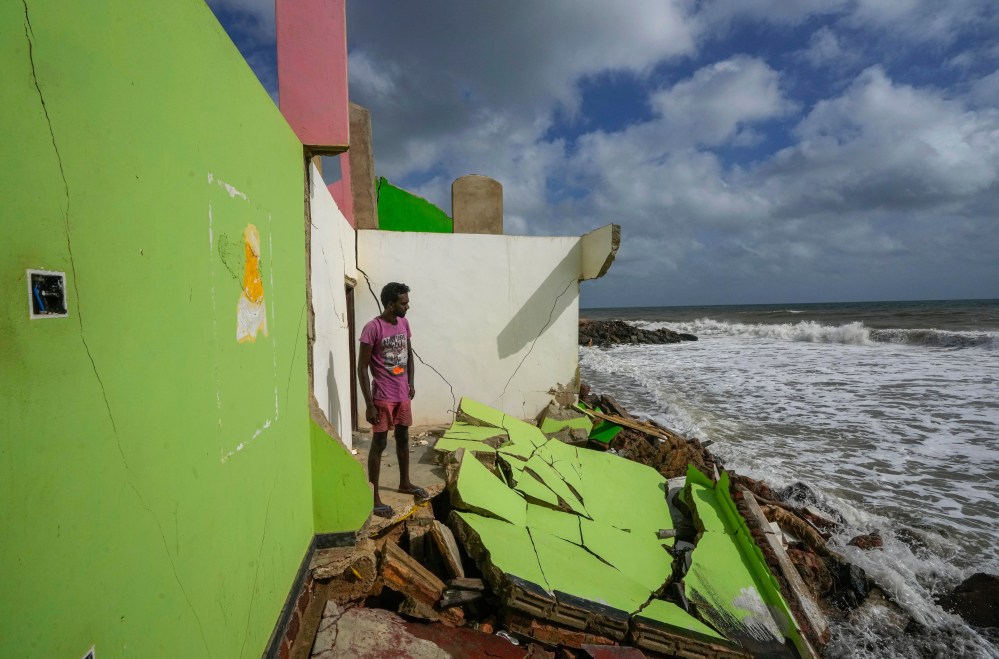
For 17-year-old climate activist Vepaiamele Trief, the projections aren’t abstract. On her island home in the South Pacific archipelago of Vanuatu, the shoreline has visibly retreated within her short lifetime, with beaches eroded, coastal trees uprooted and some homes now barely 3 feet (about 1 meter) from the sea at high tide. On her grandmother’s island of Ambae, a coastal road from the airport to her village has been rerouted inland because of encroaching water. Graves have been submerged and entire ways of life feel under threat.
“These studies, they aren’t just words on a paper. They aren’t just numbers. They’re people’s actual livelihoods,” she said. “Put yourself in the shoes of our coastal communities — their lives are going to be completely overturned because of sea level rise and climate change.”
Paying attention to the starting point
This new study is pretty much about what is the truth on the ground.
Calculations that may be correct for the seas overall or for the land aren’t quite right at that key intersection point of water and land, Seeger and Minderhoud said. It’s especially true in the Pacific.
“To understand how much higher a piece of land is than the water, you need to know the land elevation and the water elevation. And what this paper says the vast majority of studies have done is to just assume that zero in your land elevation dataset is the level of the water. When in fact, it’s not,” said sea level rise expert Ben Strauss, CEO of Climate Central. His 2019 study was one of the few the new paper said got it right.
“It’s just the baseline that you start from that people are getting wrong,” said Strauss, who wasn’t part of the research.
Maybe not so bad, some scientists say
Other outside scientists said that Minderhoud and Seeger may be making too much of the problem.
“I think they’re exaggerating the implications for impact studies a bit — the problem is actually well understood, albeit addressed in a way that could probably be improved,” said Gonéri Le Cozannet, a scientist at the French geological survey. Most local planners know their coastal issues and plan accordingly, Rutgers University sea level expert Robert Kopp said.
That’s true in Vietnam in the high-impact area, Minderhoud said. They have an accurate sense of elevation, he said.
The findings come as a new UNESCO report warns of major gaps in understanding how much carbon the ocean absorbs. That report said that models differ by 10% to 20% in estimating the size of that carbon sink, raising questions about the accuracy of global climate projections that rely on them.

Together, the studies suggest governments may be planning for coastal and climate risks with an incomplete picture of how the ocean is changing.
“When the ocean comes closer, it takes away more than just the land we used to enjoy,” said Thompson Natuoivi, a climate advocate for Save the Children Vanuatu.
“Sea level rise is not just changing our coastline, it’s changing our lives. We are not talking about the future — we’re talking about the right now.”
___
The Associated Press receives support from the Walton Family Foundation for coverage of water and environmental policy. The AP is solely responsible for all content. For all of AP’s environmental coverage, visit https://apnews.com/hub/climate-and-environment