

Consumption site research shows surprising result

Advertisement
Read this article for free:
or
Already have an account? Log in here »
To continue reading, please subscribe:

Digital Subscription
One year of digital access for only $205*
- Enjoy unlimited reading on winnipegfreepress.com
- Read the E-Edition, our digital replica newspaper
- Access News Break, our award-winning app
- Play interactive puzzles
*First annual payment billed as $205.00 + GST for one year. This annual subscription will automatically renew at $233.00 + GST every 52 weeks (10% off the regular annual price of $259.35). Offer available to new and qualified returning subscribers only. Cancel any time.
To continue reading, please subscribe:
Add Free Press access to your Brandon Sun subscription for only an additional
$1 for the first 4 weeks*
- Enjoy unlimited reading on winnipegfreepress.com
- Read the E-Edition, our digital replica newspaper
- Access News Break, our award-winning app
- Play interactive puzzles
*Your next Brandon Sun subscription payment will increase by $1.00 and you will be charged $17.95 plus GST for four weeks. After four weeks, your payment will increase to $24.95 plus GST every four weeks.
Read unlimited articles for free today:
or
Already have an account? Log in here »
Premier Wab Kinew’s government is having some difficulty in opening their promised supervised consumption site. He can at least be reassured that there will be much less difficulty if it never goes ahead.
That’s not politics talking. Nor ideology. It’s science. And evidence.
It’s all contained in a just-published study in the medical journal Addiction for the Society for the Study of Addiction. The journal has been around since 1884, so it has some game on these matters. Pithily titled “Healthcare utilization and mortality after overdose prevention site closure: A linked cohort analysis using segmented difference-in-differences time series,” it is a first of its kind study in Canada.
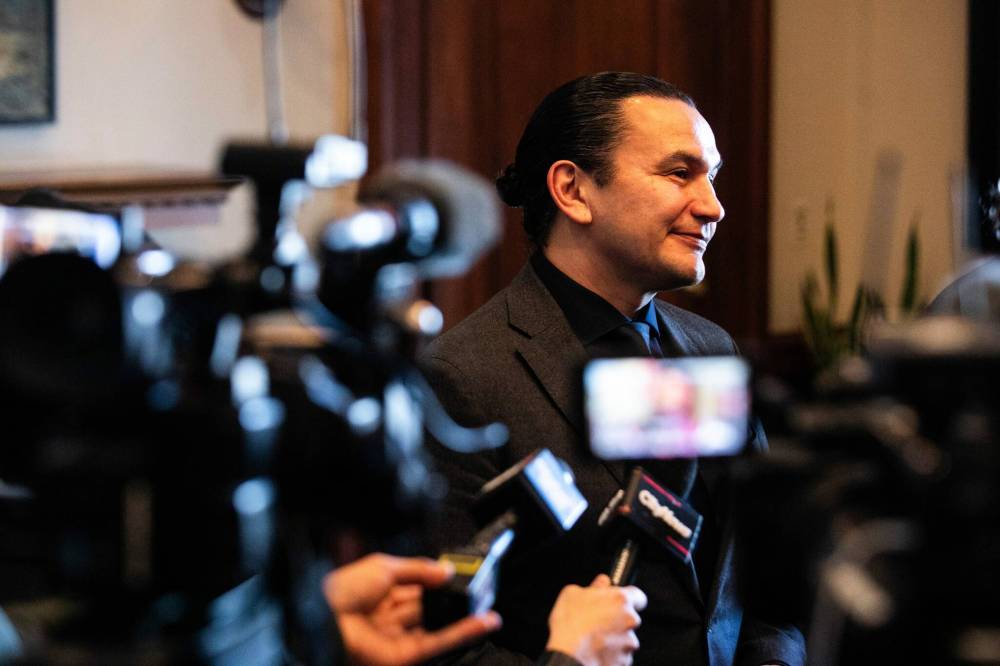
MIKAELA MACKENZIE / FREE PRESS
Premier Wab Kinew’s government should review a new study on safe consumption sites before restarting the process of establishing one in WInnipeg.
Ok, that’s not pithy. Admittedly, neither is much of the text, which is replete with medical and scientific jargon. It will not make a general public reading list. But government decision makers and health care and community activists should not let either the title or the writing style deter them from reading it from end to end. It’s what it found that matters. And that matters a lot to the Manitoba public who has been worried about what has been their government’s ‘hell-for-leather’ approach to opening a controversial new supervised consumption site for overdose prevention for opioid users to be run by the Aboriginal Health and Wellness Centre.
The study examined the impact of the closure of an overdose prevention site (OPS) in Red Deer, Alberta, on March 31, 2025. For six months afterwards, the researchers tracked 381 individuals to determine the impact of the closure on using more opioid agonist therapy dispensing (the supervised drugs part) and needing more healthcare intervention, including whether they died. They compared the results to users accessing a still-open OPS in Lethbridge, Alberta.
In medical jargon, here’s what they found, “After closure, there was no statistically significant difference in the number of ED visits or suspected opioid-related EMS (emergency medical service) events…Mortality events were rare during the follow-up period, and no statistically detectable increase was observed over the available follow-up.”
In plain language, the study showed no increase in EMS use; no increase in emergency department visits, and no increase in mortality among former Red Deer site users following its closure. There was no increase in overdose deaths after the closure of the OPS, the opposite of what you might expect and led to believe. Why? Because more, not fewer, people got connected to life saving opioid agonist therapy to combat addiction, despite the lack of an OPS. Here are the stats: the number of users getting opioid agonist therapy in Red Deer increased by 63 per cent from 9.9 per cent when the site was open, to 16.1 per cent when the site was closed.
The study was conducted by the Canadian Centre for Recovery Excellence in Alberta. The research is groundbreaking for two reasons. First, no one else has examined these kinds of linkages between closing an OPS and what then happens to users of that site. Second, it is the highest-quality scientific study on this topic to date, a Level 2 out of 5, in the scale assigned to assessing the quality of evidence provided in such published studies. It too has game.
A study like this should not be ignored. Especially in Manitoba which is struggling to embark upon its own experiment in the field of harm reduction from substance abuse. Sadly, it might be. This field is fraught with agendas and activism — ideological, political, and sociological — that get in the way of clarifying scientific evidence such as this.
But another kind of community activism by local residents about public safety has thrown sand in the government’s gears. An initial site in Point Douglas was rescinded, and the replacement West Exchange District site has no timeline to open following Premier Kinew’s walk-back announcement last week. If scientific evidence doesn’t convince politicians, then political evidence of opposition usually does.

This study should be required reading in the Manitoba government. It should presage a rethink about this desperately difficult problem on devising the most effective harm reduction strategies to help opioid users. Forging ahead with this site in Winnipeg is actually counter to the country’s trend of closing them down and offering alternative strategies. The Red Deer study shows — and this is the crucial part — more people got the harm reduction treatment they needed with no increase in deaths, in the absence of an OPS. This is encouraging and worth pursuing.
The Pallister government created Manitoba’s first ever stand-alone department of Mental Health, Wellness, and Recovery. The Kinew government changed the name, shifting the focus away from recovery with a more sprawling department of Housing, Addictions and Homelessness. This is a distinction with a material difference. While there is a continuum across these three areas, surely the best outcome for the person at risk is to get them into an individualized recovery program with proper supports, not just providing a site, however safe, to forestall immediate harm.
Follow the science, act on the evidence, is what we say we want our governments to do.
Now that the premier has indefinitely paused Manitoba’s supervised consumption site experiment, this would be a good time to consider this new evidence and forge a different path.
David McLaughlin is a former clerk of the executive council and cabinet secretary in the Manitoba government.
Our newsroom depends on a growing audience of readers to power our journalism. If you are not a paid reader, please consider becoming a subscriber.
Our newsroom depends on its audience of readers to power our journalism. Thank you for your support.
Our newsroom depends on a growing audience of readers to power our journalism. If you are not a paid reader, please consider becoming a subscriber.
Our newsroom depends on its audience of readers to power our journalism. Thank you for your support.
Related Articles
Groups call for emergency declaration as OD deaths soar

Advertisement Advertise With Us
Advertisement Advertise With Us