Alberta to change legislation allowing lawsuits over sharing deepfake intimate images

Advertisement

Advertise with us

EDMONTON - Alberta's government says it's looking to change an existing law to let people sue others for sharing fake intimate images created through artificial intelligence.

Read this article for free:


or

Already have an account? Log in here »

To continue reading, please subscribe:

Subscribe and receive a limited-edition Free Press branded hat or tote.

Digital Subscription

One year of digital access for only $205*

  • Enjoy unlimited reading on winnipegfreepress.com
  • Read the E-Edition, our digital replica newspaper
  • Access News Break, our award-winning app
  • Play interactive puzzles

*First annual payment billed as $205.00 + GST for one year. This annual subscription will automatically renew at $233.00 + GST every 52 weeks (10% off the regular annual price of $259.35). Offer available to new and qualified returning subscribers only. Cancel any time.

To continue reading, please subscribe:

Add Free Press access to your Brandon Sun subscription for only an additional

$1 for the first 4 weeks*

  • Enjoy unlimited reading on winnipegfreepress.com
  • Read the E-Edition, our digital replica newspaper
  • Access News Break, our award-winning app
  • Play interactive puzzles
Start now

*Your next Brandon Sun subscription payment will increase by $1.00 and you will be charged $17.95 plus GST for four weeks. After four weeks, your payment will increase to $24.95 plus GST every four weeks.

Hey there, time traveller!
This article was published 23/03/2026 (184 days ago), so information in it may no longer be current.

EDMONTON – Alberta’s government says it’s looking to change an existing law to let people sue others for sharing fake intimate images created through artificial intelligence.

Technology Minister Nate Glubish says such images, known as deepfakes, can cause people serious harm and that changing the law should create a new layer of protection.

“We know that deepfake technology can be used in very harmful ways, and we want to make sure we’re protecting Albertans from those abuses,” Glubish told reporters Monday.
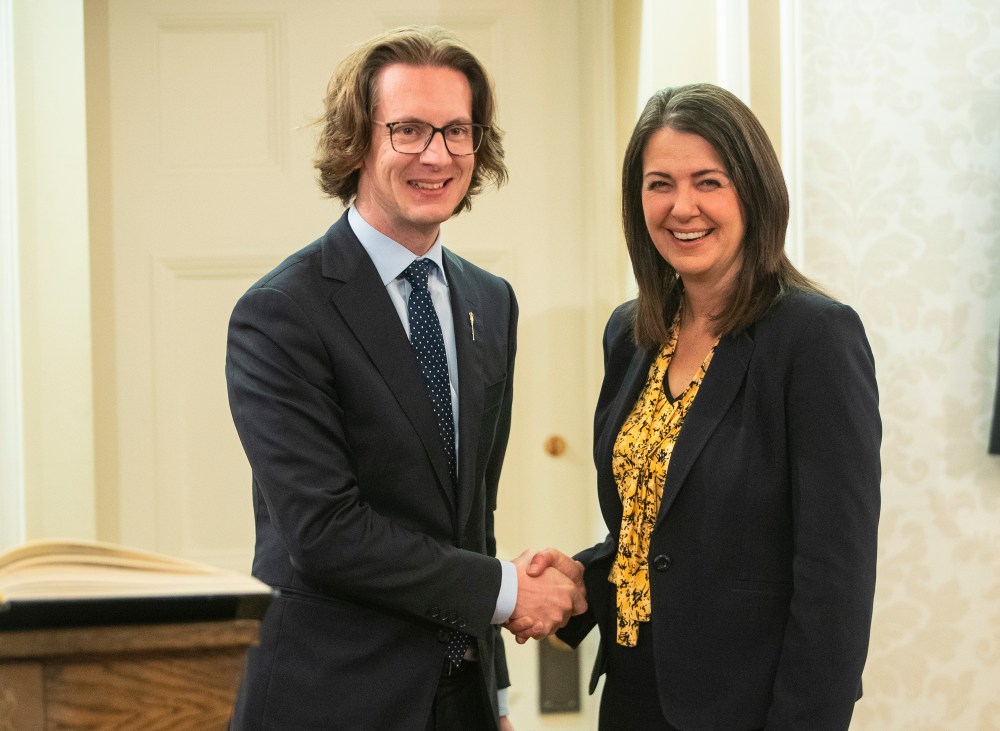
Nate Glubish shakes hands with Alberta Premier Danielle Smith after Glubish was sworn into cabinet as Minister of Technology and Innovations in Edmonton, Monday, Oct. 24, 2022. THE CANADIAN PRESS/Jason Franson

“We know that this is something Albertans care about. We’re going to take care of it.”

Alberta’s existing law, passed in 2017, lets victims of non-consensual sharing of intimate images sue for damages and seek injunctions to prevent further distribution. The law is limited to pictures or videos of individuals who are nude, partially nude or engaged in sexual activity.

Glubish’s office said that in addition to deepfakes, audio recordings are also expected to be added to the law.

On her radio call-in show Saturday, Premier Danielle Smith said she has been worried about deepfakes.

Glubish said he’s aiming to have the legislation ready by the fall.

Corinne Ofstie, a co-chief executive officer of the Association of Alberta Sexual Assault Services, said the legal changes are important and necessary.

“It’s a form of sexual violence, and that has lasting impacts,” Ofstie said.

“Just because it’s synthetic does not mean it doesn’t have the very same profound real world harm, including trauma, reputational damage and safety risks.”

Kristine Cassie, chief executive officer of the Chinook Sexual Assault Centre in Lethbridge, agreed and said she’s happy the province is looking to take action.

“We see it here. We see it in rural communities. I think it’s happening all over the place,” Cassie said of deepfake images being created of unsuspecting people.

Cassie, who has been calling for the changes described by Glubish for the past two years, said Alberta’s current rules around deepfakes are lagging compared with other provinces.

Saskatchewan updated its rules in 2021 to cover images “altered in any way, made by any means.” Manitoba, British Columbia and Quebec updated their legislation in 2024.

It’s better late than never for Alberta to take action, said Cassie, and she hopes the province also reduces the burden of proof for such cases and makes it easier for victims to get interim stop orders.

“This has to have some teeth to it, and we have to be able to move forward and really address the ills that are happening in our society this way,” she said.

Cassie said she hopes Alberta and Ottawa work together to “synthesize” laws across jurisdictions. The federal government is currently debating a bill that would make distributing intimate or pornographic deepfake images a Criminal Code offence.

If passed, Ottawa’s bill would also cover threats to distribute such images. Glubish’s office said it’s something being considered for Alberta’s legislation too. 

Rakhi Pancholi, deputy leader of Alberta’s Opposition NDP, said her party would support the changes proposed by Glubish but wants to read the proposed legislation before making that commitment.

“By all means, this is something that we share the objectives on,” she said.

Smith said on her radio show that the province is consulting with school boards on possibly introducing limitations on the use of AI in schools. But she also said the technology has a role in the classroom.

“One of the things AI can do is it can be really helpful in helping all of our newcomers who have different language learning capacities,” the premier said during “Your Province, Your Premier” on QR Calgary and 880 CHED.

Smith said Alberta students speak more than 140 languages.

AI programs could be especially beneficial for newcomers in high school to learn English while working towards graduation, Smith said.

Glubish said that any limitations — or expanded adoption — of AI in schools would be done under separate legislation.

The premier said she and her ministers use AI, specifically OpenAI’s ChatGPT software, frequently in their day-to-day work.

“It’s really been very helpful for me to understand what’s going on in the world and to see if there are policies that are taking place elsewhere that we should be adopting here,” Smith said.

This report by The Canadian Press was first published March 23, 2026.
Report Error Submit a Tip

More Stories

Audited public accounts show Manitoba's deficit last year half of predicted $1.67 billion

Carol Sanders 6 minute read Preview

Audited public accounts show Manitoba's deficit last year half of predicted $1.67 billion

Carol Sanders 6 minute read Updated: Yesterday at 7:27 PM CDT

Manitoba’s audited public accounts for the last fiscal year show the province is “moving in the right direction,” NDP Finance Minister Adrien Sala said Monday.

The provincial deficit for fiscal 2025-26 was $832 million, nearly half the $1.67-billion deficit forecast in December, and in line with the $794-million estimate in Budget 2026.

“I’m particularly proud of this final result, (given the potential) implications of tariffs on our economy, the worst wildfire season in 30 years — which resulted in significant emergency expenditures — and, of course, a significant drought,” Sala said at a news conference.

The province reported revenues of $25.1 billion and expenses of $25.9 billion, resulting in the $832-million deficit. Manitoba’s net debt is $36.5 billion and costs the province $2.3 billion a year in debt-servicing charges.

Read
Updated: Yesterday at 7:27 PM CDT

Serious crash at West Kildonan intersection known for collisions

Nicole Buffie 3 minute read Preview

Serious crash at West Kildonan intersection known for collisions

Nicole Buffie 3 minute read Sunday, Sep. 20, 2026

Residents in West Kildonan say an intersection that was the site of a serious car crash Sunday morning is notoriously dangerous.

Rob Lick heard a loud bang around 7 a.m. and rushed out of his home on Leila to see what the commotion was. He saw two crushed SUVs, a white and black one, in the intersection. Police vehicles arrived shortly after.

“It sounded like when (garbage trucks) drop a big dumpster,” he said. “I heard somebody crying or wailing, they were standing by the vehicle so I don’t know who exactly it was or if someone was injured.”

The sound of sirens followed shortly after when emergency crews came to the scene. The intersection was immediately blocked off.

Read
Sunday, Sep. 20, 2026

Woman who fled abuse decries lack of consequences for landlord who breached lease-breaking confidentiality

Carol Sanders 5 minute read Preview

Woman who fled abuse decries lack of consequences for landlord who breached lease-breaking confidentiality

Carol Sanders 5 minute read Yesterday at 6:00 AM CDT

The provincial government is being asked to penalize landlords who breach the confidentiality of tenants breaking a lease to flee domestic violence after a survivor discovered there’s no consequences now.

“It put me in a very difficult situation,” said the woman, who was stunned to see that her landlord copied her abuser in email correspondence, including the domestic violence certificate she obtained to end a tenancy agreement early and leave an abusive relationship.

“My heart dropped to my stomach — I was in disbelief,” she said, recalling the confidentiality breach that occurred in 2025.

“I’m very lucky to be in a situation where it’s no longer a threat to my immediate safety.”

Read
Yesterday at 6:00 AM CDT

RRC Polytech among schools selected to train RCAF aircraft technicians

Gabrielle Piché 5 minute read Preview

RRC Polytech among schools selected to train RCAF aircraft technicians

Gabrielle Piché 5 minute read 8:27 PM CDT

Red River College Polytechnic will become one of the first civilian schools to train Royal Canadian Air Force aircraft technicians.

The first cohort is expected to begin aircraft maintenance engineer training in fall 2027. Students will attend the post-secondary’s Stevenson campus in Winnipeg.

“There’s a lot of opportunity for us to grow,” Fred Meier, RRC Polytech’s president, said as he and University of Manitoba president Michael Benarroch addressed business executives at a Manitoba Chambers of Commerce event Tuesday morning in Winnipeg.

They highlighted the local post-secondaries’ increasing work with the Canadian Armed Forces and broader defence sector.

Read
8:27 PM CDT

Even dozen running for mayor as nomination deadline passes

Malak Abas 2 minute read Preview

Even dozen running for mayor as nomination deadline passes

Malak Abas 2 minute read 6:25 PM CDT

It’s official — a dozen people are running to become Winnipeg’s next mayor.

The deadline to both register to run as a candidate in October’s municipal election and file nomination papers was 4:30 p.m. Tuesday.

The final list of mayoral candidates includes: incumbent Scott Gillingham, Kevin Klein, Brad Gross, Mazher Alam, Mike Vogiatzakis, Christopher Clacio, Umar Hayat, Don Woodstock, Joshua Pagdato, Johnny Calderon, Noah Redden, and Tracey Drexler.

A total of 17 had registered to run but several either withdrew or did not meet the requirements to continue. Those included: Zachary Uminski, Ed Ackerman, Gagandeep Bawa, Abdel-Kareem Chehadi and Joaquin Sandul.

Read
6:25 PM CDT

Province paid three men wrongfully convicted in 1973 Winnipeg homicide $4 million apiece

Morgan Modjeski 3 minute read Preview

Province paid three men wrongfully convicted in 1973 Winnipeg homicide $4 million apiece

Morgan Modjeski 3 minute read 6:57 PM CDT

More than five decades after their lives were derailed by a racist justice system, the provincial government has paid millions of dollars to three men who were wrongfully convicted in a 1973 Winnipeg homicide.

Clarence Woodhouse, Allan Woodhouse (no relation) and Brian Anderson were wrongfully convicted of murdering restaurant worker Ting Fong Chan in 1974.

The ruling was reversed in 2024 for Clarence Woodhouse, when he was acquitted by Manitoba Court of King’s Bench Chief Justice Glenn Joyal, and in 2023 for both Allan Woodhouse and Anderson. Russell Woodhouse, Clarence’s brother, was also subjected to a miscarriage of justice — he was wrongfully convicted of manslaughter — but died in 2011.

Canada’s first post-mortem conviction review has since been called into his case.

Read
6:57 PM CDT