

Supreme Court seems likely to rule for a Black death row inmate in Mississippi
Advertisement
Read this article for free:
or
Already have an account? Log in here »
To continue reading, please subscribe:
Digital Subscription
One year of digital access for only $1.44 a week*
- Enjoy unlimited reading on winnipegfreepress.com
- Read the E-Edition, our digital replica newspaper
- Access News Break, our award-winning app
- Play interactive puzzles
*Billed as $5.77 plus GST every four weeks. After 52 weeks, price increases to the regular rate of $19.95 plus GST every four weeks. Offer available to new and qualified returning subscribers only. Cancel any time.
To continue reading, please subscribe:
Add Free Press access to your Brandon Sun subscription for only an additional
$1 for the first 4 weeks*
- Enjoy unlimited reading on winnipegfreepress.com
- Read the E-Edition, our digital replica newspaper
- Access News Break, our award-winning app
- Play interactive puzzles
*Your next Brandon Sun subscription payment will increase by $1.00 and you will be charged $17.95 plus GST for four weeks. After four weeks, your payment will increase to $24.95 plus GST every four weeks.
Read unlimited articles for free today:
or
Already have an account? Log in here »
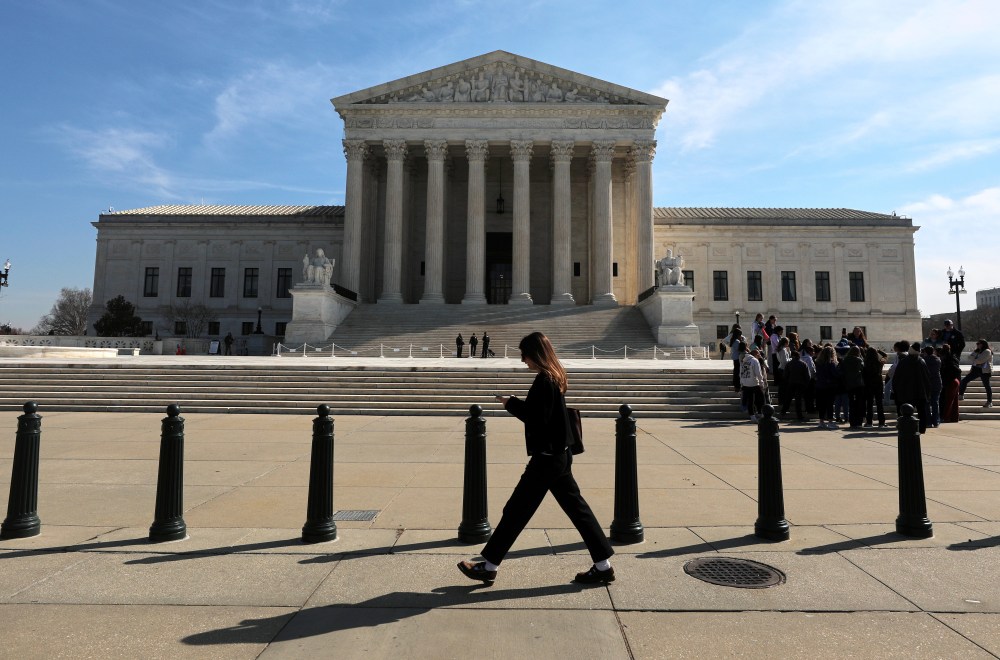
WASHINGTON (AP) — The Supreme Court on Tuesday seemed likely to rule for a Black death row inmate from Mississippi who claims there was racial bias in the makeup of the jury that convicted him.
The justices took up an appeal from Terry Pitchford in a case with similarities to that of another Black man on Mississippi’s death row, whose conviction the high court overturned seven years ago.
The jury that sentenced Pitchford to death for his role in the killing of a grocery store owner in northern Mississippi had one Black juror. Doug Evans, a now-retired prosecutor with a history of dismissing Black jurors for discriminatory reasons, had excused four other Black people.
The Supreme Court ruled 40 years ago in Batson v. Kentucky that jurors could not be excused from service because of their race and set up a system by which trial judges could evaluate claims of discrimination and the race-neutral explanations by prosecutors.
Pitchford’s case focuses on whether his lawyers did enough to object to Judge Joseph Loper’s rulings and whether the state Supreme Court acted reasonably in ruling they had not.
Justice Brett Kavanaugh said he thought one of Pitchford’s lawyers had spoken up. Reading from the trial transcript, Kavanaugh said, “She’s trying to make the objections right there.”
There was broad agreement that neither the judge nor the lawyers performed especially well when the jury was chosen.
“This is the most timid and reticent defense counsel that I have ever encountered,” Justice Samuel Alito said.
But Alito also faulted Loper, who accepted Evans’ explanations and moved on without analyzing whether race was the reason. “The judge didn’t handle this the way it should have been handled,” Alito said.
In 2019, the Supreme Court overturned the death sentence and conviction of Curtis Flowers, because of what Kavanaugh described as a “relentless, determined effort to rid the jury of Black individuals.”
Mississippi Solicitor General Scott Stewart sought to distinguish Pitchford’s case from Flowers’.
“In Flowers versus Mississippi, this Court faced an extraordinary case and ruled against the state,” Stewart said. “This case is also extraordinary but in a very different way that requires a very different result.”
The Supreme Court could rule for Pitchford but still leave it to lower courts to sort out whether his conviction should be overturned.
Pitchford, now 40, was 18 when he and a friend decided to rob the Crossroads Grocery, just outside Grenada in northern Mississippi. The friend shot store owner Reuben Britt three times, fatally wounding him, but was ineligible for the death penalty because he was younger than 18. Pitchford was tried for capital murder and sentenced to death.
The case has been making its way through the court system for 20 years. In 2023, U.S District Judge Michael P. Mills overturned Pitchford’s conviction, holding that the trial judge did not give Pitchford’s lawyers enough of a chance to argue that the prosecution was improperly dismissing Black jurors.
Mills wrote that his ruling was partially motivated by Evans’ actions in prior cases. A unanimous panel of the 5th U.S. Circuit Court of Appeals reversed the ruling.
Kavanaugh, in an exchange with Stewart, praised Mills’ handling of the case. “Mills is a very experienced district judge. He had been a former Mississippi Supreme Court justice. He knows what he’s doing. He read the record entirely differently than you did,” he said.