Apple’s 50-year odyssey has redefined technology, pop culture and comeback stories
Advertisement
Read this article for free:
or
Already have an account? Log in here »
To continue reading, please subscribe:

Digital Subscription
One year of digital access for only $205*
- Enjoy unlimited reading on winnipegfreepress.com
- Read the E-Edition, our digital replica newspaper
- Access News Break, our award-winning app
- Play interactive puzzles
*First annual payment billed as $205.00 + GST for one year. This annual subscription will automatically renew at $233.00 + GST every 52 weeks (10% off the regular annual price of $259.35). Offer available to new and qualified returning subscribers only. Cancel any time.
To continue reading, please subscribe:
Add Free Press access to your Brandon Sun subscription for only an additional
$1 for the first 4 weeks*
- Enjoy unlimited reading on winnipegfreepress.com
- Read the E-Edition, our digital replica newspaper
- Access News Break, our award-winning app
- Play interactive puzzles
*Your next Brandon Sun subscription payment will increase by $1.00 and you will be charged $17.95 plus GST for four weeks. After four weeks, your payment will increase to $24.95 plus GST every four weeks.
Read unlimited articles for free today:
or
Already have an account? Log in here »
CUPERTINO, Calif. (AP) — A scrawny hippie and a nerdy engineer who became prank-playing friends vowed to change the world when they founded a Silicon Valley startup on April Fools’ Day 50 years ago and then — no joke — pulled it off.
The improbable odyssey began April 1, 1976, when a then-shaggy Steve Jobs and his gadget-tinkering friend Steve Wozniak signed a two-page partnership document that created Apple Computer Co.
Jobs, a 21-year-old college dropout, and Wozniak, a 25-year-old Hewlett-Packard employee, each received a 45% stake in Apple, with the remaining 10% going to their 41-year-old adviser, Ron Wayne.
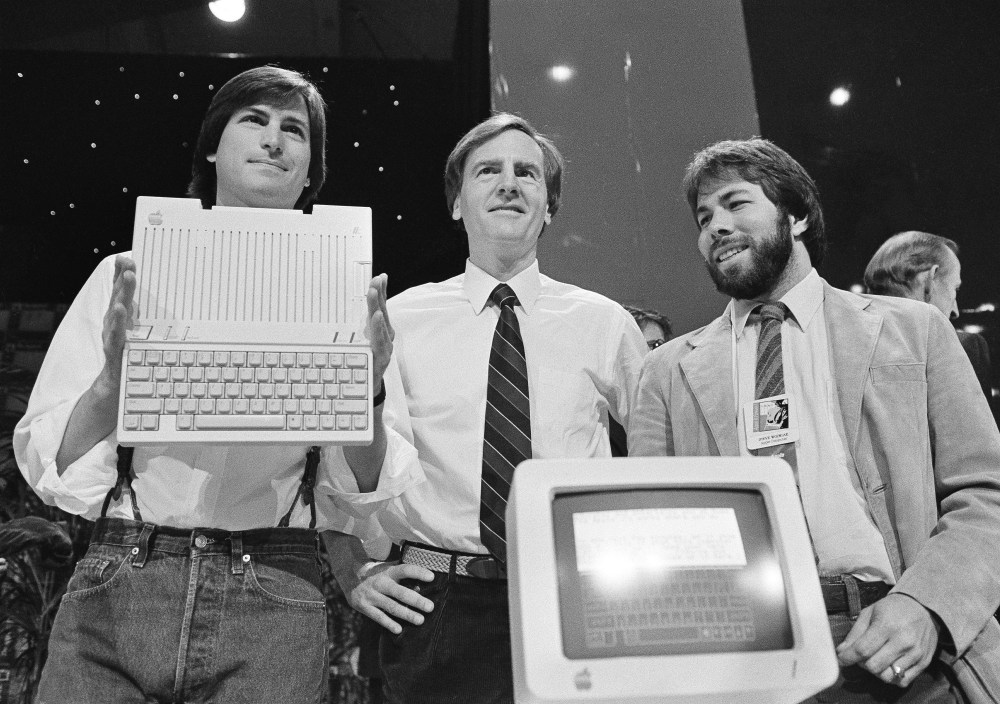
The company got off to such a shaky start while trying to build a personal computer in the Los Altos, California, home of Jobs’ parents that Wayne relinquished his stake for $2,300. It proved to be a $370 billion mistake, based on how much his holdings would have grown now that Apple boasts a $3.7 trillion market value.
But Apple nearly toppled before building its current empire.
After casting aside Jobs in a bitter 1985 breakup, the tech firm engineered a surprise deal that brought back its exiled cofounder in 1997. After reluctantly agreeing to be a temporary adviser, Jobs took over as CEO and masterminded an innovation factory that churned out the iPod, the iPhone and the iPad in a decade-long burst of feverish creativity.
Here’s a look at Apple’s odyssey so far:
The astounding ascent
Although it was founded in 1976, Apple didn’t enjoy its first smash success until June 1977, with the release of the Apple II computer priced at $1,298 (about $7,000 now, adjusted for inflation).
With its sales booming, Apple went public in late 1980 at $22 per share, which translates into 10 cents per share after adjusting for stock splits. That means $2,200 spent to purchase 100 shares at the IPO price would be worth more than $5.5 million today.
Apple’s next big thing came at Apple’s annual shareholders meeting on Jan. 24, 1984, when Jobs read the opening lines of the Bob Dylan song, “The Times They Are A-Changin’” and unveiled the first Macintosh — a machine that introduced the computer mouse and a graphical interface to the public.
That coming out party came two days after Apple teased the Macintosh computer with a 60-second commercial directed by Ridley Scott that evoked George Orwell’s “ 1984 ” novel during that year’s Super Bowl. The ad created such a huge buzz that it’s widely credited for turning Super Bowl commercials into an art form and part of the cultural zeitgeist.
Despite its breakthrough features, the Macintosh (named after an engineer’s favorite kind of apple) cost $2,500 (equal to nearly $7,900 today) — one of the reasons that it didn’t sell as well as anticipated.
The letdown resulted in layoffs and other cost-cutting by Apple CEO John Sculley, a former PepsiCo executive whom Jobs had personally helped recruit to the company in 1983. A year after the Macintosh’s release, the once-close relationship between Sculley and Jobs had disintegrated into a power struggle. Apple’s board sided with Sculley, prompting Jobs to resign in September 1985 with a feeling of betrayal that cut so deep that he sold all but one share of his Apple stock.
The jobless descent
After Jobs left, Apple produced popular versions of the Mac with Sculley at the helm.
But Apple’s sleekly designed computers couldn’t slow the sales momentum of more lower-priced PCs that ran on Microsoft software, whose brazen tactics of replicating the Mac’s graphical interface triggered a seven-year legal battle that ended with a 1994 U.S. Supreme Court decision that shot down Apple’s copyright claims.
Before that setback, Apple fired Sculley in mid-1993 and replaced him with Michael Spindler, who lasted until early 1996, when he too was ousted amid the company’s mounting losses.
In desperation, Apple plucked its next CEO from its own board, Gil Amelio, who had engineered a turnaround at computer chipmaker National Semiconductor.
Almost all of Amelio’s moves didn’t pay off except one — a surprising $428 million deal for an operating system made by NeXT, a computer startup that Jobs launched after he left Apple.
The remarkable resurrection
Jobs wanted to only spend a few months advising Amelio during 1997, insisting he wanted to focus on his family when he wasn’t busy as CEO of Pixar, the computer animation studio he bought from “Star Wars” director George Lucas for $5 million in 1986.
But those plans changed in July 1997, when Apple fired Amelio, setting the stage for Jobs to orchestrate a stunning turnaround.

By August 1997, Jobs had made peace with his longtime rival, Microsoft founder Bill Gates, and had worked out a deal that included a $150 million cash infusion from the Windows maker. The money paved the way for Jobs to introduce a new lineup of candy-colored, translucent computers dubbed the “iMac.” The ‘i” prefacing the Mac heralded a new five-point creed consisting of “internet, individual, instruct, inform, and inspire.”
Jobs introduced the first iPod in October 2001, a music storage device that initially could hold up to 1,000 songs. Apple would sell 450 million of the devices in different designs while all but killing the CD format and setting the stage for the age of music streaming.
In what would become his crowning achievement, Jobs walked onto a stage in San Francisco on Jan. 9, 2007, and informed a crowd that he was about to show them three breakthroughs: an iPod with touch-screen controls, a revolutionary cellphone and an internet communicator. Then came his bombshell revelation: “These are not three separate devices. This is one device! And we are calling it the iPhone.”
More than 3 billion iPhones have been sold since then, and the device still accounts for more than half of Apple’s annual revenue of $416 billion, nearly 15 years after Jobs died of cancer. Apple’s ongoing dependence on the iPhone stems in part from the company’s inability to create another mesmerizing product under the leadership of Jobs’ hand-picked successor, Tim Cook.
Even so, Apple is worth 10 times more than its $350 billion market value at the time Jobs died — proof that Cook has been a worthy caregiver of a legacy left behind by a visionary who embraced an advertising campaign celebrating “the ones who see things differently.”