Delays on Winnipeg sewage treatment can’t continue
Advertisement
Read this article for free:
or
Already have an account? Log in here »
To continue reading, please subscribe:

Digital Subscription
One year of digital access for only $205*
- Enjoy unlimited reading on winnipegfreepress.com
- Read the E-Edition, our digital replica newspaper
- Access News Break, our award-winning app
- Play interactive puzzles
*First annual payment billed as $205.00 + GST for one year. This annual subscription will automatically renew at $233.00 + GST every 52 weeks (10% off the regular annual price of $259.35). Offer available to new and qualified returning subscribers only. Cancel any time.
To continue reading, please subscribe:
Add Free Press access to your Brandon Sun subscription for only an additional
$1 for the first 4 weeks*
- Enjoy unlimited reading on winnipegfreepress.com
- Read the E-Edition, our digital replica newspaper
- Access News Break, our award-winning app
- Play interactive puzzles
*Your next Brandon Sun subscription payment will increase by $1.00 and you will be charged $17.95 plus GST for four weeks. After four weeks, your payment will increase to $24.95 plus GST every four weeks.
Read unlimited articles for free today:
or
Already have an account? Log in here »
Last week, the province of Manitoba handed the City of Winnipeg yet another pass on phosphorus pollution.
Environment Minister Mike Moyes extended the deadline — again — for upgrades at Winnipeg’s north end sewage treatment plant. This is the third deadline extension the province has granted for a project that was supposed to be completed in 2014, then 2019, then 2030, and now 2032.
Unsurprisingly, you can already see the cracks in the newest facade. “Even 2032 has a level of risk,” mused Coun. Jeff Browaty, laying the political groundwork for yet another missed deadline.
The Canadian Press
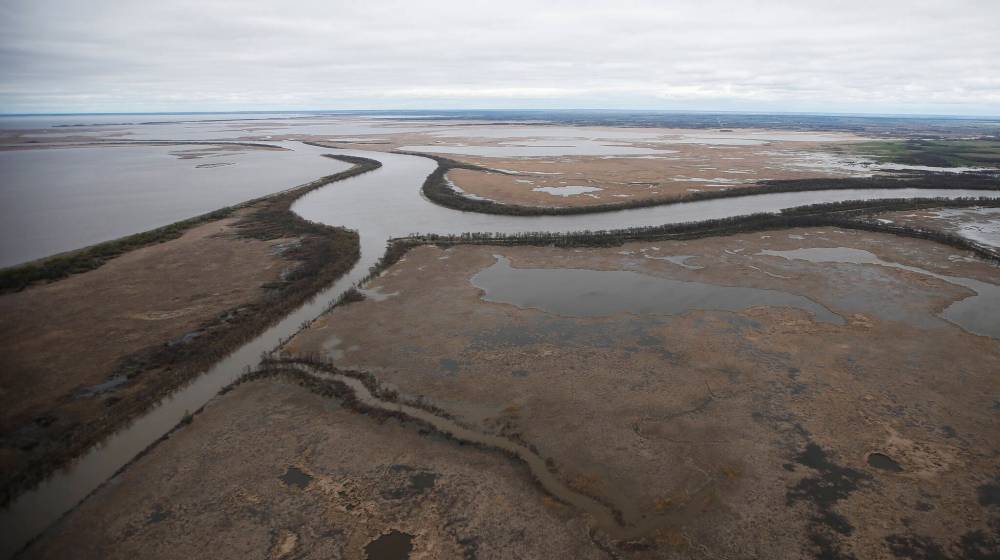
Netley Creek and The Red River enter Lake Winnipeg just north of Winnipeg. Pollution control efforts for Winnipeg sewage have been delayed again — but can Lake Winnipeg wait?
There is one thing that does shock me in all of this though — the steadfast refusal of the province to pay for the biological nutrient removal system they insist is necessary, despite decades of evidence to the contrary.
For the second year in a row since the $1.49-billion cost of biological nutrient removal was announced, the Manitoba budget contains no funding commitments for this final, environmental-protection phase of the project. Instead, Budget 2026 simply states that the province “will develop a plan to fund phase 3 of the North End Water Pollution Control Centre.”
Develop a plan? Funding conversations about NEWPCC upgrades have been going on for decades. How is it possible that “a plan” isn’t yet developed?
Here’s one thing that Winnipeg water rate payers have in common with provincial politicians — we don’t want to pay for unnecessary wastewater upgrades either.
But contrary to what Premier Wab Kinew and his cabinet might think, the lack of provincial funding for NEWPCC upgrades is no laughing matter. Because now, it’s regular Winnipeggers who are on the hook for the largest infrastructure project in the city’s history.
And we’re already feeling the pinch in our pocketbooks: water bills jumped significantly in 2025 and are projected to increase even further in 2026 and 2027. We’re paying directly out of pocket to cover the skyrocketing cost of provincial delays.
Meanwhile, Winnipeg’s largest treatment plant continues to release phosphorus pollution at levels five times higher than the environmental limit.
And most frustratingly of all, a brand-new phosphorus-reduction system at the treatment plant is operating at only a fraction of its potential. Ferric chloride, used at NEWCC to capture phosphorus before it is released into the Red River, has never been applied at more than a quarter of the rate recommended by wastewater consultants.
And yet this ferric-chloride system could achieve phosphorus compliance at the treatment plant — if only there was enough political will to get there.
Instead, the Manitoba government continues a political game of hot potato, making plenty of positive-sounding announcements while refusing to either invest in or enforce evidence-based phosphorus reduction.
When will the officials we elect to protect our waterways and maintain our city infrastructure be held accountable?
Only when we take action.
Under the Environment Act, Manitobans have 30 days to appeal decisions made by the provincial Environmental Approvals Branch. Anyone who is affected by the decision to allow two more years of phosphorus pollution to Lake Winnipeg can file an appeal, by emailing Moyes at minecc@manitoba.ca.
While it may indeed no longer be realistic to complete the biological nutrient removal system by 2030 (especially without a provincial funding commitment), it’s entirely possible to achieve phosphorus compliance within the next year using the existing chemical system.
And phosphorus compliance is the single most important upgrade needed at NEWPCC to protect Lake Winnipeg. Environmental experts across the country, from the Canada Water Agency, Environment and Climate Change Canada, Agriculture and Agri-Food Canada, and the International Joint Commission, among others, agree: reducing phosphorus alone is effective at reducing algae blooms.
Recently, just seven emailed appeals about a sewage lagoon in the Interlake prompted Moyes to take action, reversing a decision to approve the lagoon without further public input.
Certainly, there are more than seven of us now concerned about provincial decision-makers offering yet another pollution pass to the largest wastewater treatment plant in the province.

Certainly, there are more than seven of us who can’t afford to be left holding the bill for a billion-dollar upgrade that may or may not be complete by 2032.
Certainly, there are more than seven of us who have watched in despair over the last 20 years as Lake Winnipeg chokes under waves of green slime.
The NDP coast along on a public perception of environmental friendliness, and the PCs bank on being considered fiscally responsible.
Now it’s our turn to have our say. We demand a sewage solution that does both: protect Lake Winnipeg and save us all money.
Alexis Kanu is the executive director of the Lake Winnipeg Foundation.