

All signs pointing to bloated boondoggle of a World Cup
Co-hosts dismal performances latest red flag as tournament looms
Advertisement
Read this article for free:
or
Already have an account? Log in here »
To continue reading, please subscribe:

Digital Subscription
One year of digital access for only $205*
- Enjoy unlimited reading on winnipegfreepress.com
- Read the E-Edition, our digital replica newspaper
- Access News Break, our award-winning app
- Play interactive puzzles
*First annual payment billed as $205.00 + GST for one year. This annual subscription will automatically renew at $233.00 + GST every 52 weeks (10% off the regular annual price of $259.35). Offer available to new and qualified returning subscribers only. Cancel any time.
To continue reading, please subscribe:
Add Free Press access to your Brandon Sun subscription for only an additional
$1 for the first 4 weeks*
- Enjoy unlimited reading on winnipegfreepress.com
- Read the E-Edition, our digital replica newspaper
- Access News Break, our award-winning app
- Play interactive puzzles
*Your next Brandon Sun subscription payment will increase by $1.00 and you will be charged $17.95 plus GST for four weeks. After four weeks, your payment will increase to $24.95 plus GST every four weeks.
Read unlimited articles for free today:
or
Already have an account? Log in here »
Canada’s senior men’s soccer team dropped one place to 30th in the latest FIFA ranking, released Wednesday.
Now, rankings, like political polls, are snapshots in time and tell us little about how a group of players — affected by injuries, returns from injuries, new call-ups and individual streaks of form, good or bad — will fare against Uzbekistan on June 1, for example, or against Bosnia and Herzegovina 11 days later in a home World Cup.
The United States, too, dropped a spot to 16th, swapping places with Mexico, now in 15th. Again, these numbers are not informed by rigorous data, so we can’t read too much into them.
CHRIS YOUNG / THE CANADIAN PRESS
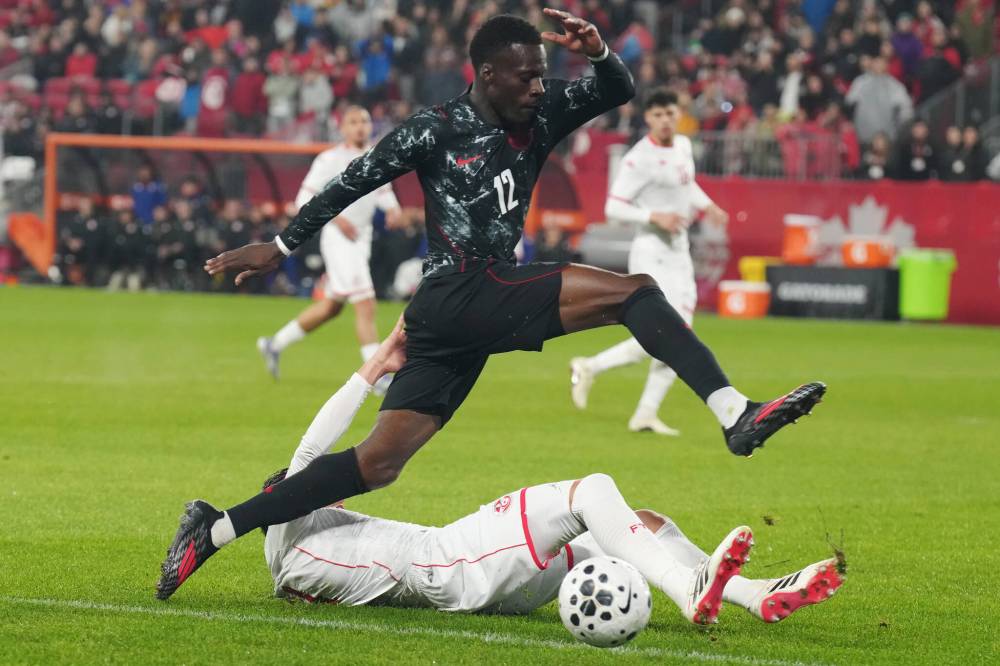
Canada’s Tani Oluwaseyi leaps over Tunisia’s Omar Rekik during the teams’ 0-0 draw on Tuesday. The way all three World Cup co-hosts — Canada, the United States and Mexico — have played recently has raised the concern that the second knockout stage may be as far as the co-hosts can reasonably advance.
What we can do, however, is examine recent results and anticipate what FIFA would consider its World Cup nightmare: the tournament’s North American co-hosts crashing out at the group stage.
Let’s start with Canada.
After hosting Bosnia and Herzegovina in Toronto, it will face Qatar and Switzerland in Vancouver. It’s a schedule of average difficulty, and Canada will enter all three matches expecting to prevail. Qatar, on June 18, will present the team with its best chance to secure a first ever World Cup win, assuming it didn’t take all three points in the Group B opener.
There’s just one problem, and it’s a big one. Canada can’t score. It created next to nothing against Tunisia in Tuesday’s 0-0 friendly, and its 2-2 draw with Iceland on March 28 came courtesy of two Jonathan David penalties.
Since exiting the Gold Cup at the quarterfinal stage in June, the Canadians have played eight games and scored six goals from open play — half of which came against Romania in September.
The absence of playmaking midfielder Stephen Eustáquio, who developed a blood clot in his leg after colliding with a referee last month, was very noticeable, and David looked every bit a struggling striker who hasn’t scored in Serie A since January.
Captain Alphonso Davies, meanwhile, hasn’t played an international match in more than a year.
Given that Switzerland is easily the best team in the section, and with Bosnia and Herzegovina having impressed in eliminating Italy from qualification, it’s not a faint possibility that Canada will finish third in the group. That wouldn’t be a disaster necessarily, but it would leave the prospect of the knockouts reliant on developments elsewhere.
OK, but what about Mexico?
El Tri played Portugal to a scoreless draw on March 28 and drew Belgium 1-1 on Tuesday. Not bad, but a broader sample size reveals just three victories in 11 games since the Gold Cup. A 4-0 thumping by Colombia in October was especially troubling.
Top striker Raúl Jiménez will be 35 when Mexico kicks off the World Cup against South Africa on June 11. Goalkeeper Guillermo Ochoa, presumably in a back-up role, will be 41 by tournament’s end. By then, his team will inevitably have dispersed.
Group A, which also features South Korea and Czechia, is winnable for Mexico, but a prospective round of 16 showdown with one of Brazil, Morocco or the Netherlands is not. And yet, the second knockout stage is about as far as any of the co-hosts can reasonably advance.
Which brings us to the Americans.
Having generated mixed results under manager Mauricio Pochettino, they seemed to have finally turned a corner in November when they thrashed Uruguay 5-1 in Tampa. Turns out it was a one-off.
One of international football’s worst-kept secrets — albeit one the U.S. pundit class will not entertain — is that this United States team is not very good. It was not very good in Tuesday’s 2-0 loss to Portugal, and it was downright terrible in a 5-2 loss to Belgium on March 28.
AC Milan attacker Christian Pulisic, who needs to be his side’s best or second-best player for it to finish first or second in Group D, took three shots in each friendly and managed to hit the target with precisely none of them.
Juventus midfielder Weston McKennie, who needs to be the Americans’ best player if Pulisic isn’t, was withdrawn at half-time against Portugal after a paltry 16 touches through 45 minutes. Versus Belgium, he gave the ball away half the time he had it.
The hard — yet obvious — truth is that FIFA can do without Canada and Mexico at this World Cup. That became apparent when the two countries were tossed the scraps of the schedule. But the United States? That’s another matter, and a quite serious one for the sport’s governing body.
Have a look at the tickets still available. Despite president Gianni Infantino’s boasting about demand, and in the face of yet another hike in prices, seats are available in every U.S. host city. Curiously, FIFA’s ticketing partner claims only 4 per cent remain for most matches. That is, it has the identical 4 per cent message for just about every game.
It’s a remarkable coincidence — or Infantino and FIFA are simply lying.

Take the U.S. men’s national team out of the picture and you suddenly have an event that lacks enthusiasm, that becomes a resale disaster and that leaves the balance of the schedule to contenders whose fanbases didn’t travel due to ticket prices, transportation costs, the spectre of ICE terrorism or all of the above.
Typically, knockout stages that see the likes of Spain, France, England, Argentina, Germany, the Netherlands and Brazil, among others, would produce some can’t-miss football. That’s not going to change, even if the European heavyweights have started to agitate over the massive costs of a continent-wide tournament taking place over five time zones.
FIFA, however, bet heavily on the United States carrying this event, whether through ticket and merchandise sales, television audiences, matchday atmospheres and general excitement. It would like all three of its co-hosts to do well, and both Canada and Mexico could go on to surprise.
But FIFA needs the U.S. It needs the Americans to live up to their inflated 16th-place ranking. Without them, it’s left with what we’re already starting to see — a bloated boondoggle of a World Cup; too big, too long and too expensive to enjoy.
winnipegfreepress.com/jerradpeters
Our newsroom depends on a growing audience of readers to power our journalism. If you are not a paid reader, please consider becoming a subscriber.
Our newsroom depends on its audience of readers to power our journalism. Thank you for your support.
Our newsroom depends on a growing audience of readers to power our journalism. If you are not a paid reader, please consider becoming a subscriber.
Our newsroom depends on its audience of readers to power our journalism. Thank you for your support.
Related Articles
PSV is Dutch champion for 3rd straight year after Feyenoord fails to win Sevilla slips closer to relegation after 3rd straight loss. Getafe boosts its European hopes Bosnia keeper Nikola Vasilj's saves help St. Pauli hold on for a point against Union Berlin







Advertisement Advertise With Us
Advertisement Advertise With Us